

Copyright © National Academy of Sciences. All rights reserved.
Solar and Space Physics: A Science for a Technological Society
REPORT OF THE PANEL ON ATMOSPHERE-IONOSPHERE-MAGNETOSPHERE INTERACTIONS
191
TABLE 8.6 Key Parameters to Be Measured by ESCAPE
Package
Instrument
Key Parameters
Fields
Double probe
Vector E, δE (dc to 8 MHz)
3D
Magnetometer
Vector B, δB (dc to 8 MHz)
3D
Langmuir probe
Plasma density, temperature
Plasma
Thermal particle spectrometers
Ion, electron core distribution (0.1-20 eV)
~3D
Superthermal particle
e – , H + , He + , He ++ , O + distributions (5 eV-30 keV)
2D
Gas
Ionization gauge
Neutral density
Neutral wind sensor
Vector winds (within ±1000 m/s)
Mass spectrometer
Ion, neutral composition: O + , H + , He + , O, N 2 , O 2 , H, He
Remote
FUV imager—1356, LBH-S
Auroral Q, E 0 ; O/N 2 (30° FOV, 0.5° res., <1 min)
Ionospheric sounder
Electron density profile
NOTE: Versions of all instruments have extensive flight heritage.
Mission Configuration
ESCAPE achieves the necessary measurements with two identically instrumented, three-axis stabilized
spacecraft (MISTE employs despun platform segments), nominally in 84°-inclination, coplanar elliptical
orbits with collinear lines of apsides and apogees of the two spacecraft 180° out of phase. The perigee
of the nominal initial orbits (500 km × 2,500 km) is in the topside ionosphere. When one spacecraft is
at higher altitude, it measures electromagnetic and precipitating particle energy inputs and properties of
outflowing ions, while the magnetically aligned low-altitude spacecraft measures the properties of the ion
and neutral gas source region and physical attributes of the energy conversion process. A wide range of
vertical separations is achieved, including over the equatorial ionosphere, as the lines of apsides complete
a full rotation in about 4.5 months. With additional propellant, the perigees of the spacecraft are lowered
midway through the mission from 500 km to 200 km, thereby providing source region measurements in
the bottomside ionosphere during the second orbital phase (200 km × 2,500 km) of the mission.
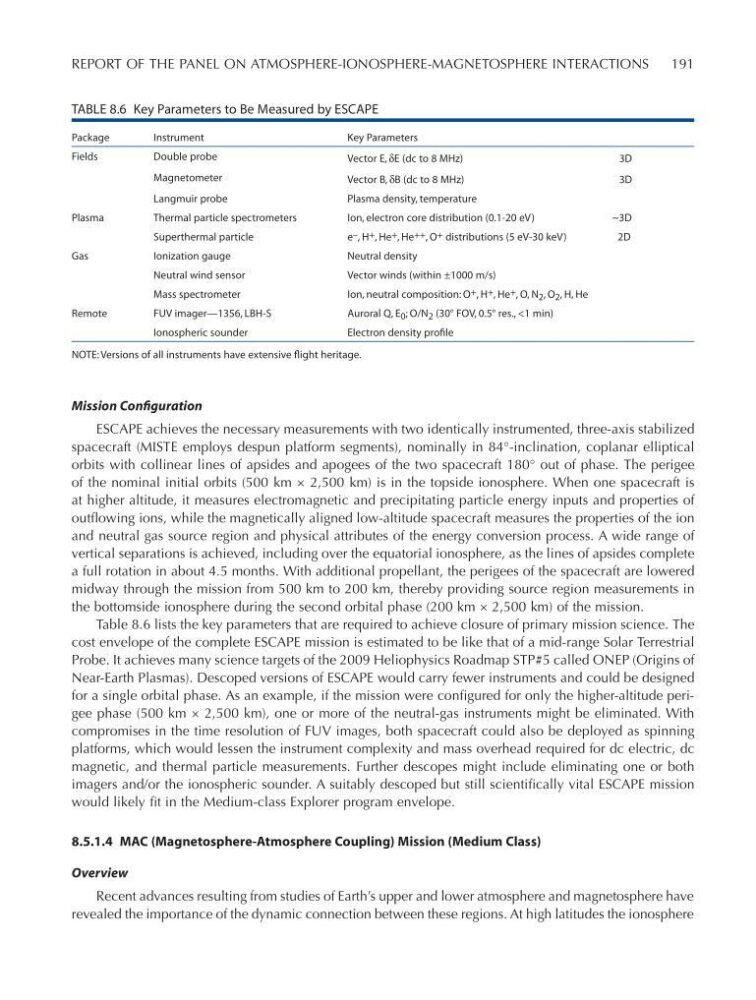
Table 8.6 lists the key parameters that are required to achieve closure of primary mission science. The
cost envelope of the complete ESCAPE mission is estimated to be like that of a mid-range Solar Terrestrial
Probe. It achieves many science targets of the 2009 Heliophysics Roadmap STP#5 called ONEP (Origins of
Near-Earth Plasmas). Descoped versions of ESCAPE would carry fewer instruments and could be designed
for a single orbital phase. As an example, if the mission were configured for only the higher-altitude perigee phase (500 km × 2,500 km), one or more of the neutral-gas instruments might be eliminated. With
compromises in the time resolution of FUV images, both spacecraft could also be deployed as spinning
platforms, which would lessen the instrument complexity and mass overhead required for dc electric, dc
magnetic, and thermal particle measurements. Further descopes might include eliminating one or both
imagers and/or the ionospheric sounder. A suitably descoped but still scientifically vital ESCAPE mission
would likely fit in the Medium-class Explorer program envelope.
8.5.1.4 MAC (Magnetosphere-Atmosphere Coupling) Mission (Medium Class)
Overview
Recent advances resulting from studies of Earth’s upper and lower atmosphere and magnetosphere have
revealed the importance of the dynamic connection between these regions. At high latitudes the ionosphere
Solar and Space Physics: A Science for a Technological Society
REPORT OF THE PANEL ON ATMOSPHERE-IONOSPHERE-MAGNETOSPHERE INTERACTIONS
191
TABLE 8.6 Key Parameters to Be Measured by ESCAPE
Package
Instrument
Key Parameters
Fields
Double probe
Vector E, δE (dc to 8 MHz)
3D
Magnetometer
Vector B, δB (dc to 8 MHz)
3D
Langmuir probe
Plasma density, temperature
Plasma
Thermal particle spectrometers
Ion, electron core distribution (0.1-20 eV)
~3D
Superthermal particle
e – , H + , He + , He ++ , O + distributions (5 eV-30 keV)
2D
Gas
Ionization gauge
Neutral density
Neutral wind sensor
Vector winds (within ±1000 m/s)
Mass spectrometer
Ion, neutral composition: O + , H + , He + , O, N 2 , O 2 , H, He
Remote
FUV imager—1356, LBH-S
Auroral Q, E 0 ; O/N 2 (30° FOV, 0.5° res., <1 min)
Ionospheric sounder
Electron density profile
NOTE: Versions of all instruments have extensive flight heritage.
Mission Configuration
ESCAPE achieves the necessary measurements with two identically instrumented, three-axis stabilized
spacecraft (MISTE employs despun platform segments), nominally in 84°-inclination, coplanar elliptical
orbits with collinear lines of apsides and apogees of the two spacecraft 180° out of phase. The perigee
of the nominal initial orbits (500 km × 2,500 km) is in the topside ionosphere. When one spacecraft is
at higher altitude, it measures electromagnetic and precipitating particle energy inputs and properties of
outflowing ions, while the magnetically aligned low-altitude spacecraft measures the properties of the ion
and neutral gas source region and physical attributes of the energy conversion process. A wide range of
vertical separations is achieved, including over the equatorial ionosphere, as the lines of apsides complete
a full rotation in about 4.5 months. With additional propellant, the perigees of the spacecraft are lowered
midway through the mission from 500 km to 200 km, thereby providing source region measurements in
the bottomside ionosphere during the second orbital phase (200 km × 2,500 km) of the mission.
Table 8.6 lists the key parameters that are required to achieve closure of primary mission science. The
cost envelope of the complete ESCAPE mission is estimated to be like that of a mid-range Solar Terrestrial
Probe. It achieves many science targets of the 2009 Heliophysics Roadmap STP#5 called ONEP (Origins of
Near-Earth Plasmas). Descoped versions of ESCAPE would carry fewer instruments and could be designed
for a single orbital phase. As an example, if the mission were configured for only the higher-altitude perigee phase (500 km × 2,500 km), one or more of the neutral-gas instruments might be eliminated. With
compromises in the time resolution of FUV images, both spacecraft could also be deployed as spinning
platforms, which would lessen the instrument complexity and mass overhead required for dc electric, dc
magnetic, and thermal particle measurements. Further descopes might include eliminating one or both
imagers and/or the ionospheric sounder. A suitably descoped but still scientifically vital ESCAPE mission
would likely fit in the Medium-class Explorer program envelope.
8.5.1.4 MAC (Magnetosphere-Atmosphere Coupling) Mission (Medium Class)
Overview
Recent advances resulting from studies of Earth’s upper and lower atmosphere and magnetosphere have
revealed the importance of the dynamic connection between these regions. At high latitudes the ionosphere