

Copyright © National Academy of Sciences. All rights reserved.
Solar and Space Physics: A Science for a Technological Society
190
SOLAR AND SPACE PHYSICS: A SCIENCE FOR A TECHNOLOGICAL SOCIETY
alignments at altitudes below the ion baropause (~2,000-km altitude), where upflowing ionospheric ions
become sufficiently energized to escape coulomb collisions and gravity. The primary goal of the ESCAPE
mission is to answer the question, How are ionospheric outflows energized?
Despite the many successes of satellite missions devoted to the physics of auroral and polar-region
particle acceleration, the physical processes of conversion of electromagnetic energy into particle energy,
the evolution of energy conversion and particle acceleration along magnetic field lines, and the control
of ionospheric outflows by plasma-neutral interactions are yet to be discovered because two spacecraft
have never been accurately positioned along magnetic field lines while measuring ionized and neutral
gas properties and simultaneously imaging the aurora at their ionospheric footpoints. A key aspect of
such measurements, relevant to space weather prediction, is to determine how the outflow flux and other
properties such as composition, density, and energy vary with electromagnetic and precipitating particle
energy inputs into the outflow source region; e.g., the efficiency of energy conversion may be quantitatively
expressed as an intensive transport relation between electromagnetic energy flux and particle energy flux.
Such relationships are crucial elements of simulation models of AIM dynamics, yet little reliable information is available on their form.
By combining two-point ESCAPE measurements with solar wind and interplanetary magnetic field
measurements; ground-based radar, lidar, imaging, and TEC measurements; and global geospace simulations, the ESCAPE mission can also address two related, global questions directly aligned with AIMI panel
science priorities 1 and 3: How do interplanetary and AIM conditions control outflows, their distributions,
and fluxes? How does the AIM system respond to ionospheric outflows?
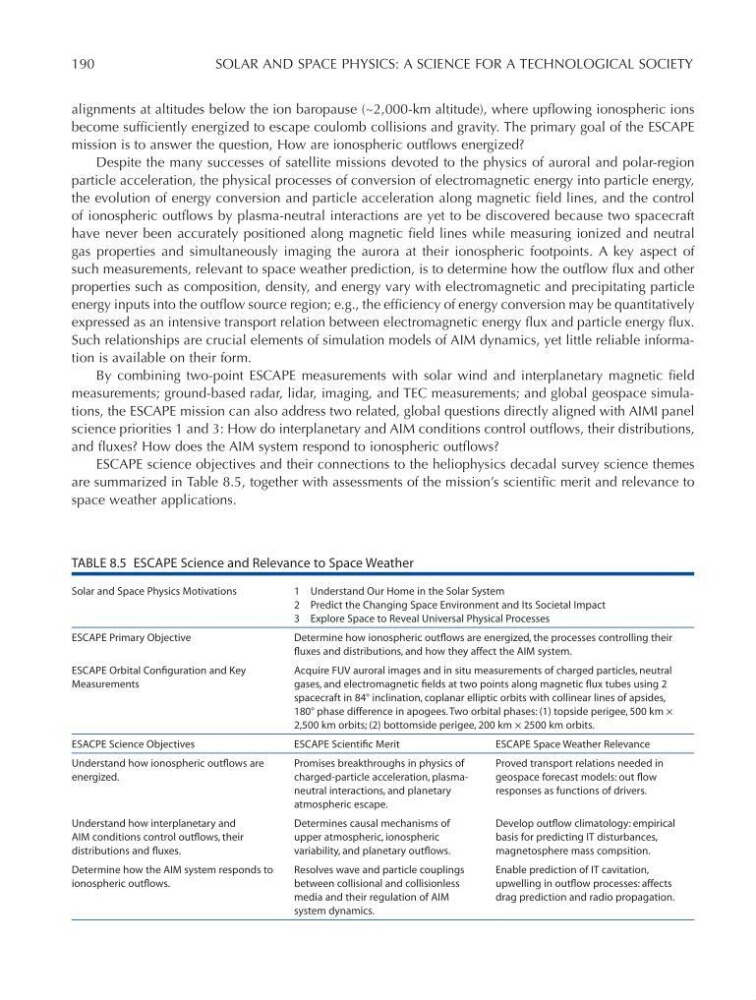
ESCAPE science objectives and their connections to the heliophysics decadal survey science themes
are summarized in Table 8.5, together with assessments of the mission’s scientific merit and relevance to
space weather applications.
TABLE 8.5 ESCAPE Science and Relevance to Space Weather
Solar and Space Physics Motivations
1 Understand Our Home in the Solar System
2 Predict the Changing Space Environment and Its Societal Impact
3 Explore Space to Reveal Universal Physical Processes
ESCAPE Primary Objective
Determine how ionospheric outflows are energized, the processes controlling their
fluxes and distributions, and how they affect the AIM system.
ESCAPE Orbital Configuration and Key
Measurements
Acquire FUV auroral images and in situ measurements of charged particles, neutral
gases, and electromagnetic fields at two points along magnetic flux tubes using 2
spacecraft in 84° inclination, coplanar elliptic orbits with collinear lines of apsides,
180° phase difference in apogees. Two orbital phases: (1) topside perigee, 500 km ×
2,500 km orbits; (2) bottomside perigee, 200 km × 2500 km orbits.
ESACPE Science Objectives
ESCAPE Scientific Merit
ESCAPE Space Weather Relevance
Understand how ionospheric outflows are
energized.
Promises breakthroughs in physics of
charged-particle acceleration, plasmaneutral interactions, and planetary
atmospheric escape.
Proved transport relations needed in
geospace forecast models: out flow
responses as functions of drivers.
Understand how interplanetary and
AIM conditions control outflows, their
distributions and fluxes.
Determines causal mechanisms of
upper atmospheric, ionospheric
variability, and planetary outflows.
Develop outflow climatology: empirical
basis for predicting IT disturbances,
magnetosphere mass compsition.
Determine how the AIM system responds to
ionospheric outflows.
Resolves wave and particle couplings
between collisional and collisionless
media and their regulation of AIM
system dynamics.
Enable prediction of IT cavitation,
upwelling in outflow processes: affects
drag prediction and radio propagation.
Solar and Space Physics: A Science for a Technological Society
190
SOLAR AND SPACE PHYSICS: A SCIENCE FOR A TECHNOLOGICAL SOCIETY
alignments at altitudes below the ion baropause (~2,000-km altitude), where upflowing ionospheric ions
become sufficiently energized to escape coulomb collisions and gravity. The primary goal of the ESCAPE
mission is to answer the question, How are ionospheric outflows energized?
Despite the many successes of satellite missions devoted to the physics of auroral and polar-region
particle acceleration, the physical processes of conversion of electromagnetic energy into particle energy,
the evolution of energy conversion and particle acceleration along magnetic field lines, and the control
of ionospheric outflows by plasma-neutral interactions are yet to be discovered because two spacecraft
have never been accurately positioned along magnetic field lines while measuring ionized and neutral
gas properties and simultaneously imaging the aurora at their ionospheric footpoints. A key aspect of
such measurements, relevant to space weather prediction, is to determine how the outflow flux and other
properties such as composition, density, and energy vary with electromagnetic and precipitating particle
energy inputs into the outflow source region; e.g., the efficiency of energy conversion may be quantitatively
expressed as an intensive transport relation between electromagnetic energy flux and particle energy flux.
Such relationships are crucial elements of simulation models of AIM dynamics, yet little reliable information is available on their form.
By combining two-point ESCAPE measurements with solar wind and interplanetary magnetic field
measurements; ground-based radar, lidar, imaging, and TEC measurements; and global geospace simulations, the ESCAPE mission can also address two related, global questions directly aligned with AIMI panel
science priorities 1 and 3: How do interplanetary and AIM conditions control outflows, their distributions,
and fluxes? How does the AIM system respond to ionospheric outflows?
ESCAPE science objectives and their connections to the heliophysics decadal survey science themes
are summarized in Table 8.5, together with assessments of the mission’s scientific merit and relevance to
space weather applications.
TABLE 8.5 ESCAPE Science and Relevance to Space Weather
Solar and Space Physics Motivations
1 Understand Our Home in the Solar System
2 Predict the Changing Space Environment and Its Societal Impact
3 Explore Space to Reveal Universal Physical Processes
ESCAPE Primary Objective
Determine how ionospheric outflows are energized, the processes controlling their
fluxes and distributions, and how they affect the AIM system.
ESCAPE Orbital Configuration and Key
Measurements
Acquire FUV auroral images and in situ measurements of charged particles, neutral
gases, and electromagnetic fields at two points along magnetic flux tubes using 2
spacecraft in 84° inclination, coplanar elliptic orbits with collinear lines of apsides,
180° phase difference in apogees. Two orbital phases: (1) topside perigee, 500 km ×
2,500 km orbits; (2) bottomside perigee, 200 km × 2500 km orbits.
ESACPE Science Objectives
ESCAPE Scientific Merit
ESCAPE Space Weather Relevance
Understand how ionospheric outflows are
energized.
Promises breakthroughs in physics of
charged-particle acceleration, plasmaneutral interactions, and planetary
atmospheric escape.
Proved transport relations needed in
geospace forecast models: out flow
responses as functions of drivers.
Understand how interplanetary and
AIM conditions control outflows, their
distributions and fluxes.
Determines causal mechanisms of
upper atmospheric, ionospheric
variability, and planetary outflows.
Develop outflow climatology: empirical
basis for predicting IT disturbances,
magnetosphere mass compsition.
Determine how the AIM system responds to
ionospheric outflows.
Resolves wave and particle couplings
between collisional and collisionless
media and their regulation of AIM
system dynamics.
Enable prediction of IT cavitation,
upwelling in outflow processes: affects
drag prediction and radio propagation.