

Copyright © National Academy of Sciences. All rights reserved.
Solar and Space Physics: A Science for a Technological Society
REPORT OF THE PANEL ON ATMOSPHERE-IONOSPHERE-MAGNETOSPHERE INTERACTIONS
189
8.5.1.3 ESCAPE (Energetics, Sources and Couplings of Atmosphere-Plasma Escape) Mission (Medium
Class)
Overview
With the recognition that outflows of ionospheric ions can have profound effects on the AIM system,
it has become abundantly evident that understanding of the outflow process is severely lacking, especially
during episodic space weather events when O + ion outflows become superfluent. An important step forward
in remedying this deficiency can be accomplished with a dual spacecraft mission identified here as ESCAPE.
Its configuration and its instrumentation resemble those of the SWMI panel mission MISTE, but, with its
closer vertical separations and lower-altitude apogee, ESCAPE achieves relatively high-accuracy magnetic
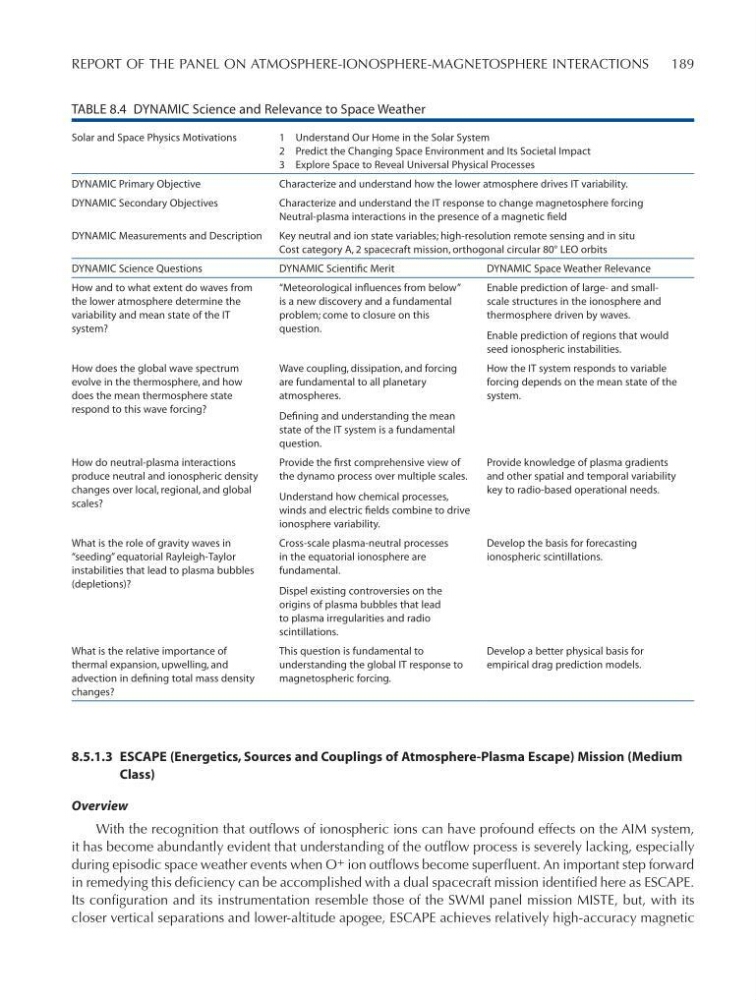
TABLE 8.4 DYNAMIC Science and Relevance to Space Weather
Solar and Space Physics Motivations
1 Understand Our Home in the Solar System
2 Predict the Changing Space Environment and Its Societal Impact
3 Explore Space to Reveal Universal Physical Processes
DYNAMIC Primary Objective
Characterize and understand how the lower atmosphere drives IT variability.
DYNAMIC Secondary Objectives
Characterize and understand the IT response to change magnetosphere forcing
Neutral-plasma interactions in the presence of a magnetic field
DYNAMIC Measurements and Description
Key neutral and ion state variables; high-resolution remote sensing and in situ
Cost category A, 2 spacecraft mission, orthogonal circular 80° LEO orbits
DYNAMIC Science Questions
DYNAMIC Scientific Merit
DYNAMIC Space Weather Relevance
How and to what extent do waves from
the lower atmosphere determine the
variability and mean state of the IT
system?
“Meteorological influences from below”
is a new discovery and a fundamental
problem; come to closure on this
question.
Enable prediction of large- and smallscale structures in the ionosphere and
thermosphere driven by waves.
Enable prediction of regions that would
seed ionospheric instabilities.
How does the global wave spectrum
evolve in the thermosphere, and how
does the mean thermosphere state
respond to this wave forcing?
Wave coupling, dissipation, and forcing
are fundamental to all planetary
atmospheres.
Defining and understanding the mean
state of the IT system is a fundamental
question.
How the IT system responds to variable
forcing depends on the mean state of the
system.
How do neutral-plasma interactions
produce neutral and ionospheric density
changes over local, regional, and global
scales?
Provide the first comprehensive view of
the dynamo process over multiple scales.
Understand how chemical processes,
winds and electric fields combine to drive
ionosphere variability.
Provide knowledge of plasma gradients
and other spatial and temporal variability
key to radio-based operational needs.
What is the role of gravity waves in
“seeding” equatorial Rayleigh-Taylor
instabilities that lead to plasma bubbles
(depletions)?
Cross-scale plasma-neutral processes
in the equatorial ionosphere are
fundamental.
Dispel existing controversies on the
origins of plasma bubbles that lead
to plasma irregularities and radio
scintillations.
Develop the basis for forecasting
ionospheric scintillations.
What is the relative importance of
thermal expansion, upwelling, and
advection in defining total mass density
changes?
This question is fundamental to
understanding the global IT response to
magnetospheric forcing.
Develop a better physical basis for
empirical drag prediction models.
Solar and Space Physics: A Science for a Technological Society
REPORT OF THE PANEL ON ATMOSPHERE-IONOSPHERE-MAGNETOSPHERE INTERACTIONS
189
8.5.1.3 ESCAPE (Energetics, Sources and Couplings of Atmosphere-Plasma Escape) Mission (Medium
Class)
Overview
With the recognition that outflows of ionospheric ions can have profound effects on the AIM system,
it has become abundantly evident that understanding of the outflow process is severely lacking, especially
during episodic space weather events when O + ion outflows become superfluent. An important step forward
in remedying this deficiency can be accomplished with a dual spacecraft mission identified here as ESCAPE.
Its configuration and its instrumentation resemble those of the SWMI panel mission MISTE, but, with its
closer vertical separations and lower-altitude apogee, ESCAPE achieves relatively high-accuracy magnetic
TABLE 8.4 DYNAMIC Science and Relevance to Space Weather
Solar and Space Physics Motivations
1 Understand Our Home in the Solar System
2 Predict the Changing Space Environment and Its Societal Impact
3 Explore Space to Reveal Universal Physical Processes
DYNAMIC Primary Objective
Characterize and understand how the lower atmosphere drives IT variability.
DYNAMIC Secondary Objectives
Characterize and understand the IT response to change magnetosphere forcing
Neutral-plasma interactions in the presence of a magnetic field
DYNAMIC Measurements and Description
Key neutral and ion state variables; high-resolution remote sensing and in situ
Cost category A, 2 spacecraft mission, orthogonal circular 80° LEO orbits
DYNAMIC Science Questions
DYNAMIC Scientific Merit
DYNAMIC Space Weather Relevance
How and to what extent do waves from
the lower atmosphere determine the
variability and mean state of the IT
system?
“Meteorological influences from below”
is a new discovery and a fundamental
problem; come to closure on this
question.
Enable prediction of large- and smallscale structures in the ionosphere and
thermosphere driven by waves.
Enable prediction of regions that would
seed ionospheric instabilities.
How does the global wave spectrum
evolve in the thermosphere, and how
does the mean thermosphere state
respond to this wave forcing?
Wave coupling, dissipation, and forcing
are fundamental to all planetary
atmospheres.
Defining and understanding the mean
state of the IT system is a fundamental
question.
How the IT system responds to variable
forcing depends on the mean state of the
system.
How do neutral-plasma interactions
produce neutral and ionospheric density
changes over local, regional, and global
scales?
Provide the first comprehensive view of
the dynamo process over multiple scales.
Understand how chemical processes,
winds and electric fields combine to drive
ionosphere variability.
Provide knowledge of plasma gradients
and other spatial and temporal variability
key to radio-based operational needs.
What is the role of gravity waves in
“seeding” equatorial Rayleigh-Taylor
instabilities that lead to plasma bubbles
(depletions)?
Cross-scale plasma-neutral processes
in the equatorial ionosphere are
fundamental.
Dispel existing controversies on the
origins of plasma bubbles that lead
to plasma irregularities and radio
scintillations.
Develop the basis for forecasting
ionospheric scintillations.
What is the relative importance of
thermal expansion, upwelling, and
advection in defining total mass density
changes?
This question is fundamental to
understanding the global IT response to
magnetospheric forcing.
Develop a better physical basis for
empirical drag prediction models.