

Copyright © National Academy of Sciences. All rights reserved.
Solar and Space Physics: A Science for a Technological Society
188
SOLAR AND SPACE PHYSICS: A SCIENCE FOR A TECHNOLOGICAL SOCIETY
would be acquired about once every 20 days. Gravity waves would be measured throughout each orbit,
and planetary waves would easily be extracted with 1-day resolution. With the exception of semidiurnal
tides, all wave-wave interactions could be explored, and on a 20-day timescale the interactions between
the wave field and the mean state could be explored. In situ plasma and neutral responses at 600 km to
these wave inputs would be measured over similar timescales.
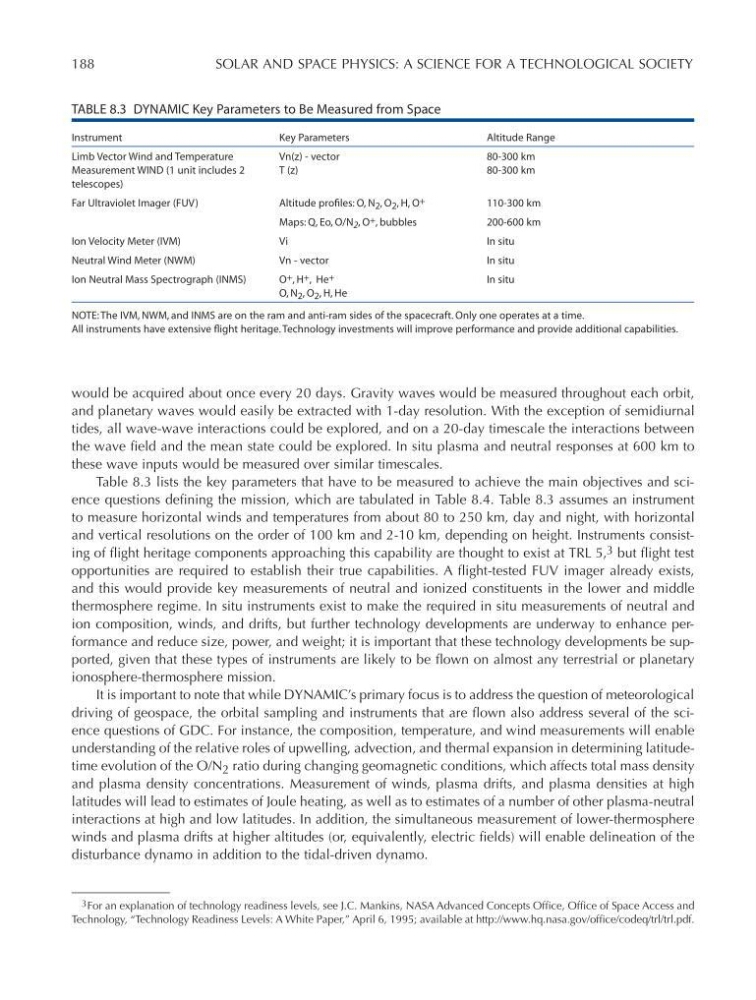
Table 8.3 lists the key parameters that have to be measured to achieve the main objectives and science questions defining the mission, which are tabulated in Table 8.4. Table 8.3 assumes an instrument
to measure horizontal winds and temperatures from about 80 to 250 km, day and night, with horizontal
and vertical resolutions on the order of 100 km and 2-10 km, depending on height. Instruments consisting of flight heritage components approaching this capability are thought to exist at TRL 5, 3 but flight test
opportunities are required to establish their true capabilities. A flight-tested FUV imager already exists,
and this would provide key measurements of neutral and ionized constituents in the lower and middle
thermosphere regime. In situ instruments exist to make the required in situ measurements of neutral and
ion composition, winds, and drifts, but further technology developments are underway to enhance performance and reduce size, power, and weight; it is important that these technology developments be supported, given that these types of instruments are likely to be flown on almost any terrestrial or planetary
ionosphere-thermosphere mission.
It is important to note that while DYNAMIC’s primary focus is to address the question of meteorological
driving of geospace, the orbital sampling and instruments that are flown also address several of the science questions of GDC. For instance, the composition, temperature, and wind measurements will enable
understanding of the relative roles of upwelling, advection, and thermal expansion in determining latitudetime evolution of the O/N 2 ratio during changing geomagnetic conditions, which affects total mass density
and plasma density concentrations. Measurement of winds, plasma drifts, and plasma densities at high
latitudes will lead to estimates of Joule heating, as well as to estimates of a number of other plasma-neutral
interactions at high and low latitudes. In addition, the simultaneous measurement of lower-thermosphere
winds and plasma drifts at higher altitudes (or, equivalently, electric fields) will enable delineation of the
disturbance dynamo in addition to the tidal-driven dynamo.
3 For an explanation of technology readiness levels, see J.C. Mankins, NASA Advanced Concepts Office, Office of Space Access and
Technology, “Technology Readiness Levels: A White Paper,” April 6, 1995; available at http://www.hq.nasa.gov/office/codeq/trl/trl.pdf.
TABLE 8.3 DYNAMIC Key Parameters to Be Measured from Space
Instrument
Key Parameters
Altitude Range
Limb Vector Wind and Temperature
Measurement WIND (1 unit includes 2
telescopes)
Vn(z) - vector
T (z)
80-300 km
80-300 km
Far Ultraviolet Imager (FUV)
Altitude profiles: O, N 2 , O 2 , H, O +
110-300 km
Maps: Q, Eo, O/N 2 , O + , bubbles
200-600 km
Ion Velocity Meter (IVM)
Vi
In situ
Neutral Wind Meter (NWM)
Vn - vector
In situ
Ion Neutral Mass Spectrograph (INMS)
O + , H + , He +
O, N 2 , O 2 , H, He
In situ
NOTE: The IVM, NWM, and INMS are on the ram and anti-ram sides of the spacecraft. Only one operates at a time.
All instruments have extensive flight heritage. Technology investments will improve performance and provide additional capabilities.
Solar and Space Physics: A Science for a Technological Society
188
SOLAR AND SPACE PHYSICS: A SCIENCE FOR A TECHNOLOGICAL SOCIETY
would be acquired about once every 20 days. Gravity waves would be measured throughout each orbit,
and planetary waves would easily be extracted with 1-day resolution. With the exception of semidiurnal
tides, all wave-wave interactions could be explored, and on a 20-day timescale the interactions between
the wave field and the mean state could be explored. In situ plasma and neutral responses at 600 km to
these wave inputs would be measured over similar timescales.
Table 8.3 lists the key parameters that have to be measured to achieve the main objectives and science questions defining the mission, which are tabulated in Table 8.4. Table 8.3 assumes an instrument
to measure horizontal winds and temperatures from about 80 to 250 km, day and night, with horizontal
and vertical resolutions on the order of 100 km and 2-10 km, depending on height. Instruments consisting of flight heritage components approaching this capability are thought to exist at TRL 5, 3 but flight test
opportunities are required to establish their true capabilities. A flight-tested FUV imager already exists,
and this would provide key measurements of neutral and ionized constituents in the lower and middle
thermosphere regime. In situ instruments exist to make the required in situ measurements of neutral and
ion composition, winds, and drifts, but further technology developments are underway to enhance performance and reduce size, power, and weight; it is important that these technology developments be supported, given that these types of instruments are likely to be flown on almost any terrestrial or planetary
ionosphere-thermosphere mission.
It is important to note that while DYNAMIC’s primary focus is to address the question of meteorological
driving of geospace, the orbital sampling and instruments that are flown also address several of the science questions of GDC. For instance, the composition, temperature, and wind measurements will enable
understanding of the relative roles of upwelling, advection, and thermal expansion in determining latitudetime evolution of the O/N 2 ratio during changing geomagnetic conditions, which affects total mass density
and plasma density concentrations. Measurement of winds, plasma drifts, and plasma densities at high
latitudes will lead to estimates of Joule heating, as well as to estimates of a number of other plasma-neutral
interactions at high and low latitudes. In addition, the simultaneous measurement of lower-thermosphere
winds and plasma drifts at higher altitudes (or, equivalently, electric fields) will enable delineation of the
disturbance dynamo in addition to the tidal-driven dynamo.
3 For an explanation of technology readiness levels, see J.C. Mankins, NASA Advanced Concepts Office, Office of Space Access and
Technology, “Technology Readiness Levels: A White Paper,” April 6, 1995; available at http://www.hq.nasa.gov/office/codeq/trl/trl.pdf.
TABLE 8.3 DYNAMIC Key Parameters to Be Measured from Space
Instrument
Key Parameters
Altitude Range
Limb Vector Wind and Temperature
Measurement WIND (1 unit includes 2
telescopes)
Vn(z) - vector
T (z)
80-300 km
80-300 km
Far Ultraviolet Imager (FUV)
Altitude profiles: O, N 2 , O 2 , H, O +
110-300 km
Maps: Q, Eo, O/N 2 , O + , bubbles
200-600 km
Ion Velocity Meter (IVM)
Vi
In situ
Neutral Wind Meter (NWM)
Vn - vector
In situ
Ion Neutral Mass Spectrograph (INMS)
O + , H + , He +
O, N 2 , O 2 , H, He
In situ
NOTE: The IVM, NWM, and INMS are on the ram and anti-ram sides of the spacecraft. Only one operates at a time.
All instruments have extensive flight heritage. Technology investments will improve performance and provide additional capabilities.