

Copyright © National Academy of Sciences. All rights reserved.
Solar and Space Physics: A Science for a Technological Society
170
SOLAR AND SPACE PHYSICS: A SCIENCE FOR A TECHNOLOGICAL SOCIETY
and give up momentum to the mean circulation. What are needed are observations between about 100
and 200 km that include the critical dynamo region where electric fields are generated, and that would,
moreover, make it possible to answer the question, How does the mean thermosphere state respond to
wave forcing? Observations of both the mean state and of the waves are required to elucidate how the
waves dissipate, how they relate to the background flow and thermal structure, and how their effects can
be parametrized in general circulation models.
It is important to measure the tidal PWs, and GWs together, to be able to understand the interactions
between them. For instance, PWs do not penetrate much above 100 km, but instead are thought to impose
their periodicities on the IT system by modulating the tidal and GW parts of the spectrum that do penetrate
to higher altitudes. This raises the following questions: How are GWs modulated by PWs and tides, and do
they effectively map these structures to higher altitudes? and By what mechanisms are electric fields and
plasma drifts generated in the dynamo region at PW periods? As one example, recent measurements reveal
the fascinating result that stratospheric warmings significantly alter the state of the IT system: a prevailing
theory is that enhanced quasi-stationary PWs common to these dynamical events interact nonlinearly with
existing tides to produce secondary tides that propagate globally and generate dynamo electric fields in the
ionosphere. The electric field subsequently redistributes ionospheric plasma, dramatically changing TEC
gradients that are known to degrade communications and navigation systems. This emergent behavior in
the system, once completely understood, has the potential to dramatically improve ionospheric predictions
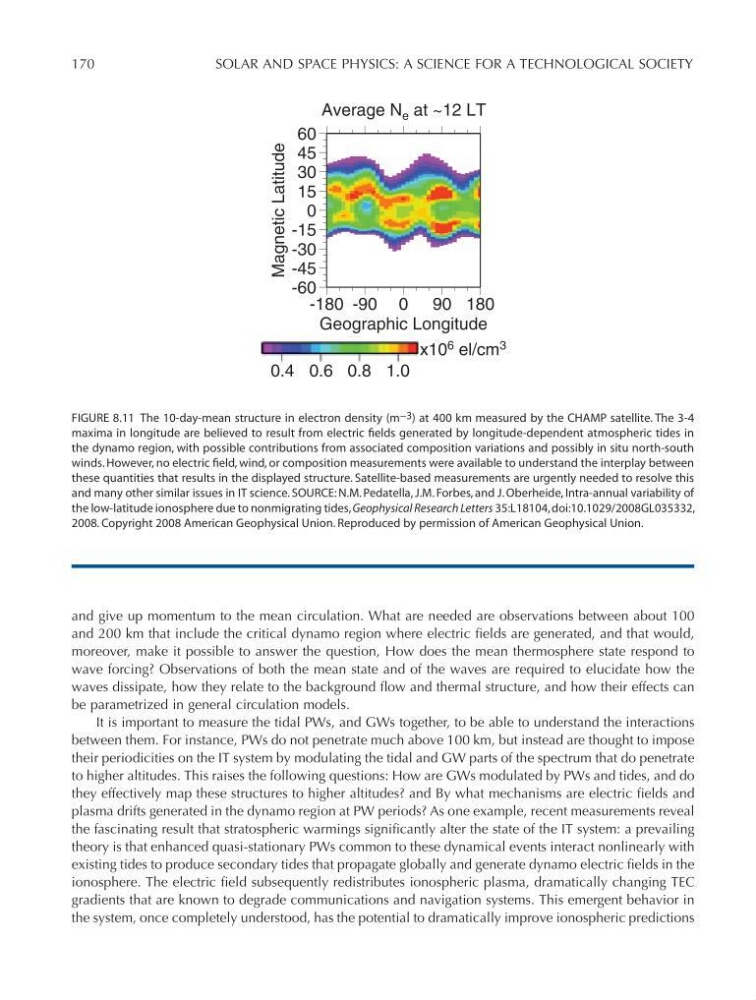
FIGURE 8.11 The 10-day-mean structure in electron density (m −3 ) at 400 km measured by the CHAMP satellite. The 3-4
maxima in longitude are believed to result from electric fields generated by longitude-dependent atmospheric tides in
the dynamo region, with possible contributions from associated composition variations and possibly in situ north-south
winds. However, no electric field, wind, or composition measurements were available to understand the interplay between
these quantities that results in the displayed structure. Satellite-based measurements are urgently needed to resolve this
and many other similar issues in IT science. SOURCE: N.M. Pedatella, J.M. Forbes, and J. Oberheide, Intra-annual variability of
the low-latitude ionosphere due to nonmigrating tides, Geophysical Research Letters 35:L18104, doi:10.1029/2008GL035332,
2008. Copyright 2008 American Geophysical Union. Reproduced by permission of American Geophysical Union.
Figure 8-11
Solar and Space Physics: A Science for a Technological Society
170
SOLAR AND SPACE PHYSICS: A SCIENCE FOR A TECHNOLOGICAL SOCIETY
and give up momentum to the mean circulation. What are needed are observations between about 100
and 200 km that include the critical dynamo region where electric fields are generated, and that would,
moreover, make it possible to answer the question, How does the mean thermosphere state respond to
wave forcing? Observations of both the mean state and of the waves are required to elucidate how the
waves dissipate, how they relate to the background flow and thermal structure, and how their effects can
be parametrized in general circulation models.
It is important to measure the tidal PWs, and GWs together, to be able to understand the interactions
between them. For instance, PWs do not penetrate much above 100 km, but instead are thought to impose
their periodicities on the IT system by modulating the tidal and GW parts of the spectrum that do penetrate
to higher altitudes. This raises the following questions: How are GWs modulated by PWs and tides, and do
they effectively map these structures to higher altitudes? and By what mechanisms are electric fields and
plasma drifts generated in the dynamo region at PW periods? As one example, recent measurements reveal
the fascinating result that stratospheric warmings significantly alter the state of the IT system: a prevailing
theory is that enhanced quasi-stationary PWs common to these dynamical events interact nonlinearly with
existing tides to produce secondary tides that propagate globally and generate dynamo electric fields in the
ionosphere. The electric field subsequently redistributes ionospheric plasma, dramatically changing TEC
gradients that are known to degrade communications and navigation systems. This emergent behavior in
the system, once completely understood, has the potential to dramatically improve ionospheric predictions
FIGURE 8.11 The 10-day-mean structure in electron density (m −3 ) at 400 km measured by the CHAMP satellite. The 3-4
maxima in longitude are believed to result from electric fields generated by longitude-dependent atmospheric tides in
the dynamo region, with possible contributions from associated composition variations and possibly in situ north-south
winds. However, no electric field, wind, or composition measurements were available to understand the interplay between
these quantities that results in the displayed structure. Satellite-based measurements are urgently needed to resolve this
and many other similar issues in IT science. SOURCE: N.M. Pedatella, J.M. Forbes, and J. Oberheide, Intra-annual variability of
the low-latitude ionosphere due to nonmigrating tides, Geophysical Research Letters 35:L18104, doi:10.1029/2008GL035332,
2008. Copyright 2008 American Geophysical Union. Reproduced by permission of American Geophysical Union.
Figure 8-11