

Copyright © National Academy of Sciences. All rights reserved.
Solar and Space Physics: A Science for a Technological Society
REPORT OF THE PANEL ON ATMOSPHERE-IONOSPHERE-MAGNETOSPHERE INTERACTIONS
169
carried by the waves can redistribute ionospheric plasma, either through the electric fields generated via
the dynamo mechanism, or directly by moving plasma along magnetic field lines (Figure 8.11).
Although the presence and importance of waves are without dispute, the relevant coupling processes
operating within the neutral atmosphere, and between the neutral atmosphere and ionosphere, involve a
host of multiscale dynamics that are not understood at present. The connection between tropical convection
and modification of the ionosphere described above is just one example of emergent behavior that typifies
the coupling between the lower atmosphere and the IT system. Below, the panel presents its analysis of
what are the most pressing science questions that must be addressed on this topic in the coming decade,
particularly with respect to developing a capability to predict the space weather of the IT system.
A first and fundamental question is, How does the global wave spectrum evolve temporally and spatially in the thermosphere? The TIMED, CHAMP, and GRACE missions provide approximately 2-month
average tidal climatologies below 110 km and above 400 km, respectively (Figure 8.12), but with little
information on the intervening region where the tidal and gravity wave spectra evolve with height, dissipate,
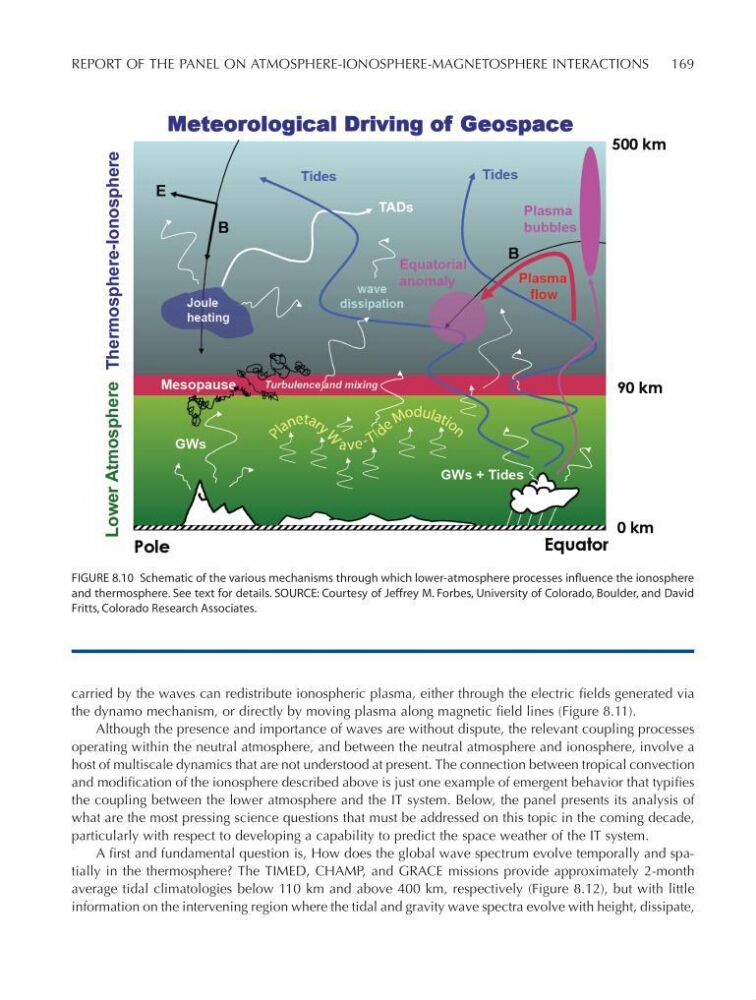
FIGURE 8.10 Schematic of the various mechanisms through which lower-atmosphere processes influence the ionosphere
and thermosphere. See text for details. SOURCE: Courtesy of Jeffrey M. Forbes, University of Colorado, Boulder, and David
Fritts, Colorado Research Associates.
Figure 8-10
Solar and Space Physics: A Science for a Technological Society
REPORT OF THE PANEL ON ATMOSPHERE-IONOSPHERE-MAGNETOSPHERE INTERACTIONS
169
carried by the waves can redistribute ionospheric plasma, either through the electric fields generated via
the dynamo mechanism, or directly by moving plasma along magnetic field lines (Figure 8.11).
Although the presence and importance of waves are without dispute, the relevant coupling processes
operating within the neutral atmosphere, and between the neutral atmosphere and ionosphere, involve a
host of multiscale dynamics that are not understood at present. The connection between tropical convection
and modification of the ionosphere described above is just one example of emergent behavior that typifies
the coupling between the lower atmosphere and the IT system. Below, the panel presents its analysis of
what are the most pressing science questions that must be addressed on this topic in the coming decade,
particularly with respect to developing a capability to predict the space weather of the IT system.
A first and fundamental question is, How does the global wave spectrum evolve temporally and spatially in the thermosphere? The TIMED, CHAMP, and GRACE missions provide approximately 2-month
average tidal climatologies below 110 km and above 400 km, respectively (Figure 8.12), but with little
information on the intervening region where the tidal and gravity wave spectra evolve with height, dissipate,
FIGURE 8.10 Schematic of the various mechanisms through which lower-atmosphere processes influence the ionosphere
and thermosphere. See text for details. SOURCE: Courtesy of Jeffrey M. Forbes, University of Colorado, Boulder, and David
Fritts, Colorado Research Associates.
Figure 8-10