

Copyright © National Academy of Sciences. All rights reserved.
Solar and Space Physics: A Science for a Technological Society
REPORT OF THE PANEL ON ATMOSPHERE-IONOSPHERE-MAGNETOSPHERE INTERACTIONS
171
since the peak of the ionospheric response occurs several days after the stratospheric warming. In addition,
first-principles modeling predicts a thermospheric warming in response to the stratospheric warmings, and
resulting changes in thermospheric winds and density that impact satellite drag.
The above wave-plasma interactions focus on electric fields generated by the dynamo mechanism,
but one must ask: What other processes compete with dynamo electric fields to modify and redistribute
plasma in the F region (~200-600 km)? Recent studies, in fact, show that winds associated with tides that
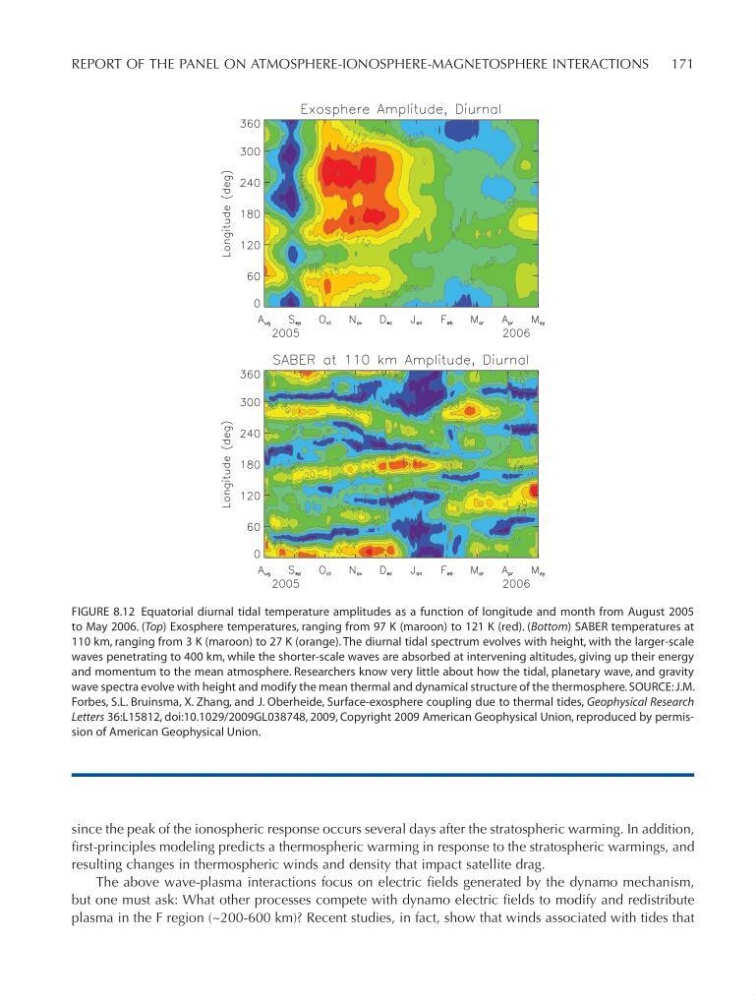
FIGURE 8.12 Equatorial diurnal tidal temperature amplitudes as a function of longitude and month from August 2005
to May 2006. (Top) Exosphere temperatures, ranging from 97 K (maroon) to 121 K (red). (Bottom) SABER temperatures at
110 km, ranging from 3 K (maroon) to 27 K (orange). The diurnal tidal spectrum evolves with height, with the larger-scale
waves penetrating to 400 km, while the shorter-scale waves are absorbed at intervening altitudes, giving up their energy
and momentum to the mean atmosphere. Researchers know very little about how the tidal, planetary wave, and gravity
wave spectra evolve with height and modify the mean thermal and dynamical structure of the thermosphere. SOURCE: J.M.
Forbes, S.L. Bruinsma, X. Zhang, and J. Oberheide, Surface-exosphere coupling due to thermal tides, Geophysical Research
Letters 36:L15812, doi:10.1029/2009GL038748, 2009, Copyright 2009 American Geophysical Union, reproduced by permission of American Geophysical Union.
Figure 8-12
Solar and Space Physics: A Science for a Technological Society
REPORT OF THE PANEL ON ATMOSPHERE-IONOSPHERE-MAGNETOSPHERE INTERACTIONS
171
since the peak of the ionospheric response occurs several days after the stratospheric warming. In addition,
first-principles modeling predicts a thermospheric warming in response to the stratospheric warmings, and
resulting changes in thermospheric winds and density that impact satellite drag.
The above wave-plasma interactions focus on electric fields generated by the dynamo mechanism,
but one must ask: What other processes compete with dynamo electric fields to modify and redistribute
plasma in the F region (~200-600 km)? Recent studies, in fact, show that winds associated with tides that
FIGURE 8.12 Equatorial diurnal tidal temperature amplitudes as a function of longitude and month from August 2005
to May 2006. (Top) Exosphere temperatures, ranging from 97 K (maroon) to 121 K (red). (Bottom) SABER temperatures at
110 km, ranging from 3 K (maroon) to 27 K (orange). The diurnal tidal spectrum evolves with height, with the larger-scale
waves penetrating to 400 km, while the shorter-scale waves are absorbed at intervening altitudes, giving up their energy
and momentum to the mean atmosphere. Researchers know very little about how the tidal, planetary wave, and gravity
wave spectra evolve with height and modify the mean thermal and dynamical structure of the thermosphere. SOURCE: J.M.
Forbes, S.L. Bruinsma, X. Zhang, and J. Oberheide, Surface-exosphere coupling due to thermal tides, Geophysical Research
Letters 36:L15812, doi:10.1029/2009GL038748, 2009, Copyright 2009 American Geophysical Union, reproduced by permission of American Geophysical Union.
Figure 8-12