

Copyright © National Academy of Sciences. All rights reserved.
Solar and Space Physics: A Science for a Technological Society
166
SOLAR AND SPACE PHYSICS: A SCIENCE FOR A TECHNOLOGICAL SOCIETY
system at high latitudes? How does such a varying, spatially structured environment feed back on and
modify field-aligned current and electric potential patterns imposed from the magnetosphere?
High-latitude heating (mainly below 200 km) causes N 2 -rich air to upwell, and strong winds driven by
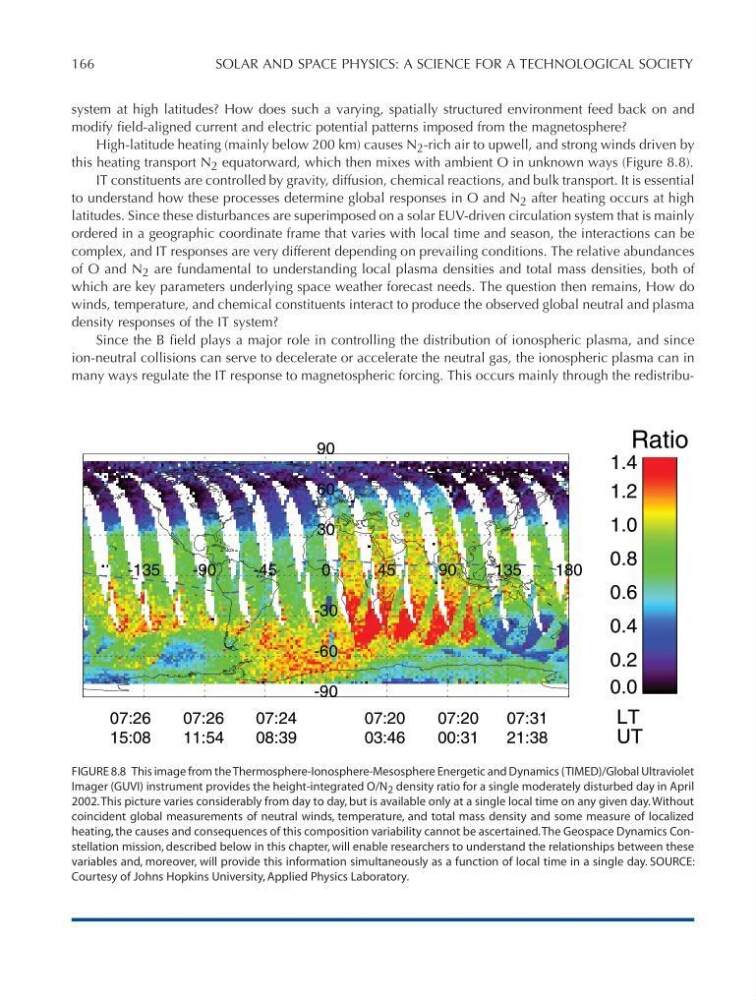
this heating transport N 2 equatorward, which then mixes with ambient O in unknown ways (Figure 8.8).
IT constituents are controlled by gravity, diffusion, chemical reactions, and bulk transport. It is essential
to understand how these processes determine global responses in O and N 2 after heating occurs at high
latitudes. Since these disturbances are superimposed on a solar EUV-driven circulation system that is mainly
ordered in a geographic coordinate frame that varies with local time and season, the interactions can be
complex, and IT responses are very different depending on prevailing conditions. The relative abundances
of O and N 2 are fundamental to understanding local plasma densities and total mass densities, both of
which are key parameters underlying space weather forecast needs. The question then remains, How do
winds, temperature, and chemical constituents interact to produce the observed global neutral and plasma
density responses of the IT system?
Since the B field plays a major role in controlling the distribution of ionospheric plasma, and since
ion-neutral collisions can serve to decelerate or accelerate the neutral gas, the ionospheric plasma can in
many ways regulate the IT response to magnetospheric forcing. This occurs mainly through the redistribuFIGURE 8.8 This image from the Thermosphere-Ionosphere-Mesosphere Energetic and Dynamics (TIMED)/Global Ultraviolet
Imager (GUVI) instrument provides the height-integrated O/N 2 density ratio for a single moderately disturbed day in April
2002. This picture varies considerably from day to day, but is available only at a single local time on any given day. Without
coincident global measurements of neutral winds, temperature, and total mass density and some measure of localized
heating, the causes and consequences of this composition variability cannot be ascertained. The Geospace Dynamics Constellation mission, described below in this chapter, will enable researchers to understand the relationships between these
variables and, moreover, will provide this information simultaneously as a function of local time in a single day. SOURCE:
Courtesy of Johns Hopkins University, Applied Physics Laboratory.
-135
-90
-45
0
45
90
135
180
-90
-60
-30
0
30
60
90
Ratio
0.0
0.2
0.4
0.6
0.8
1.0
1.2
1.4
07:24
08:39
07:26
11:54
07:26
15:08
07:31
21:38
07:20
00:31
07:20
03:46
LT
UT
Figure 8-8
Solar and Space Physics: A Science for a Technological Society
166
SOLAR AND SPACE PHYSICS: A SCIENCE FOR A TECHNOLOGICAL SOCIETY
system at high latitudes? How does such a varying, spatially structured environment feed back on and
modify field-aligned current and electric potential patterns imposed from the magnetosphere?
High-latitude heating (mainly below 200 km) causes N 2 -rich air to upwell, and strong winds driven by
this heating transport N 2 equatorward, which then mixes with ambient O in unknown ways (Figure 8.8).
IT constituents are controlled by gravity, diffusion, chemical reactions, and bulk transport. It is essential
to understand how these processes determine global responses in O and N 2 after heating occurs at high
latitudes. Since these disturbances are superimposed on a solar EUV-driven circulation system that is mainly
ordered in a geographic coordinate frame that varies with local time and season, the interactions can be
complex, and IT responses are very different depending on prevailing conditions. The relative abundances
of O and N 2 are fundamental to understanding local plasma densities and total mass densities, both of
which are key parameters underlying space weather forecast needs. The question then remains, How do
winds, temperature, and chemical constituents interact to produce the observed global neutral and plasma
density responses of the IT system?
Since the B field plays a major role in controlling the distribution of ionospheric plasma, and since
ion-neutral collisions can serve to decelerate or accelerate the neutral gas, the ionospheric plasma can in
many ways regulate the IT response to magnetospheric forcing. This occurs mainly through the redistribuFIGURE 8.8 This image from the Thermosphere-Ionosphere-Mesosphere Energetic and Dynamics (TIMED)/Global Ultraviolet
Imager (GUVI) instrument provides the height-integrated O/N 2 density ratio for a single moderately disturbed day in April
2002. This picture varies considerably from day to day, but is available only at a single local time on any given day. Without
coincident global measurements of neutral winds, temperature, and total mass density and some measure of localized
heating, the causes and consequences of this composition variability cannot be ascertained. The Geospace Dynamics Constellation mission, described below in this chapter, will enable researchers to understand the relationships between these
variables and, moreover, will provide this information simultaneously as a function of local time in a single day. SOURCE:
Courtesy of Johns Hopkins University, Applied Physics Laboratory.
-135
-90
-45
0
45
90
135
180
-90
-60
-30
0
30
60
90
Ratio
0.0
0.2
0.4
0.6
0.8
1.0
1.2
1.4
07:24
08:39
07:26
11:54
07:26
15:08
07:31
21:38
07:20
00:31
07:20
03:46
LT
UT
Figure 8-8