

Copyright © National Academy of Sciences. All rights reserved.
Solar and Space Physics: A Science for a Technological Society
REPORT OF THE PANEL ON ATMOSPHERE-IONOSPHERE-MAGNETOSPHERE INTERACTIONS
165
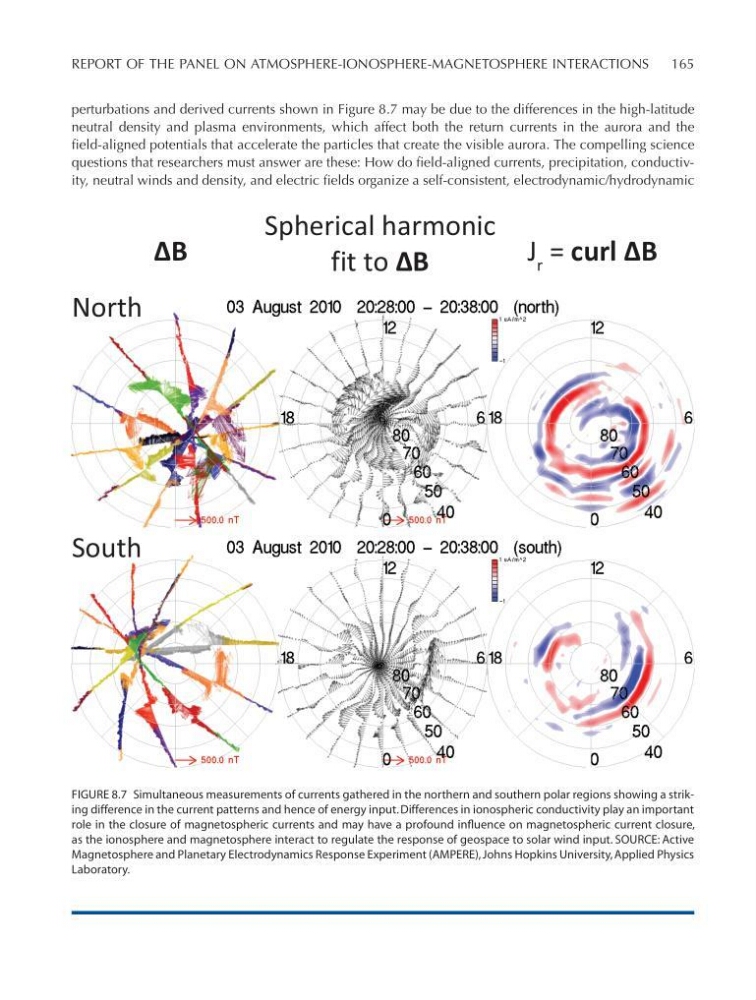
perturbations and derived currents shown in Figure 8.7 may be due to the differences in the high-latitude
neutral density and plasma environments, which affect both the return currents in the aurora and the
field-aligned potentials that accelerate the particles that create the visible aurora. The compelling science
questions that researchers must answer are these: How do field-aligned currents, precipitation, conductivity, neutral winds and density, and electric fields organize a self-consistent, electrodynamic/hydrodynamic
FIGURE 8.7 Simultaneous measurements of currents gathered in the northern and southern polar regions showing a striking difference in the current patterns and hence of energy input. Differences in ionospheric conductivity play an important
role in the closure of magnetospheric currents and may have a profound influence on magnetospheric current closure,
as the ionosphere and magnetosphere interact to regulate the response of geospace to solar wind input. SOURCE: Active
Magnetosphere and Planetary Electrodynamics Response Experiment (AMPERE), Johns Hopkins University, Applied Physics
Laboratory.
ΔB
J r = curl ΔB
Spherical harmonic
fit to ΔB
North
South
Figure 8-7
Solar and Space Physics: A Science for a Technological Society
REPORT OF THE PANEL ON ATMOSPHERE-IONOSPHERE-MAGNETOSPHERE INTERACTIONS
165
perturbations and derived currents shown in Figure 8.7 may be due to the differences in the high-latitude
neutral density and plasma environments, which affect both the return currents in the aurora and the
field-aligned potentials that accelerate the particles that create the visible aurora. The compelling science
questions that researchers must answer are these: How do field-aligned currents, precipitation, conductivity, neutral winds and density, and electric fields organize a self-consistent, electrodynamic/hydrodynamic
FIGURE 8.7 Simultaneous measurements of currents gathered in the northern and southern polar regions showing a striking difference in the current patterns and hence of energy input. Differences in ionospheric conductivity play an important
role in the closure of magnetospheric currents and may have a profound influence on magnetospheric current closure,
as the ionosphere and magnetosphere interact to regulate the response of geospace to solar wind input. SOURCE: Active
Magnetosphere and Planetary Electrodynamics Response Experiment (AMPERE), Johns Hopkins University, Applied Physics
Laboratory.
ΔB
J r = curl ΔB
Spherical harmonic
fit to ΔB
North
South
Figure 8-7