

Copyright © National Academy of Sciences. All rights reserved.
Solar and Space Physics: A Science for a Technological Society
164
SOLAR AND SPACE PHYSICS: A SCIENCE FOR A TECHNOLOGICAL SOCIETY
8.4.1 AIMI Science Goal 1. Global Behavior of the Ionosphere-Thermosphere
How does the IT system respond to, and regulate, magnetospheric forcing over global, regional, and
local scales?
At high latitudes, the AIM system directly impacts magnetospheric dynamics through conductivity changes, current closure, and ion outflow. Spatially confined energy input from the magnetosphere
can quickly be redistributed to the ionized and neutral gases over much larger scales. A response of the
system can occur at locations well removed from the input. Determination of changes in the system that
are imposed externally and changes resulting from the internal system response is required to understand
the geo-effectiveness of the interaction of the planet with the solar wind. In other words, the ionospherethermosphere system both adjusts to the varying input from above, and also feeds back and regulates this
exchange.
Inter-hemispheric differences address the asymmetric closure of currents, as well as local ionospheric
structuring and electric fields. Indeed, the dissimilarities present in the simultaneously measured magnetic
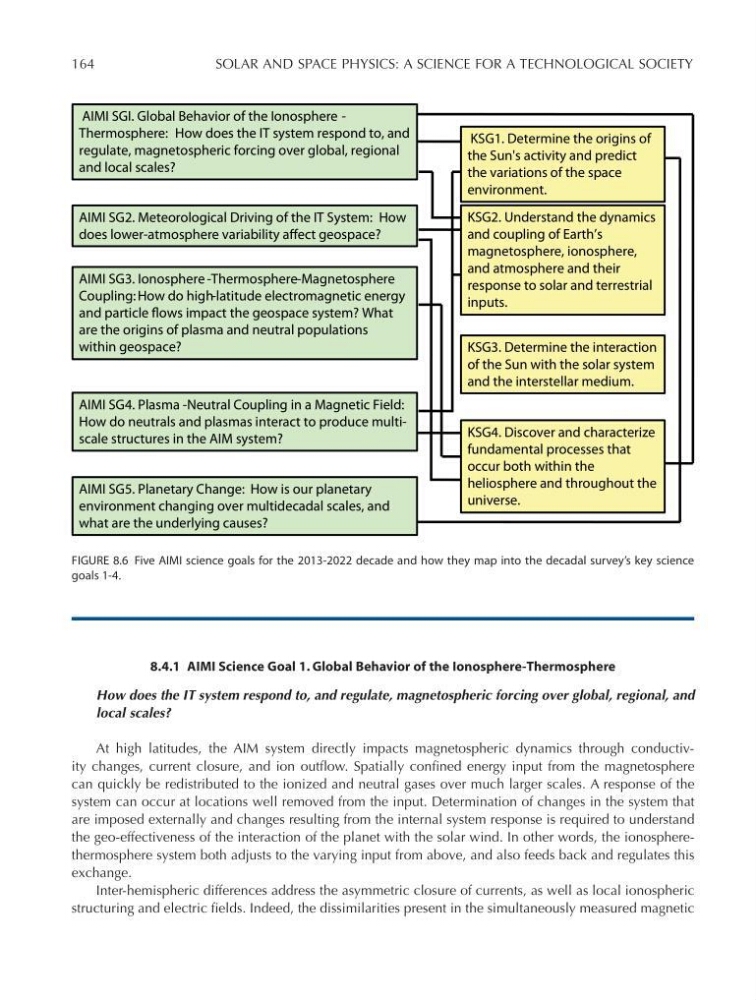
FIGURE 8.6 Five AIMI science goals for the 2013-2022 decade and how they map into the decadal survey’s key science
goals 1-4.
AIMI SGI. Global Behavior of the Ionosphere -
Thermosphere: How does the IT system respond to, and
regulate, magnetospheric forcing over global, regional
and local scales?
AIMI SG2. Meteorological Driving of the IT System: How
does lower-atmosphere variability aaect geospace?
AIMI SG3. Ionosphere -Thermosphere-Magnetosphere
Coupling: How do high-latitude electromagnetic energy
and particle ows impact the geospace system? What
are the origins of plasma and neutral populations
within geospace?
AIMI SG4. Plasma -Neutral Coupling in a Magnetic Field:
How do neutrals and plasmas interact to produce multiscale structures in the AIM system?
AIMI SG5. Planetary Change: How is our planetary
environment changing over multidecadal scales, and
what are the underlying causes?
KSG3. Determine the interaction
of the Sun with the solar system
and the interstellar medium.
KSG1. Determine the origins of
the Sun's activity and predict
the variations of the space
environment.
KSG4. Discover and characterize
fundamental processes that
occur both within the
heliosphere and throughout the
universe.
KSG2. Understand the dynamics
and coupling of Earth’s
magnetosphere, ionosphere,
and atmosphere and their
response to solar and terrestrial
inputs.
Figure 8-6
Solar and Space Physics: A Science for a Technological Society
164
SOLAR AND SPACE PHYSICS: A SCIENCE FOR A TECHNOLOGICAL SOCIETY
8.4.1 AIMI Science Goal 1. Global Behavior of the Ionosphere-Thermosphere
How does the IT system respond to, and regulate, magnetospheric forcing over global, regional, and
local scales?
At high latitudes, the AIM system directly impacts magnetospheric dynamics through conductivity changes, current closure, and ion outflow. Spatially confined energy input from the magnetosphere
can quickly be redistributed to the ionized and neutral gases over much larger scales. A response of the
system can occur at locations well removed from the input. Determination of changes in the system that
are imposed externally and changes resulting from the internal system response is required to understand
the geo-effectiveness of the interaction of the planet with the solar wind. In other words, the ionospherethermosphere system both adjusts to the varying input from above, and also feeds back and regulates this
exchange.
Inter-hemispheric differences address the asymmetric closure of currents, as well as local ionospheric
structuring and electric fields. Indeed, the dissimilarities present in the simultaneously measured magnetic
FIGURE 8.6 Five AIMI science goals for the 2013-2022 decade and how they map into the decadal survey’s key science
goals 1-4.
AIMI SGI. Global Behavior of the Ionosphere -
Thermosphere: How does the IT system respond to, and
regulate, magnetospheric forcing over global, regional
and local scales?
AIMI SG2. Meteorological Driving of the IT System: How
does lower-atmosphere variability aaect geospace?
AIMI SG3. Ionosphere -Thermosphere-Magnetosphere
Coupling: How do high-latitude electromagnetic energy
and particle ows impact the geospace system? What
are the origins of plasma and neutral populations
within geospace?
AIMI SG4. Plasma -Neutral Coupling in a Magnetic Field:
How do neutrals and plasmas interact to produce multiscale structures in the AIM system?
AIMI SG5. Planetary Change: How is our planetary
environment changing over multidecadal scales, and
what are the underlying causes?
KSG3. Determine the interaction
of the Sun with the solar system
and the interstellar medium.
KSG1. Determine the origins of
the Sun's activity and predict
the variations of the space
environment.
KSG4. Discover and characterize
fundamental processes that
occur both within the
heliosphere and throughout the
universe.
KSG2. Understand the dynamics
and coupling of Earth’s
magnetosphere, ionosphere,
and atmosphere and their
response to solar and terrestrial
inputs.
Figure 8-6