

Copyright © National Academy of Sciences. All rights reserved.
Solar and Space Physics: A Science for a Technological Society
REPORT OF THE PANEL ON ATMOSPHERE-IONOSPHERE-MAGNETOSPHERE INTERACTIONS
167
tion of plasma by electric fields. For instance, in connection with a sudden storm commencement, eastward
penetrating electric fields can lift the equatorial ionosphere and accelerate the neutral gas through removal
of the drag effect of the ions. A similar effect can occur at middle latitudes when equatorward winds push
the plasma up magnetic field lines, lessening the drag on the zonal winds. Large redistributions of plasma
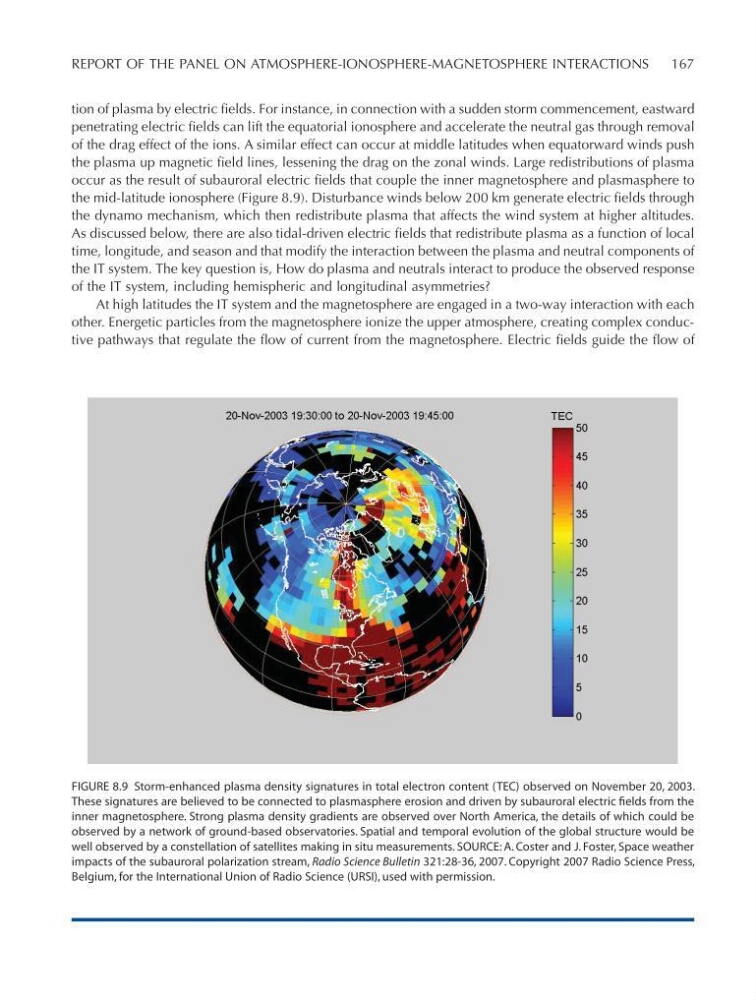
occur as the result of subauroral electric fields that couple the inner magnetosphere and plasmasphere to
the mid-latitude ionosphere (Figure 8.9). Disturbance winds below 200 km generate electric fields through
the dynamo mechanism, which then redistribute plasma that affects the wind system at higher altitudes.
As discussed below, there are also tidal-driven electric fields that redistribute plasma as a function of local
time, longitude, and season and that modify the interaction between the plasma and neutral components of
the IT system. The key question is, How do plasma and neutrals interact to produce the observed response
of the IT system, including hemispheric and longitudinal asymmetries?
At high latitudes the IT system and the magnetosphere are engaged in a two-way interaction with each
other. Energetic particles from the magnetosphere ionize the upper atmosphere, creating complex conductive pathways that regulate the flow of current from the magnetosphere. Electric fields guide the flow of
FIGURE 8.9 Storm-enhanced plasma density signatures in total electron content (TEC) observed on November 20, 2003.
These signatures are believed to be connected to plasmasphere erosion and driven by subauroral electric fields from the
inner magnetosphere. Strong plasma density gradients are observed over North America, the details of which could be
observed by a network of ground-based observatories. Spatial and temporal evolution of the global structure would be
well observed by a constellation of satellites making in situ measurements. SOURCE: A. Coster and J. Foster, Space weather
impacts of the subauroral polarization stream, Radio Science Bulletin 321:28-36, 2007. Copyright 2007 Radio Science Press,
Belgium, for the International Union of Radio Science (URSI), used with permission.
Figure 3-3 and 8-9
Solar and Space Physics: A Science for a Technological Society
REPORT OF THE PANEL ON ATMOSPHERE-IONOSPHERE-MAGNETOSPHERE INTERACTIONS
167
tion of plasma by electric fields. For instance, in connection with a sudden storm commencement, eastward
penetrating electric fields can lift the equatorial ionosphere and accelerate the neutral gas through removal
of the drag effect of the ions. A similar effect can occur at middle latitudes when equatorward winds push
the plasma up magnetic field lines, lessening the drag on the zonal winds. Large redistributions of plasma
occur as the result of subauroral electric fields that couple the inner magnetosphere and plasmasphere to
the mid-latitude ionosphere (Figure 8.9). Disturbance winds below 200 km generate electric fields through
the dynamo mechanism, which then redistribute plasma that affects the wind system at higher altitudes.
As discussed below, there are also tidal-driven electric fields that redistribute plasma as a function of local
time, longitude, and season and that modify the interaction between the plasma and neutral components of
the IT system. The key question is, How do plasma and neutrals interact to produce the observed response
of the IT system, including hemispheric and longitudinal asymmetries?
At high latitudes the IT system and the magnetosphere are engaged in a two-way interaction with each
other. Energetic particles from the magnetosphere ionize the upper atmosphere, creating complex conductive pathways that regulate the flow of current from the magnetosphere. Electric fields guide the flow of
FIGURE 8.9 Storm-enhanced plasma density signatures in total electron content (TEC) observed on November 20, 2003.
These signatures are believed to be connected to plasmasphere erosion and driven by subauroral electric fields from the
inner magnetosphere. Strong plasma density gradients are observed over North America, the details of which could be
observed by a network of ground-based observatories. Spatial and temporal evolution of the global structure would be
well observed by a constellation of satellites making in situ measurements. SOURCE: A. Coster and J. Foster, Space weather
impacts of the subauroral polarization stream, Radio Science Bulletin 321:28-36, 2007. Copyright 2007 Radio Science Press,
Belgium, for the International Union of Radio Science (URSI), used with permission.
Figure 3-3 and 8-9