

Copyright © National Academy of Sciences. All rights reserved.
Solar and Space Physics: A Science for a Technological Society
160
SOLAR AND SPACE PHYSICS: A SCIENCE FOR A TECHNOLOGICAL SOCIETY
ary change in Earth’s atmosphere may alter short-term system variability or multiscale temporal response
in the AIM system. Studies of these effects have been newly undertaken in the recent decade, with some
remarkable findings.
The AIM system can serve as a conduit or amplifier of externally induced climate drivers, coupling
different regions via radiative, dynamical, and chemical feedbacks. These pathways are shown schematically in Figure 8.5. Through these feedback processes remote regions highly driven by solar influences
are linked to the troposphere.
Yet how and to what extent solar and magnetospheric variability affects atmospheric conditions and
climate in such an interconnected system remains an open question. A clear link between space weather
and ozone destruction is contained in the large fluxes of aurorally produced nitric oxide (NO) that are
observed moving downward into the stratosphere within the winter polar vortex. The circulation of air
within the vortex confines the NO to dark high latitudes and rapidly transports it to lower altitudes before
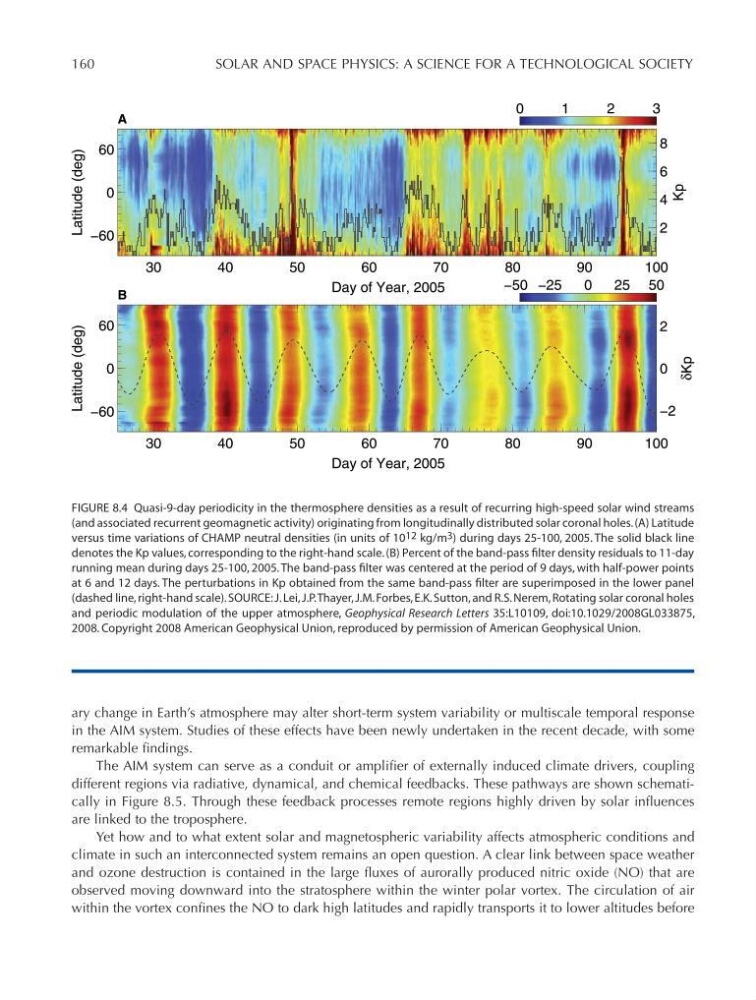
FIGURE 8.4 Quasi-9-day periodicity in the thermosphere densities as a result of recurring high-speed solar wind streams
(and associated recurrent geomagnetic activity) originating from longitudinally distributed solar coronal holes. (A) Latitude
versus time variations of CHAMP neutral densities (in units of 10 12 kg/m 3 ) during days 25-100, 2005. The solid black line
denotes the Kp values, corresponding to the right-hand scale. (B) Percent of the band-pass filter density residuals to 11-day
running mean during days 25-100, 2005. The band-pass filter was centered at the period of 9 days, with half-power points
at 6 and 12 days. The perturbations in Kp obtained from the same band-pass filter are superimposed in the lower panel
(dashed line, right-hand scale). SOURCE: J. Lei, J.P. Thayer, J.M. Forbes, E.K. Sutton, and R.S. Nerem, Rotating solar coronal holes
and periodic modulation of the upper atmosphere, Geophysical Research Letters 35:L10109, doi:10.1029/2008GL033875,
2008. Copyright 2008 American Geophysical Union, reproduced by permission of American Geophysical Union.
Figure 8-4
Solar and Space Physics: A Science for a Technological Society
160
SOLAR AND SPACE PHYSICS: A SCIENCE FOR A TECHNOLOGICAL SOCIETY
ary change in Earth’s atmosphere may alter short-term system variability or multiscale temporal response
in the AIM system. Studies of these effects have been newly undertaken in the recent decade, with some
remarkable findings.
The AIM system can serve as a conduit or amplifier of externally induced climate drivers, coupling
different regions via radiative, dynamical, and chemical feedbacks. These pathways are shown schematically in Figure 8.5. Through these feedback processes remote regions highly driven by solar influences
are linked to the troposphere.
Yet how and to what extent solar and magnetospheric variability affects atmospheric conditions and
climate in such an interconnected system remains an open question. A clear link between space weather
and ozone destruction is contained in the large fluxes of aurorally produced nitric oxide (NO) that are
observed moving downward into the stratosphere within the winter polar vortex. The circulation of air
within the vortex confines the NO to dark high latitudes and rapidly transports it to lower altitudes before
FIGURE 8.4 Quasi-9-day periodicity in the thermosphere densities as a result of recurring high-speed solar wind streams
(and associated recurrent geomagnetic activity) originating from longitudinally distributed solar coronal holes. (A) Latitude
versus time variations of CHAMP neutral densities (in units of 10 12 kg/m 3 ) during days 25-100, 2005. The solid black line
denotes the Kp values, corresponding to the right-hand scale. (B) Percent of the band-pass filter density residuals to 11-day
running mean during days 25-100, 2005. The band-pass filter was centered at the period of 9 days, with half-power points
at 6 and 12 days. The perturbations in Kp obtained from the same band-pass filter are superimposed in the lower panel
(dashed line, right-hand scale). SOURCE: J. Lei, J.P. Thayer, J.M. Forbes, E.K. Sutton, and R.S. Nerem, Rotating solar coronal holes
and periodic modulation of the upper atmosphere, Geophysical Research Letters 35:L10109, doi:10.1029/2008GL033875,
2008. Copyright 2008 American Geophysical Union, reproduced by permission of American Geophysical Union.
Figure 8-4