

Copyright © National Academy of Sciences. All rights reserved.
Solar and Space Physics: A Science for a Technological Society
REPORT OF THE PANEL ON ATMOSPHERE-IONOSPHERE-MAGNETOSPHERE INTERACTIONS
159
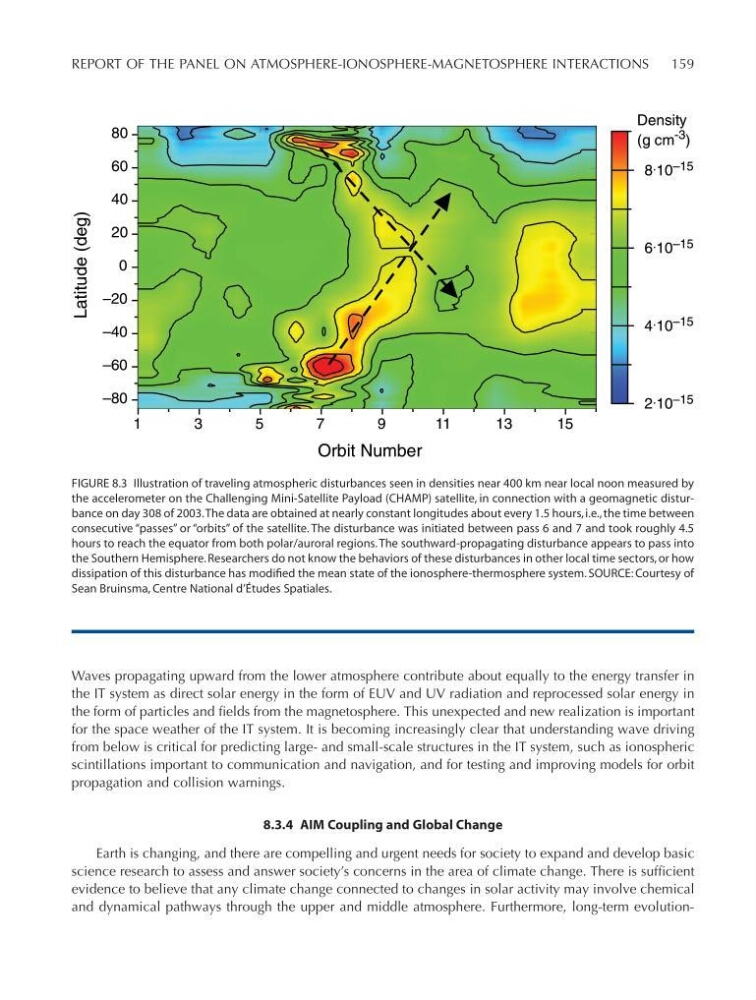
FIGURE 8.3 Illustration of traveling atmospheric disturbances seen in densities near 400 km near local noon measured by
the accelerometer on the Challenging Mini-Satellite Payload (CHAMP) satellite, in connection with a geomagnetic disturbance on day 308 of 2003. The data are obtained at nearly constant longitudes about every 1.5 hours, i.e., the time between
consecutive “passes” or “orbits” of the satellite. The disturbance was initiated between pass 6 and 7 and took roughly 4.5
hours to reach the equator from both polar/auroral regions. The southward-propagating disturbance appears to pass into
the Southern Hemisphere. Researchers do not know the behaviors of these disturbances in other local time sectors, or how
dissipation of this disturbance has modified the mean state of the ionosphere-thermosphere system. SOURCE: Courtesy of
Sean Bruinsma, Centre National d’Études Spatiales.
Waves propagating upward from the lower atmosphere contribute about equally to the energy transfer in
the IT system as direct solar energy in the form of EUV and UV radiation and reprocessed solar energy in
the form of particles and fields from the magnetosphere. This unexpected and new realization is important
for the space weather of the IT system. It is becoming increasingly clear that understanding wave driving
from below is critical for predicting large- and small-scale structures in the IT system, such as ionospheric
scintillations important to communication and navigation, and for testing and improving models for orbit
propagation and collision warnings.
8.3.4 AIM Coupling and Global Change
Earth is changing, and there are compelling and urgent needs for society to expand and develop basic
science research to assess and answer society’s concerns in the area of climate change. There is sufficient
evidence to believe that any climate change connected to changes in solar activity may involve chemical
and dynamical pathways through the upper and middle atmosphere. Furthermore, long-term evolution1
3
5
7
9
11
13
15
–80
–60
–40
–20
0
20
40
60
80
Orbit Number
Latitude (deg)
2 . 10 –15
4 . 10 –15
6 . 10 –15
8 . 10 –15
Density
(g cm -3 )
Figure 8-3
Solar and Space Physics: A Science for a Technological Society
REPORT OF THE PANEL ON ATMOSPHERE-IONOSPHERE-MAGNETOSPHERE INTERACTIONS
159
FIGURE 8.3 Illustration of traveling atmospheric disturbances seen in densities near 400 km near local noon measured by
the accelerometer on the Challenging Mini-Satellite Payload (CHAMP) satellite, in connection with a geomagnetic disturbance on day 308 of 2003. The data are obtained at nearly constant longitudes about every 1.5 hours, i.e., the time between
consecutive “passes” or “orbits” of the satellite. The disturbance was initiated between pass 6 and 7 and took roughly 4.5
hours to reach the equator from both polar/auroral regions. The southward-propagating disturbance appears to pass into
the Southern Hemisphere. Researchers do not know the behaviors of these disturbances in other local time sectors, or how
dissipation of this disturbance has modified the mean state of the ionosphere-thermosphere system. SOURCE: Courtesy of
Sean Bruinsma, Centre National d’Études Spatiales.
Waves propagating upward from the lower atmosphere contribute about equally to the energy transfer in
the IT system as direct solar energy in the form of EUV and UV radiation and reprocessed solar energy in
the form of particles and fields from the magnetosphere. This unexpected and new realization is important
for the space weather of the IT system. It is becoming increasingly clear that understanding wave driving
from below is critical for predicting large- and small-scale structures in the IT system, such as ionospheric
scintillations important to communication and navigation, and for testing and improving models for orbit
propagation and collision warnings.
8.3.4 AIM Coupling and Global Change
Earth is changing, and there are compelling and urgent needs for society to expand and develop basic
science research to assess and answer society’s concerns in the area of climate change. There is sufficient
evidence to believe that any climate change connected to changes in solar activity may involve chemical
and dynamical pathways through the upper and middle atmosphere. Furthermore, long-term evolution1
3
5
7
9
11
13
15
–80
–60
–40
–20
0
20
40
60
80
Orbit Number
Latitude (deg)
2 . 10 –15
4 . 10 –15
6 . 10 –15
8 . 10 –15
Density
(g cm -3 )
Figure 8-3