

Copyright © National Academy of Sciences. All rights reserved.
Solar and Space Physics: A Science for a Technological Society
REPORT OF THE PANEL ON ATMOSPHERE-IONOSPHERE-MAGNETOSPHERE INTERACTIONS
161
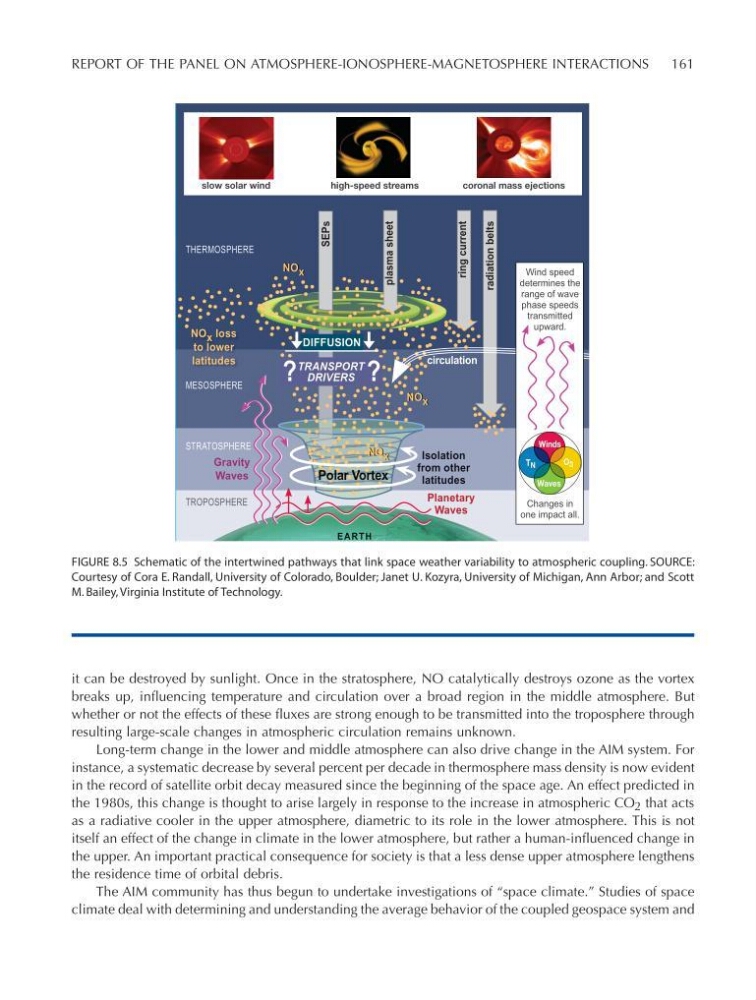
it can be destroyed by sunlight. Once in the stratosphere, NO catalytically destroys ozone as the vortex
breaks up, influencing temperature and circulation over a broad region in the middle atmosphere. But
whether or not the effects of these fluxes are strong enough to be transmitted into the troposphere through
resulting large-scale changes in atmospheric circulation remains unknown.
Long-term change in the lower and middle atmosphere can also drive change in the AIM system. For
instance, a systematic decrease by several percent per decade in thermosphere mass density is now evident
in the record of satellite orbit decay measured since the beginning of the space age. An effect predicted in
the 1980s, this change is thought to arise largely in response to the increase in atmospheric CO 2 that acts
as a radiative cooler in the upper atmosphere, diametric to its role in the lower atmosphere. This is not
itself an effect of the change in climate in the lower atmosphere, but rather a human-influenced change in
the upper. An important practical consequence for society is that a less dense upper atmosphere lengthens
the residence time of orbital debris.
The AIM community has thus begun to undertake investigations of “space climate.” Studies of space
climate deal with determining and understanding the average behavior of the coupled geospace system and
FIGURE 8.5 Schematic of the intertwined pathways that link space weather variability to atmospheric coupling. SOURCE:
Courtesy of Cora E. Randall, University of Colorado, Boulder; Janet U. Kozyra, University of Michigan, Ann Arbor; and Scott
M. Bailey, Virginia Institute of Technology.
THERMOSPHERE
TROPOSPHERE
STRATOSPHERE
MESOSPHERE
SEPs
ring current
radiation belts
Polar Vortex
Gravity
Waves
Planetary
Waves
EARTH
Isolation
from other
latitudes
DIFFUSION
TRANSPORT
DRIVERS
circulation
?
?
plasma sheet
slow solar wind
coronal mass ejections
high-speed streams
TROPOSPHERE 0-10 km
STRATOSPHERE 10-50 km
MESOSPHERE 50-100 km
THERMOSPHERE 100-600 km
this is 100 km from top of mesosphere
T N
Winds
Waves
O 3
NO x loss
to lower
latitudes
NO x
NO x
NO x
NO x
NO x
NO x
Changes in
one impact all.
Wind speed
determines the
range of wave
phase speeds
transmitted
upward.
Figure 8-5
excess material cropped
Solar and Space Physics: A Science for a Technological Society
REPORT OF THE PANEL ON ATMOSPHERE-IONOSPHERE-MAGNETOSPHERE INTERACTIONS
161
it can be destroyed by sunlight. Once in the stratosphere, NO catalytically destroys ozone as the vortex
breaks up, influencing temperature and circulation over a broad region in the middle atmosphere. But
whether or not the effects of these fluxes are strong enough to be transmitted into the troposphere through
resulting large-scale changes in atmospheric circulation remains unknown.
Long-term change in the lower and middle atmosphere can also drive change in the AIM system. For
instance, a systematic decrease by several percent per decade in thermosphere mass density is now evident
in the record of satellite orbit decay measured since the beginning of the space age. An effect predicted in
the 1980s, this change is thought to arise largely in response to the increase in atmospheric CO 2 that acts
as a radiative cooler in the upper atmosphere, diametric to its role in the lower atmosphere. This is not
itself an effect of the change in climate in the lower atmosphere, but rather a human-influenced change in
the upper. An important practical consequence for society is that a less dense upper atmosphere lengthens
the residence time of orbital debris.
The AIM community has thus begun to undertake investigations of “space climate.” Studies of space
climate deal with determining and understanding the average behavior of the coupled geospace system and
FIGURE 8.5 Schematic of the intertwined pathways that link space weather variability to atmospheric coupling. SOURCE:
Courtesy of Cora E. Randall, University of Colorado, Boulder; Janet U. Kozyra, University of Michigan, Ann Arbor; and Scott
M. Bailey, Virginia Institute of Technology.
THERMOSPHERE
TROPOSPHERE
STRATOSPHERE
MESOSPHERE
SEPs
ring current
radiation belts
Polar Vortex
Gravity
Waves
Planetary
Waves
EARTH
Isolation
from other
latitudes
DIFFUSION
TRANSPORT
DRIVERS
circulation
?
?
plasma sheet
slow solar wind
coronal mass ejections
high-speed streams
TROPOSPHERE 0-10 km
STRATOSPHERE 10-50 km
MESOSPHERE 50-100 km
THERMOSPHERE 100-600 km
this is 100 km from top of mesosphere
T N
Winds
Waves
O 3
NO x loss
to lower
latitudes
NO x
NO x
NO x
NO x
NO x
NO x
Changes in
one impact all.
Wind speed
determines the
range of wave
phase speeds
transmitted
upward.
Figure 8-5
excess material cropped