

74
A. Boudaya et al.
3 Experimental Evaluation
Our protocol revolves around the following axes: eight volunteers in which four
women and four men aged twenty six and fifty eight with normal mental health.
For each participant, we make three recordings of sixteen minutes divided over
three day periods (morning, afternoon and evening). To fully understand the
condition of the participants, we split the signal into windows to accurately
identify these different states.
In the proposed simple CNN architecture for EEG signals classification, we
use the Keras deep learning library. The different parameters as filters, kernelsize, padding, kernel-initializer, and activation of the four convolutional layers
have the same values respectively 512, 32, same, normal and relu. The parameter
values of the remaining layers are detailed in the following:
– the dropout layer value equal to 0.2 (respect. 0.5) is used to inactivate 20%
(respect. 50%) of neurons in order to prevent overfitting.
– the Max-Pooling 1D layer is used with a filter size of 128.
– The muti-dimensional data output flatting using 1D flatten layer.
– For better classification results, two dropout layers are used. The first hidden
layer takes a value of 128 neurons. Since a binary classification problem, the
second layer takes a value of 1.
The choice of the optimization algorithm makes the difference between good
results in minutes, hours or even days. There are various optimizers like
Adam [18], SGD [19] and RMS pop optimizer [20]. In our model, we use the
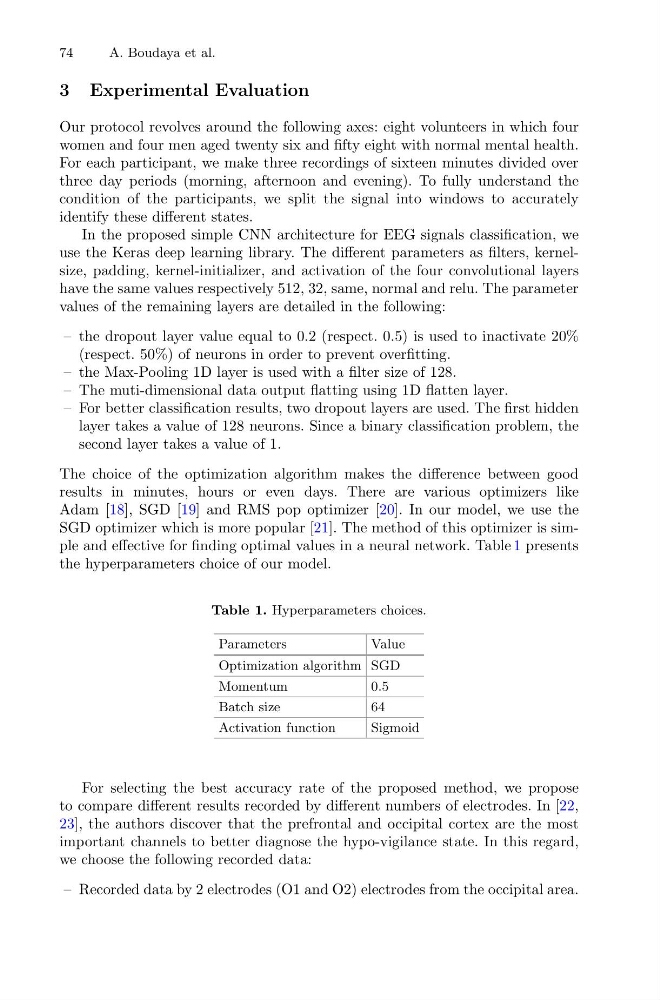
SGD optimizer which is more popular [21]. The method of this optimizer is simple and effective for finding optimal values in a neural network. Table 1 presents
the hyperparameters choice of our model.
Table 1. Hyperparameters choices.
Parameters
Value
Optimization algorithm SGD
Momentum
0.5
Batch size
64
Activation function
Sigmoid
For selecting the best accuracy rate of the proposed method, we propose
to compare different results recorded by different numbers of electrodes. In [22,
23], the authors discover that the prefrontal and occipital cortex are the most
important channels to better diagnose the hypo-vigilance state. In this regard,
we choose the following recorded data:
– Recorded data by 2 electrodes (O1 and O2) electrodes from the occipital area.
A. Boudaya et al.
3 Experimental Evaluation
Our protocol revolves around the following axes: eight volunteers in which four
women and four men aged twenty six and fifty eight with normal mental health.
For each participant, we make three recordings of sixteen minutes divided over
three day periods (morning, afternoon and evening). To fully understand the
condition of the participants, we split the signal into windows to accurately
identify these different states.
In the proposed simple CNN architecture for EEG signals classification, we
use the Keras deep learning library. The different parameters as filters, kernelsize, padding, kernel-initializer, and activation of the four convolutional layers
have the same values respectively 512, 32, same, normal and relu. The parameter
values of the remaining layers are detailed in the following:
– the dropout layer value equal to 0.2 (respect. 0.5) is used to inactivate 20%
(respect. 50%) of neurons in order to prevent overfitting.
– the Max-Pooling 1D layer is used with a filter size of 128.
– The muti-dimensional data output flatting using 1D flatten layer.
– For better classification results, two dropout layers are used. The first hidden
layer takes a value of 128 neurons. Since a binary classification problem, the
second layer takes a value of 1.
The choice of the optimization algorithm makes the difference between good
results in minutes, hours or even days. There are various optimizers like
Adam [18], SGD [19] and RMS pop optimizer [20]. In our model, we use the
SGD optimizer which is more popular [21]. The method of this optimizer is simple and effective for finding optimal values in a neural network. Table 1 presents
the hyperparameters choice of our model.
Table 1. Hyperparameters choices.
Parameters
Value
Optimization algorithm SGD
Momentum
0.5
Batch size
64
Activation function
Sigmoid
For selecting the best accuracy rate of the proposed method, we propose
to compare different results recorded by different numbers of electrodes. In [22,
23], the authors discover that the prefrontal and occipital cortex are the most
important channels to better diagnose the hypo-vigilance state. In this regard,
we choose the following recorded data:
– Recorded data by 2 electrodes (O1 and O2) electrodes from the occipital area.