

EEG-Based Hypo-vigilance Detection Using Convolutional Neural Network
73
– Data augmentation
In order to reduce overfitting and increase testing accuracy, we use the data
augmentation technique [17] which consists of increasing the training set by
label-retaining data transformations. The purpose procedure is to extend the
data by doubling the vectors from (5850, 2) to (59053, 2) where 5850 (resp.
59053) represents the vector size and 2 represents the class number.
2.2 Data Analysis: Simple CNN Classification
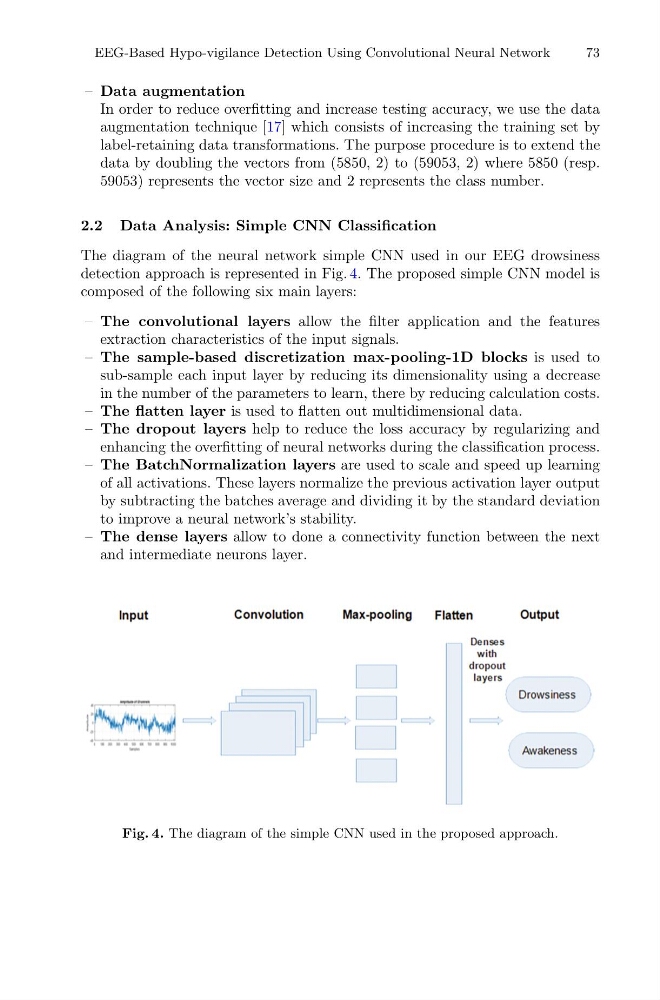
The diagram of the neural network simple CNN used in our EEG drowsiness
detection approach is represented in Fig. 4. The proposed simple CNN model is
composed of the following six main layers:
– The convolutional layers allow the filter application and the features
extraction characteristics of the input signals.
– The sample-based discretization max-pooling-1D blocks is used to
sub-sample each input layer by reducing its dimensionality using a decrease
in the number of the parameters to learn, there by reducing calculation costs.
– The flatten layer is used to flatten out multidimensional data.
– The dropout layers help to reduce the loss accuracy by regularizing and
enhancing the overfitting of neural networks during the classification process.
– The BatchNormalization layers are used to scale and speed up learning
of all activations. These layers normalize the previous activation layer output
by subtracting the batches average and dividing it by the standard deviation
to improve a neural network’s stability.
– The dense layers allow to done a connectivity function between the next
and intermediate neurons layer.
Fig. 4. The diagram of the simple CNN used in the proposed approach.
73
– Data augmentation
In order to reduce overfitting and increase testing accuracy, we use the data
augmentation technique [17] which consists of increasing the training set by
label-retaining data transformations. The purpose procedure is to extend the
data by doubling the vectors from (5850, 2) to (59053, 2) where 5850 (resp.
59053) represents the vector size and 2 represents the class number.
2.2 Data Analysis: Simple CNN Classification
The diagram of the neural network simple CNN used in our EEG drowsiness
detection approach is represented in Fig. 4. The proposed simple CNN model is
composed of the following six main layers:
– The convolutional layers allow the filter application and the features
extraction characteristics of the input signals.
– The sample-based discretization max-pooling-1D blocks is used to
sub-sample each input layer by reducing its dimensionality using a decrease
in the number of the parameters to learn, there by reducing calculation costs.
– The flatten layer is used to flatten out multidimensional data.
– The dropout layers help to reduce the loss accuracy by regularizing and
enhancing the overfitting of neural networks during the classification process.
– The BatchNormalization layers are used to scale and speed up learning
of all activations. These layers normalize the previous activation layer output
by subtracting the batches average and dividing it by the standard deviation
to improve a neural network’s stability.
– The dense layers allow to done a connectivity function between the next
and intermediate neurons layer.
Fig. 4. The diagram of the simple CNN used in the proposed approach.