

EEG-Based Hypo-vigilance Detection Using Convolutional Neural Network
71
As shown in Fig. 1, the realization of the proposed approach is suggested
by two primary procedures: data acquisition and data analysis. The following
subsections provide a detailed explanation of each procedure.
2.1 Data Acquisition
The EEG data acquisition procedure is made up of two main steps which are
data collection and data preprocessing.
Data Collection: To collect the raw EEG data from participants, we use an
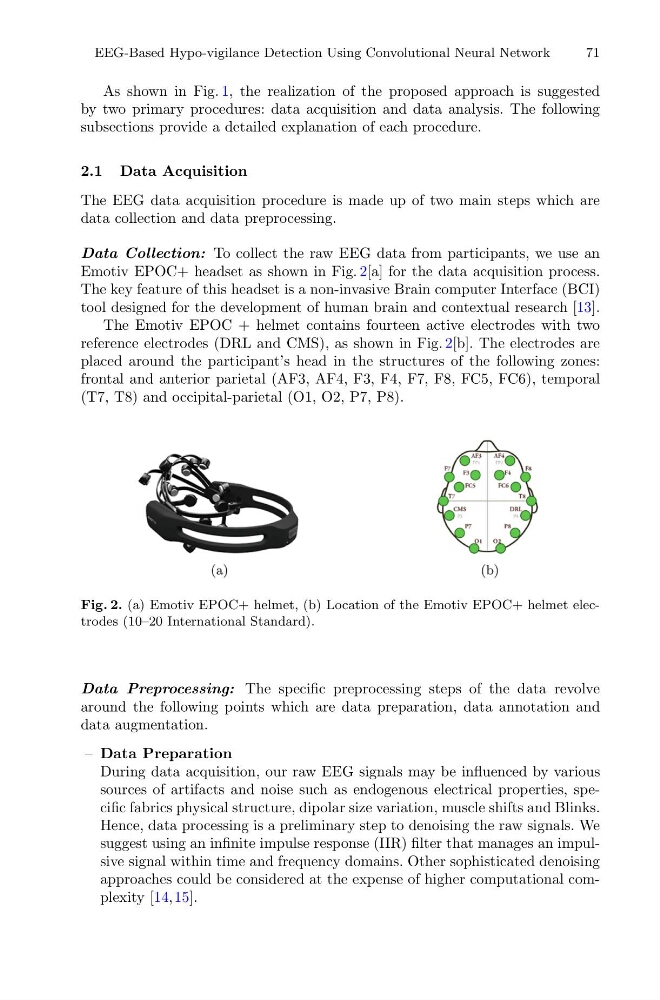
Emotiv EPOC+ headset as shown in Fig. 2[a] for the data acquisition process.
The key feature of this headset is a non-invasive Brain computer Interface (BCI)
tool designed for the development of human brain and contextual research [13].
The Emotiv EPOC + helmet contains fourteen active electrodes with two
reference electrodes (DRL and CMS), as shown in Fig. 2[b]. The electrodes are
placed around the participant’s head in the structures of the following zones:
frontal and anterior parietal (AF3, AF4, F3, F4, F7, F8, FC5, FC6), temporal
(T7, T8) and occipital-parietal (O1, O2, P7, P8).
Fig. 2. (a) Emotiv EPOC+ helmet, (b) Location of the Emotiv EPOC+ helmet electrodes (10–20 International Standard).
Data Preprocessing: The specific preprocessing steps of the data revolve
around the following points which are data preparation, data annotation and
data augmentation.
– Data Preparation
During data acquisition, our raw EEG signals may be influenced by various
sources of artifacts and noise such as endogenous electrical properties, specific fabrics physical structure, dipolar size variation, muscle shifts and Blinks.
Hence, data processing is a preliminary step to denoising the raw signals. We
suggest using an infinite impulse response (IIR) filter that manages an impulsive signal within time and frequency domains. Other sophisticated denoising
approaches could be considered at the expense of higher computational complexity [14,15].
71
As shown in Fig. 1, the realization of the proposed approach is suggested
by two primary procedures: data acquisition and data analysis. The following
subsections provide a detailed explanation of each procedure.
2.1 Data Acquisition
The EEG data acquisition procedure is made up of two main steps which are
data collection and data preprocessing.
Data Collection: To collect the raw EEG data from participants, we use an
Emotiv EPOC+ headset as shown in Fig. 2[a] for the data acquisition process.
The key feature of this headset is a non-invasive Brain computer Interface (BCI)
tool designed for the development of human brain and contextual research [13].
The Emotiv EPOC + helmet contains fourteen active electrodes with two
reference electrodes (DRL and CMS), as shown in Fig. 2[b]. The electrodes are
placed around the participant’s head in the structures of the following zones:
frontal and anterior parietal (AF3, AF4, F3, F4, F7, F8, FC5, FC6), temporal
(T7, T8) and occipital-parietal (O1, O2, P7, P8).
Fig. 2. (a) Emotiv EPOC+ helmet, (b) Location of the Emotiv EPOC+ helmet electrodes (10–20 International Standard).
Data Preprocessing: The specific preprocessing steps of the data revolve
around the following points which are data preparation, data annotation and
data augmentation.
– Data Preparation
During data acquisition, our raw EEG signals may be influenced by various
sources of artifacts and noise such as endogenous electrical properties, specific fabrics physical structure, dipolar size variation, muscle shifts and Blinks.
Hence, data processing is a preliminary step to denoising the raw signals. We
suggest using an infinite impulse response (IIR) filter that manages an impulsive signal within time and frequency domains. Other sophisticated denoising
approaches could be considered at the expense of higher computational complexity [14,15].