

• Apply the mean shift; keep the center ðx c ; y c Þ and the zeo-order moment M oo
• The window W will be centered on ðx c ; y c Þ with the width w ¼ 2
ffiffiffiffiffi ffi
M 00
256
q
and the
height h ¼ 1:2 w
Cam-shift is mainly used in the image segmentation. In fact, after convergence of
the mean shift, the height of the window is chosen 20% greater than its width, but this
choice is arbitrary and can be changed according to the application.
4 Results and Discussion
In this section, we present the test conditions and the results of target detection and
recognition depending on the distance, the angle of view and the luminosity. In
addition, we worked on measuring variables (distance, angle, illumination) because of
the sensitivity of mobile application in natural indoor environment conditions.
4.1 Target Detection
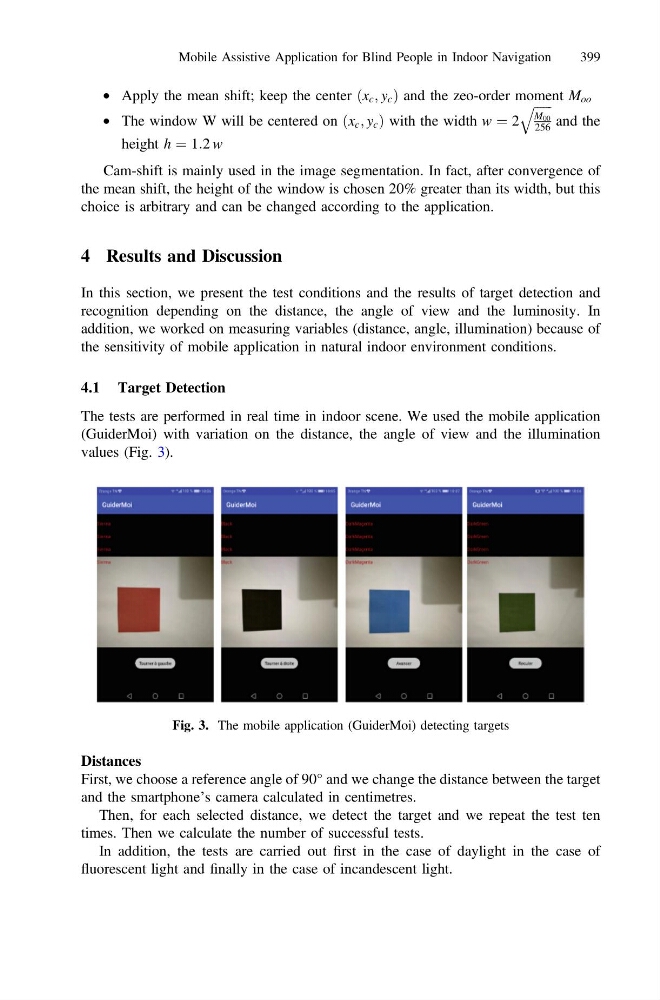
The tests are performed in real time in indoor scene. We used the mobile application
(GuiderMoi) with variation on the distance, the angle of view and the illumination
values (Fig. 3).
Distances
First, we choose a reference angle of 90° and we change the distance between the target
and the smartphone’s camera calculated in centimetres.
Then, for each selected distance, we detect the target and we repeat the test ten
times. Then we calculate the number of successful tests.
In addition, the tests are carried out first in the case of daylight in the case of
fluorescent light and finally in the case of incandescent light.
Fig. 3. The mobile application (GuiderMoi) detecting targets
Mobile Assistive Application for Blind People in Indoor Navigation
399
• The window W will be centered on ðx c ; y c Þ with the width w ¼ 2
ffiffiffiffiffi ffi
M 00
256
q
and the
height h ¼ 1:2 w
Cam-shift is mainly used in the image segmentation. In fact, after convergence of
the mean shift, the height of the window is chosen 20% greater than its width, but this
choice is arbitrary and can be changed according to the application.
4 Results and Discussion
In this section, we present the test conditions and the results of target detection and
recognition depending on the distance, the angle of view and the luminosity. In
addition, we worked on measuring variables (distance, angle, illumination) because of
the sensitivity of mobile application in natural indoor environment conditions.
4.1 Target Detection
The tests are performed in real time in indoor scene. We used the mobile application
(GuiderMoi) with variation on the distance, the angle of view and the illumination
values (Fig. 3).
Distances
First, we choose a reference angle of 90° and we change the distance between the target
and the smartphone’s camera calculated in centimetres.
Then, for each selected distance, we detect the target and we repeat the test ten
times. Then we calculate the number of successful tests.
In addition, the tests are carried out first in the case of daylight in the case of
fluorescent light and finally in the case of incandescent light.
Fig. 3. The mobile application (GuiderMoi) detecting targets
Mobile Assistive Application for Blind People in Indoor Navigation
399