

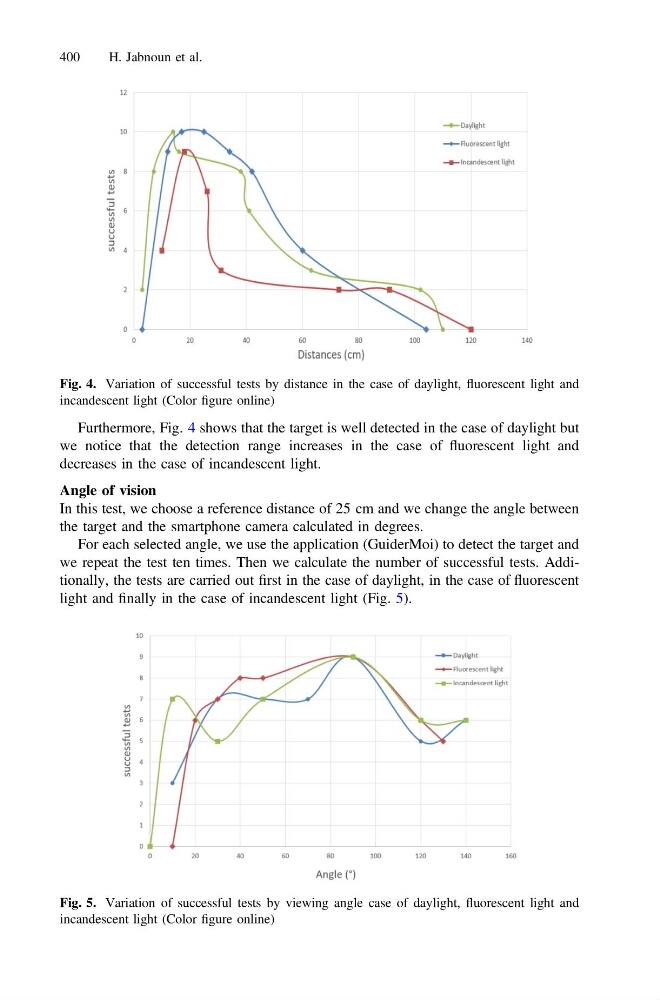
Furthermore, Fig. 4 shows that the target is well detected in the case of daylight but
we notice that the detection range increases in the case of fluorescent light and
decreases in the case of incandescent light.
Angle of vision
In this test, we choose a reference distance of 25 cm and we change the angle between
the target and the smartphone camera calculated in degrees.
For each selected angle, we use the application (GuiderMoi) to detect the target and
we repeat the test ten times. Then we calculate the number of successful tests. Additionally, the tests are carried out first in the case of daylight, in the case of fluorescent
light and finally in the case of incandescent light (Fig. 5).
Fig. 4. Variation of successful tests by distance in the case of daylight, fluorescent light and
incandescent light (Color figure online)
Fig. 5. Variation of successful tests by viewing angle case of daylight, fluorescent light and
incandescent light (Color figure online)
400
H. Jabnoun et al.
we notice that the detection range increases in the case of fluorescent light and
decreases in the case of incandescent light.
Angle of vision
In this test, we choose a reference distance of 25 cm and we change the angle between
the target and the smartphone camera calculated in degrees.
For each selected angle, we use the application (GuiderMoi) to detect the target and
we repeat the test ten times. Then we calculate the number of successful tests. Additionally, the tests are carried out first in the case of daylight, in the case of fluorescent
light and finally in the case of incandescent light (Fig. 5).
Fig. 4. Variation of successful tests by distance in the case of daylight, fluorescent light and
incandescent light (Color figure online)
Fig. 5. Variation of successful tests by viewing angle case of daylight, fluorescent light and
incandescent light (Color figure online)
400
H. Jabnoun et al.