

3.2 Continually Adaptive MeanShift (Camshift) for Target Color
Detection
Color targets are a tracking symbols designed to solve the problem of environmental
labelling [17]. They are distinctive and difficult to confuse with a typical background
clutter and are detectable by a robust algorithm that can work very quickly on a
smartphone. Based on the idea of [18], we added the fourth color to detect the last
direction.
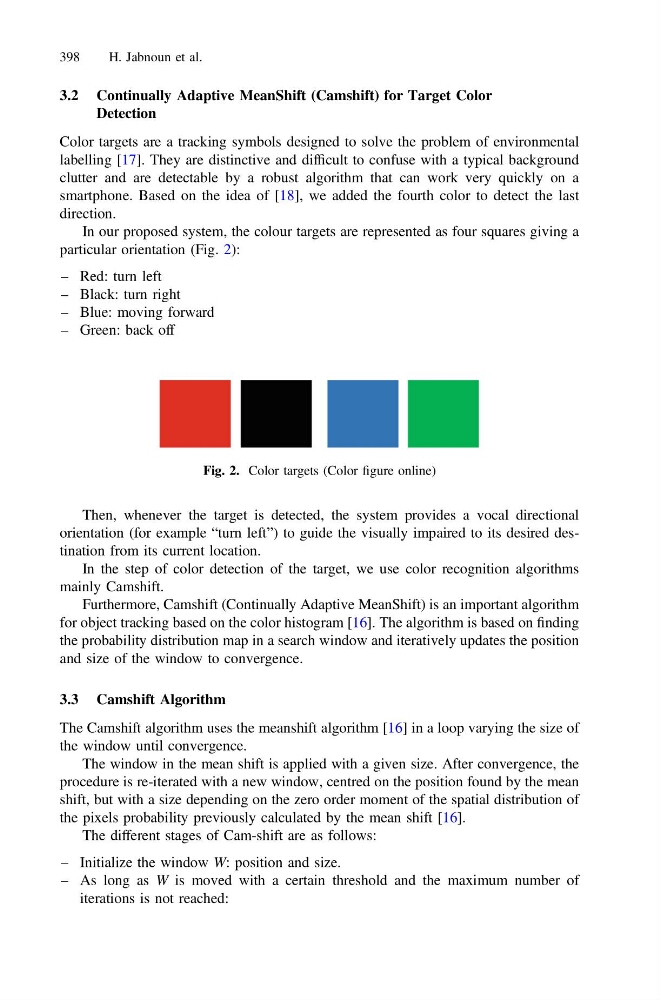
In our proposed system, the colour targets are represented as four squares giving a
particular orientation (Fig. 2):
– Red: turn left
– Black: turn right
– Blue: moving forward
– Green: back off
Then, whenever the target is detected, the system provides a vocal directional
orientation (for example “turn left”) to guide the visually impaired to its desired destination from its current location.
In the step of color detection of the target, we use color recognition algorithms
mainly Camshift.
Furthermore, Camshift (Continually Adaptive MeanShift) is an important algorithm
for object tracking based on the color histogram [16]. The algorithm is based on finding
the probability distribution map in a search window and iteratively updates the position
and size of the window to convergence.
3.3 Camshift Algorithm
The Camshift algorithm uses the meanshift algorithm [16] in a loop varying the size of
the window until convergence.
The window in the mean shift is applied with a given size. After convergence, the
procedure is re-iterated with a new window, centred on the position found by the mean
shift, but with a size depending on the zero order moment of the spatial distribution of
the pixels probability previously calculated by the mean shift [16].
The different stages of Cam-shift are as follows:
– Initialize the window W: position and size.
– As long as W is moved with a certain threshold and the maximum number of
iterations is not reached:
Fig. 2. Color targets (Color figure online)
398
H. Jabnoun et al.
Detection
Color targets are a tracking symbols designed to solve the problem of environmental
labelling [17]. They are distinctive and difficult to confuse with a typical background
clutter and are detectable by a robust algorithm that can work very quickly on a
smartphone. Based on the idea of [18], we added the fourth color to detect the last
direction.
In our proposed system, the colour targets are represented as four squares giving a
particular orientation (Fig. 2):
– Red: turn left
– Black: turn right
– Blue: moving forward
– Green: back off
Then, whenever the target is detected, the system provides a vocal directional
orientation (for example “turn left”) to guide the visually impaired to its desired destination from its current location.
In the step of color detection of the target, we use color recognition algorithms
mainly Camshift.
Furthermore, Camshift (Continually Adaptive MeanShift) is an important algorithm
for object tracking based on the color histogram [16]. The algorithm is based on finding
the probability distribution map in a search window and iteratively updates the position
and size of the window to convergence.
3.3 Camshift Algorithm
The Camshift algorithm uses the meanshift algorithm [16] in a loop varying the size of
the window until convergence.
The window in the mean shift is applied with a given size. After convergence, the
procedure is re-iterated with a new window, centred on the position found by the mean
shift, but with a size depending on the zero order moment of the spatial distribution of
the pixels probability previously calculated by the mean shift [16].
The different stages of Cam-shift are as follows:
– Initialize the window W: position and size.
– As long as W is moved with a certain threshold and the maximum number of
iterations is not reached:
Fig. 2. Color targets (Color figure online)
398
H. Jabnoun et al.