

3 Results
3.1 Simulated Data
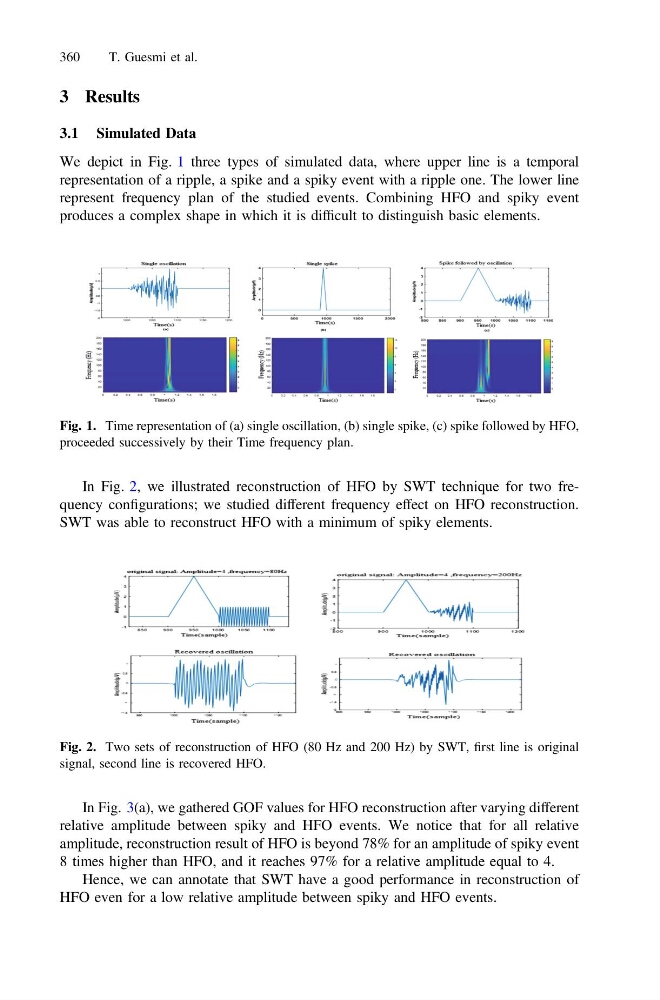
We depict in Fig. 1 three types of simulated data, where upper line is a temporal
representation of a ripple, a spike and a spiky event with a ripple one. The lower line
represent frequency plan of the studied events. Combining HFO and spiky event
produces a complex shape in which it is difficult to distinguish basic elements.
In Fig. 2, we illustrated reconstruction of HFO by SWT technique for two frequency configurations; we studied different frequency effect on HFO reconstruction.
SWT was able to reconstruct HFO with a minimum of spiky elements.
In Fig. 3(a), we gathered GOF values for HFO reconstruction after varying different
relative amplitude between spiky and HFO events. We notice that for all relative
amplitude, reconstruction result of HFO is beyond 78% for an amplitude of spiky event
8 times higher than HFO, and it reaches 97% for a relative amplitude equal to 4.
Hence, we can annotate that SWT have a good performance in reconstruction of
HFO even for a low relative amplitude between spiky and HFO events.
Fig. 1. Time representation of (a) single oscillation, (b) single spike, (c) spike followed by HFO,
proceeded successively by their Time frequency plan.
Fig. 2. Two sets of reconstruction of HFO (80 Hz and 200 Hz) by SWT, first line is original
signal, second line is recovered HFO.
360
T. Guesmi et al.
3.1 Simulated Data
We depict in Fig. 1 three types of simulated data, where upper line is a temporal
representation of a ripple, a spike and a spiky event with a ripple one. The lower line
represent frequency plan of the studied events. Combining HFO and spiky event
produces a complex shape in which it is difficult to distinguish basic elements.
In Fig. 2, we illustrated reconstruction of HFO by SWT technique for two frequency configurations; we studied different frequency effect on HFO reconstruction.
SWT was able to reconstruct HFO with a minimum of spiky elements.
In Fig. 3(a), we gathered GOF values for HFO reconstruction after varying different
relative amplitude between spiky and HFO events. We notice that for all relative
amplitude, reconstruction result of HFO is beyond 78% for an amplitude of spiky event
8 times higher than HFO, and it reaches 97% for a relative amplitude equal to 4.
Hence, we can annotate that SWT have a good performance in reconstruction of
HFO even for a low relative amplitude between spiky and HFO events.
Fig. 1. Time representation of (a) single oscillation, (b) single spike, (c) spike followed by HFO,
proceeded successively by their Time frequency plan.
Fig. 2. Two sets of reconstruction of HFO (80 Hz and 200 Hz) by SWT, first line is original
signal, second line is recovered HFO.
360
T. Guesmi et al.