

Real Data: (IEEG) recordings for a pharmaco-resistant epileptic subject, where
acquisition and pretreatment steps were assigned to clinical neurophysiology department of La Timone Hospital, Marseille [6] and validated by an expert neurologist. Our
data is recorded on a Deltamed system, sampled at 1000 Hz with a low-pass filter. This
particular IEEG signal is selected since it exhibits important epileptic HFOs patterns
and regular spikes.
2.2 Methods
The Stationary Wavelet Transform SWT technique is a diversity of Dynamic Wavelet
Transform with an advantage of overcoming decimation of DWT; which leads to a
better maintain of signal characteristics. It performs even better than Continuous
Wavelet Transform CWT by exceeding frequency-overlapping band.
In fact, SWT was used in various fields of application such as de-noising and
detection [8], also, very useful in physiological signal analysis [7].
In [9] SWT was studied and implemented to reconstruct pre-ictal gamma oscillations in order to predict seizure build up. Hence, we proposed to study and evaluate
SWT method performance in reconstruction of ripples and fast ripples: HFO. SWT
decomposed a signal to be filtered into approximations and details coefficients, then,
and through a thresholding steps (using masks), it allows to detect only desired parts by
inverse of SWT method (iswt) [10]. Our thresholding step consists of creating a
rectangle mask with a width equal to raw window studied and a length equal to 2 scales
of decomposition (approximation and detail coefficients) [6]. SWT is a projection of
scale h j;k function dilated and translated to obtain cA j ðkÞ as approximations coefficients
and cD j ðkÞ as detail ones.
During implementation steps of SWT, we choose 6 levels of decomposition for a
better detection of HFO [6]. We adopted the symlet wavelet family, since they are
almost symmetrical to oscillation; moreover they are featured by their orthogonally
which facilitate the reconstruction step.
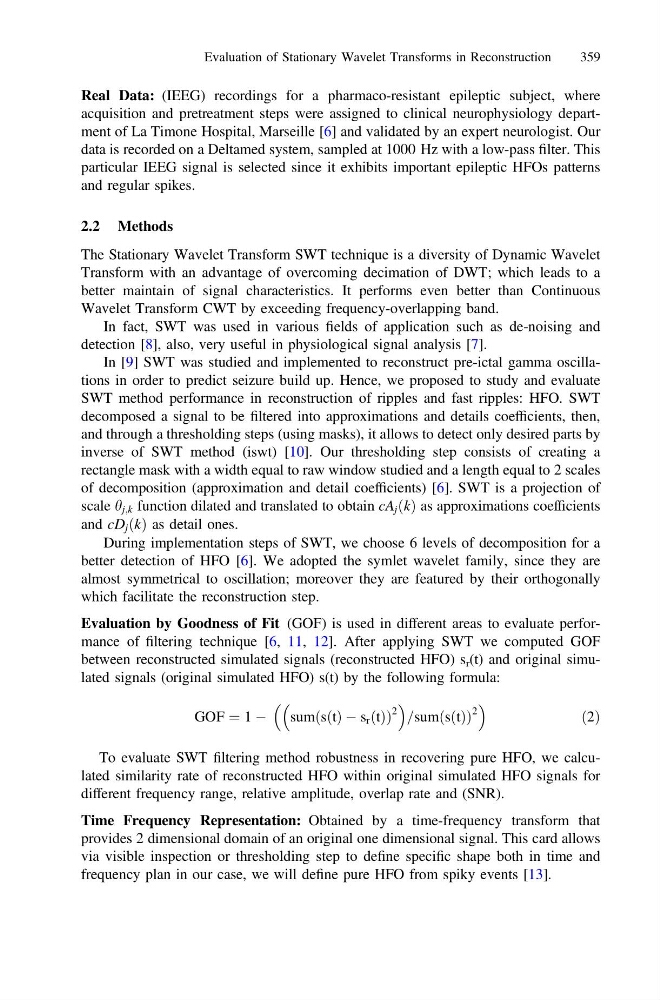
Evaluation by Goodness of Fit (GOF) is used in different areas to evaluate performance of filtering technique [6, 11, 12]. After applying SWT we computed GOF
between reconstructed simulated signals (reconstructed HFO) s r (t) and original simulated signals (original simulated HFO) s(t) by the following formula:
GOF ¼ 1 À
sum s t
ð Þ À s r t
ð Þ
ð
Þ
2
=sum s t
ð Þ
ð Þ
2
ð2Þ
To evaluate SWT filtering method robustness in recovering pure HFO, we calculated similarity rate of reconstructed HFO within original simulated HFO signals for
different frequency range, relative amplitude, overlap rate and (SNR).
Time Frequency Representation: Obtained by a time-frequency transform that
provides 2 dimensional domain of an original one dimensional signal. This card allows
via visible inspection or thresholding step to define specific shape both in time and
frequency plan in our case, we will define pure HFO from spiky events [13].
Evaluation of Stationary Wavelet Transforms in Reconstruction
359
acquisition and pretreatment steps were assigned to clinical neurophysiology department of La Timone Hospital, Marseille [6] and validated by an expert neurologist. Our
data is recorded on a Deltamed system, sampled at 1000 Hz with a low-pass filter. This
particular IEEG signal is selected since it exhibits important epileptic HFOs patterns
and regular spikes.
2.2 Methods
The Stationary Wavelet Transform SWT technique is a diversity of Dynamic Wavelet
Transform with an advantage of overcoming decimation of DWT; which leads to a
better maintain of signal characteristics. It performs even better than Continuous
Wavelet Transform CWT by exceeding frequency-overlapping band.
In fact, SWT was used in various fields of application such as de-noising and
detection [8], also, very useful in physiological signal analysis [7].
In [9] SWT was studied and implemented to reconstruct pre-ictal gamma oscillations in order to predict seizure build up. Hence, we proposed to study and evaluate
SWT method performance in reconstruction of ripples and fast ripples: HFO. SWT
decomposed a signal to be filtered into approximations and details coefficients, then,
and through a thresholding steps (using masks), it allows to detect only desired parts by
inverse of SWT method (iswt) [10]. Our thresholding step consists of creating a
rectangle mask with a width equal to raw window studied and a length equal to 2 scales
of decomposition (approximation and detail coefficients) [6]. SWT is a projection of
scale h j;k function dilated and translated to obtain cA j ðkÞ as approximations coefficients
and cD j ðkÞ as detail ones.
During implementation steps of SWT, we choose 6 levels of decomposition for a
better detection of HFO [6]. We adopted the symlet wavelet family, since they are
almost symmetrical to oscillation; moreover they are featured by their orthogonally
which facilitate the reconstruction step.
Evaluation by Goodness of Fit (GOF) is used in different areas to evaluate performance of filtering technique [6, 11, 12]. After applying SWT we computed GOF
between reconstructed simulated signals (reconstructed HFO) s r (t) and original simulated signals (original simulated HFO) s(t) by the following formula:
GOF ¼ 1 À
sum s t
ð Þ À s r t
ð Þ
ð
Þ
2
=sum s t
ð Þ
ð Þ
2
ð2Þ
To evaluate SWT filtering method robustness in recovering pure HFO, we calculated similarity rate of reconstructed HFO within original simulated HFO signals for
different frequency range, relative amplitude, overlap rate and (SNR).
Time Frequency Representation: Obtained by a time-frequency transform that
provides 2 dimensional domain of an original one dimensional signal. This card allows
via visible inspection or thresholding step to define specific shape both in time and
frequency plan in our case, we will define pure HFO from spiky events [13].
Evaluation of Stationary Wavelet Transforms in Reconstruction
359