

2.2 Denoising
The digitized signal x n is denoised by using an offline designed band-pass FIR filter.
The denoising diminishes the noise like the “Power Line Interference” (PLI) and
“Baseline Wander” (BW) from the ECG signal. It improves the efficiency of collection
and classification of the features. The ECG signal’s useful frequency range lies between
[0.5; 50] Hz [9, 10]. Accordingly, a band-pass linear phase filter is configured offline
for the cut-off frequencies of [Fc L = 0.5; Fc H = 50] Hz it resulted in a 122
nd order filter
designed for F S ¼ 360 Hz. For proper filtering, Fc H is kept less than half of the signal
sampling rate [5]. Therefore, F S ¼ 360 Hz fulfils this criterion.
2.3 Subsampling
The functioning of conventional ECG acquisition and analysis processes is of timeinvariant nature [2–4]. Consequently, a worst-case parameterization is enforced [5]. It
causes the processing ineffectiveness in the case of time-varying and sporadic ECG
signals. These inadequacies can be diminished by using multirate processing approaches [2, 5, 6]. In this framework, the denoised signal xf n is subsampled with a factor of
D ¼ 4 to obtain xd n ¼ xf Dn . Subsampling without a prior digital antialiasing filtering
can cause aliasing [6]. However, a proper choice of D allows to perform subsampling
without prior filtering. In this case, the selected value of D should respect the condition:
D
F S
F Nyq
¼ 3:6. Here, F S ¼ 360 Hz, F Nyq ¼ 2: f max and f max is the bandwidth of xf n and
is equal to Fc H = 50 Hz. It shows that for the chosen D ¼ 3 subsampling does not
cause aliasing.
2.4 Segmentation
In order to split the continuous time ECG records into ECG pulses, xd n is divided in
0.9-s length segments. Each segment, xs n , contains one ECG pulse. The segmentation
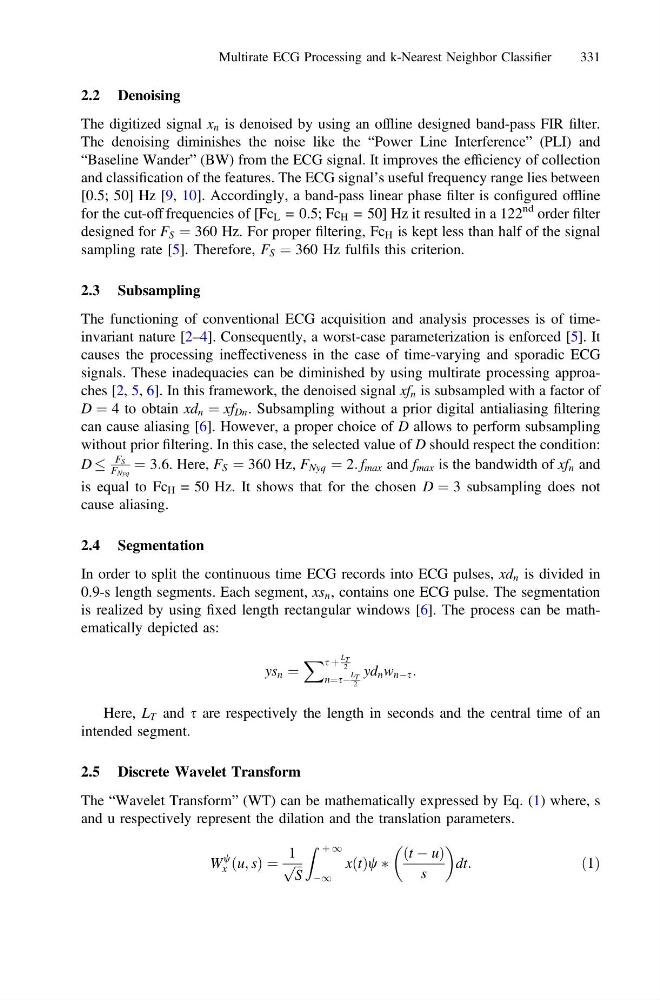
is realized by using fixed length rectangular windows [6]. The process can be mathematically depicted as:
ys n ¼
X s þ
L T
2
n¼sÀ
L T
2
yd n w nÀs :
Here, L T and s are respectively the length in seconds and the central time of an
intended segment.
2.5 Discrete Wavelet Transform
The “Wavelet Transform” (WT) can be mathematically expressed by Eq. (1) where, s
and u respectively represent the dilation and the translation parameters.
W
w
x u; s
ð Þ ¼
1
ffiffi ffi
S
p
Z þ 1
À1
xðtÞw Ã
ðt À uÞ
s
dt:
ð1Þ
Multirate ECG Processing and k-Nearest Neighbor Classifier
331
The digitized signal x n is denoised by using an offline designed band-pass FIR filter.
The denoising diminishes the noise like the “Power Line Interference” (PLI) and
“Baseline Wander” (BW) from the ECG signal. It improves the efficiency of collection
and classification of the features. The ECG signal’s useful frequency range lies between
[0.5; 50] Hz [9, 10]. Accordingly, a band-pass linear phase filter is configured offline
for the cut-off frequencies of [Fc L = 0.5; Fc H = 50] Hz it resulted in a 122
nd order filter
designed for F S ¼ 360 Hz. For proper filtering, Fc H is kept less than half of the signal
sampling rate [5]. Therefore, F S ¼ 360 Hz fulfils this criterion.
2.3 Subsampling
The functioning of conventional ECG acquisition and analysis processes is of timeinvariant nature [2–4]. Consequently, a worst-case parameterization is enforced [5]. It
causes the processing ineffectiveness in the case of time-varying and sporadic ECG
signals. These inadequacies can be diminished by using multirate processing approaches [2, 5, 6]. In this framework, the denoised signal xf n is subsampled with a factor of
D ¼ 4 to obtain xd n ¼ xf Dn . Subsampling without a prior digital antialiasing filtering
can cause aliasing [6]. However, a proper choice of D allows to perform subsampling
without prior filtering. In this case, the selected value of D should respect the condition:
D
F S
F Nyq
¼ 3:6. Here, F S ¼ 360 Hz, F Nyq ¼ 2: f max and f max is the bandwidth of xf n and
is equal to Fc H = 50 Hz. It shows that for the chosen D ¼ 3 subsampling does not
cause aliasing.
2.4 Segmentation
In order to split the continuous time ECG records into ECG pulses, xd n is divided in
0.9-s length segments. Each segment, xs n , contains one ECG pulse. The segmentation
is realized by using fixed length rectangular windows [6]. The process can be mathematically depicted as:
ys n ¼
X s þ
L T
2
n¼sÀ
L T
2
yd n w nÀs :
Here, L T and s are respectively the length in seconds and the central time of an
intended segment.
2.5 Discrete Wavelet Transform
The “Wavelet Transform” (WT) can be mathematically expressed by Eq. (1) where, s
and u respectively represent the dilation and the translation parameters.
W
w
x u; s
ð Þ ¼
1
ffiffi ffi
S
p
Z þ 1
À1
xðtÞw Ã
ðt À uÞ
s
dt:
ð1Þ
Multirate ECG Processing and k-Nearest Neighbor Classifier
331