

Alzheimer’s Disease Early Detection Using a Densenet-121
11
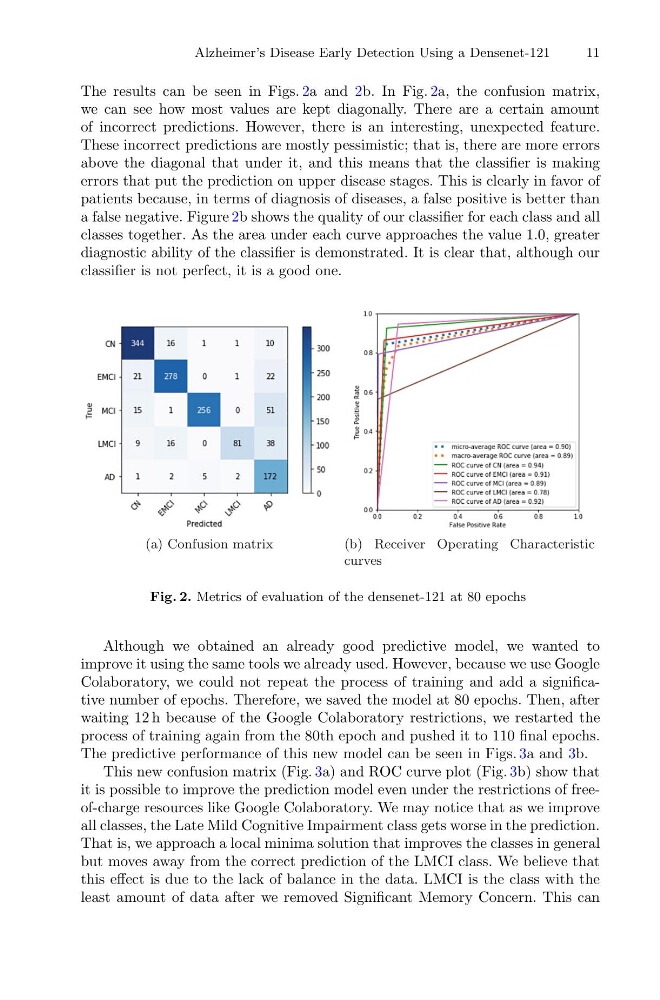
The results can be seen in Figs. 2a and 2b. In Fig. 2a, the confusion matrix,
we can see how most values are kept diagonally. There are a certain amount
of incorrect predictions. However, there is an interesting, unexpected feature.
These incorrect predictions are mostly pessimistic; that is, there are more errors
above the diagonal that under it, and this means that the classifier is making
errors that put the prediction on upper disease stages. This is clearly in favor of
patients because, in terms of diagnosis of diseases, a false positive is better than
a false negative. Figure 2b shows the quality of our classifier for each class and all
classes together. As the area under each curve approaches the value 1.0, greater
diagnostic ability of the classifier is demonstrated. It is clear that, although our
classifier is not perfect, it is a good one.
(a) Confusion matrix
(b) Receiver Operating Characteristic
curves
Fig. 2. Metrics of evaluation of the densenet-121 at 80 epochs
Although we obtained an already good predictive model, we wanted to
improve it using the same tools we already used. However, because we use Google
Colaboratory, we could not repeat the process of training and add a significative number of epochs. Therefore, we saved the model at 80 epochs. Then, after
waiting 12 h because of the Google Colaboratory restrictions, we restarted the
process of training again from the 80th epoch and pushed it to 110 final epochs.
The predictive performance of this new model can be seen in Figs. 3a and 3b.
This new confusion matrix (Fig. 3a) and ROC curve plot (Fig. 3b) show that
it is possible to improve the prediction model even under the restrictions of freeof-charge resources like Google Colaboratory. We may notice that as we improve
all classes, the Late Mild Cognitive Impairment class gets worse in the prediction.
That is, we approach a local minima solution that improves the classes in general
but moves away from the correct prediction of the LMCI class. We believe that
this effect is due to the lack of balance in the data. LMCI is the class with the
least amount of data after we removed Significant Memory Concern. This can
11
The results can be seen in Figs. 2a and 2b. In Fig. 2a, the confusion matrix,
we can see how most values are kept diagonally. There are a certain amount
of incorrect predictions. However, there is an interesting, unexpected feature.
These incorrect predictions are mostly pessimistic; that is, there are more errors
above the diagonal that under it, and this means that the classifier is making
errors that put the prediction on upper disease stages. This is clearly in favor of
patients because, in terms of diagnosis of diseases, a false positive is better than
a false negative. Figure 2b shows the quality of our classifier for each class and all
classes together. As the area under each curve approaches the value 1.0, greater
diagnostic ability of the classifier is demonstrated. It is clear that, although our
classifier is not perfect, it is a good one.
(a) Confusion matrix
(b) Receiver Operating Characteristic
curves
Fig. 2. Metrics of evaluation of the densenet-121 at 80 epochs
Although we obtained an already good predictive model, we wanted to
improve it using the same tools we already used. However, because we use Google
Colaboratory, we could not repeat the process of training and add a significative number of epochs. Therefore, we saved the model at 80 epochs. Then, after
waiting 12 h because of the Google Colaboratory restrictions, we restarted the
process of training again from the 80th epoch and pushed it to 110 final epochs.
The predictive performance of this new model can be seen in Figs. 3a and 3b.
This new confusion matrix (Fig. 3a) and ROC curve plot (Fig. 3b) show that
it is possible to improve the prediction model even under the restrictions of freeof-charge resources like Google Colaboratory. We may notice that as we improve
all classes, the Late Mild Cognitive Impairment class gets worse in the prediction.
That is, we approach a local minima solution that improves the classes in general
but moves away from the correct prediction of the LMCI class. We believe that
this effect is due to the lack of balance in the data. LMCI is the class with the
least amount of data after we removed Significant Memory Concern. This can