

10
B. Solano-Rojas et al.
with GPU for a determined number of hours. These limitations imply that the
training and testing have to be done in one run before the first 12 h end. There
are other implications to the restrictions. For instance, it is customary to test or
validate neural networks during training; thus the loss and accuracy of the neural
networks can be analyzed at each epoch. However, to reduce computation time,
testing or validation of the trained DNN is only done at the end. We chose this
because a validation cycle of 25% of the data takes approximately 2 or 3 min. In
30 epochs, that would take 1 h or more. This trade-off is not severe, we can save
intermediate neural networks states and study them after finishing the training.
However, this choice also implies that techniques like early stopping can not be
employed. There are also disk size limitations.
Taking all the limitations into account and with the mentioned configuration
parameters of our development, we obtained the results that we discuss in the
next section.
5 Results and Discussion
The first finding of this work is the characterization of the significant memory
concern class as a noisy class for training. This problem may be due to the fact
that the class is subjective and is possibly composed of at least two classes: those
who will develop the disease and those who will not. Also, those who will develop
it may have different levels of progression, being, in turn, a class composed of
different classes. Another reason for the class to be problematic is its size. It is
the smallest cohort and by far. This makes it difficult to classify during training.
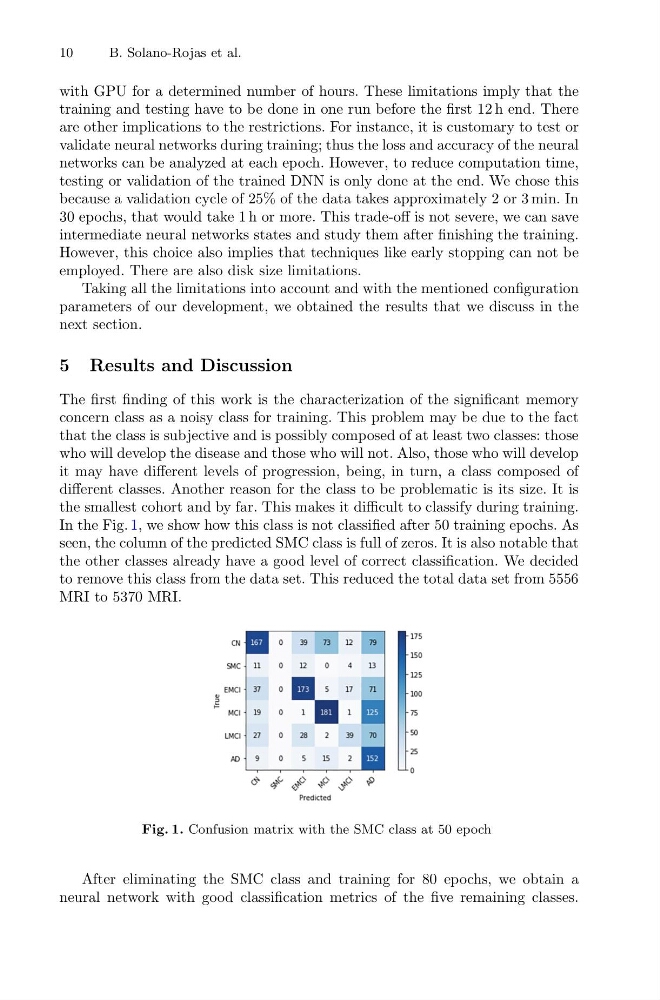
In the Fig. 1, we show how this class is not classified after 50 training epochs. As
seen, the column of the predicted SMC class is full of zeros. It is also notable that
the other classes already have a good level of correct classification. We decided
to remove this class from the data set. This reduced the total data set from 5556
MRI to 5370 MRI.
Fig. 1. Confusion matrix with the SMC class at 50 epoch
After eliminating the SMC class and training for 80 epochs, we obtain a
neural network with good classification metrics of the five remaining classes.
B. Solano-Rojas et al.
with GPU for a determined number of hours. These limitations imply that the
training and testing have to be done in one run before the first 12 h end. There
are other implications to the restrictions. For instance, it is customary to test or
validate neural networks during training; thus the loss and accuracy of the neural
networks can be analyzed at each epoch. However, to reduce computation time,
testing or validation of the trained DNN is only done at the end. We chose this
because a validation cycle of 25% of the data takes approximately 2 or 3 min. In
30 epochs, that would take 1 h or more. This trade-off is not severe, we can save
intermediate neural networks states and study them after finishing the training.
However, this choice also implies that techniques like early stopping can not be
employed. There are also disk size limitations.
Taking all the limitations into account and with the mentioned configuration
parameters of our development, we obtained the results that we discuss in the
next section.
5 Results and Discussion
The first finding of this work is the characterization of the significant memory
concern class as a noisy class for training. This problem may be due to the fact
that the class is subjective and is possibly composed of at least two classes: those
who will develop the disease and those who will not. Also, those who will develop
it may have different levels of progression, being, in turn, a class composed of
different classes. Another reason for the class to be problematic is its size. It is
the smallest cohort and by far. This makes it difficult to classify during training.
In the Fig. 1, we show how this class is not classified after 50 training epochs. As
seen, the column of the predicted SMC class is full of zeros. It is also notable that
the other classes already have a good level of correct classification. We decided
to remove this class from the data set. This reduced the total data set from 5556
MRI to 5370 MRI.
Fig. 1. Confusion matrix with the SMC class at 50 epoch
After eliminating the SMC class and training for 80 epochs, we obtain a
neural network with good classification metrics of the five remaining classes.