

188
F. Othmen et al.
Fisher Discrimination Dictionary Learning (FDDL). In [31], Yang et al.
proposed an SDL method that learns class-specific structured dictionary while
managing its discriminability through adding a Fisher criterion. Thus, the learned
dictionary D = [D 1 , D 2 , .., D m ], where D i is a sub-dictionary corresponding to
the class i, powerfully represents the inter-class similarity and the intra-class variance. To describe FDDL more formally, suppose X = [X 1 , X 2 , .., X c ], such as the
training samples are grouped according to the classes they belong and c is the total
number of classes. The overall objective function of FDDL is written as shown by
Eq. (5):
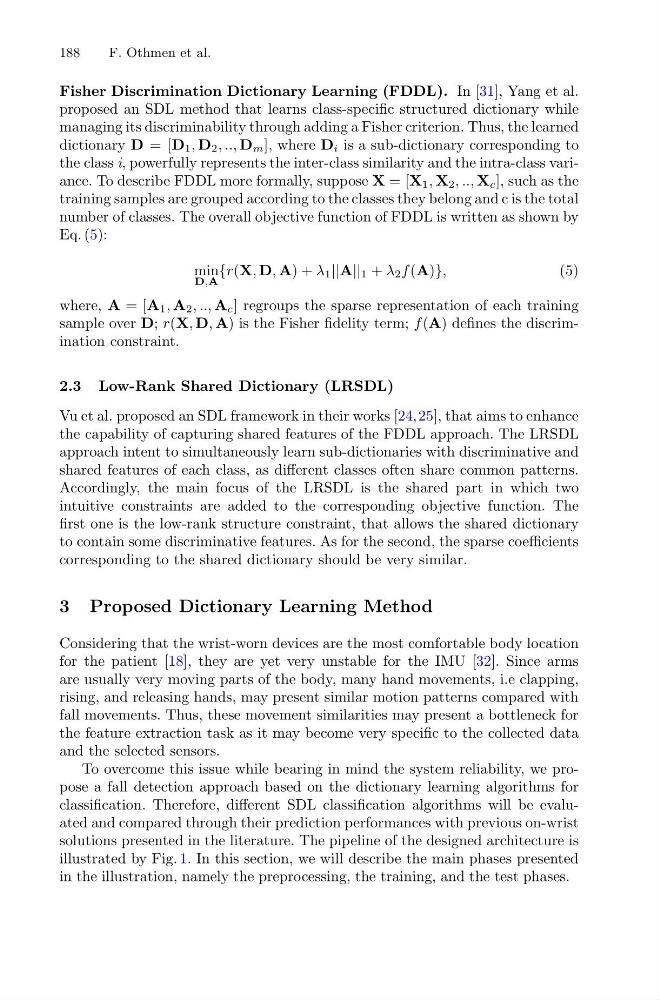
min
D,A
{r(X, D, A) + λ 1 ||A|| 1 + λ 2 f (A)},
(5)
where, A = [A 1 , A 2 , .., A c ] regroups the sparse representation of each training
sample over D; r(X, D, A) is the Fisher fidelity term; f (A) defines the discrimination constraint.
2.3 Low-Rank Shared Dictionary (LRSDL)
Vu et al. proposed an SDL framework in their works [24,25], that aims to enhance
the capability of capturing shared features of the FDDL approach. The LRSDL
approach intent to simultaneously learn sub-dictionaries with discriminative and
shared features of each class, as different classes often share common patterns.
Accordingly, the main focus of the LRSDL is the shared part in which two
intuitive constraints are added to the corresponding objective function. The
first one is the low-rank structure constraint, that allows the shared dictionary
to contain some discriminative features. As for the second, the sparse coefficients
corresponding to the shared dictionary should be very similar.
3 Proposed Dictionary Learning Method
Considering that the wrist-worn devices are the most comfortable body location
for the patient [18], they are yet very unstable for the IMU [32]. Since arms
are usually very moving parts of the body, many hand movements, i.e clapping,
rising, and releasing hands, may present similar motion patterns compared with
fall movements. Thus, these movement similarities may present a bottleneck for
the feature extraction task as it may become very specific to the collected data
and the selected sensors.
To overcome this issue while bearing in mind the system reliability, we propose a fall detection approach based on the dictionary learning algorithms for
classification. Therefore, different SDL classification algorithms will be evaluated and compared through their prediction performances with previous on-wrist
solutions presented in the literature. The pipeline of the designed architecture is
illustrated by Fig. 1. In this section, we will describe the main phases presented
in the illustration, namely the preprocessing, the training, and the test phases.
F. Othmen et al.
Fisher Discrimination Dictionary Learning (FDDL). In [31], Yang et al.
proposed an SDL method that learns class-specific structured dictionary while
managing its discriminability through adding a Fisher criterion. Thus, the learned
dictionary D = [D 1 , D 2 , .., D m ], where D i is a sub-dictionary corresponding to
the class i, powerfully represents the inter-class similarity and the intra-class variance. To describe FDDL more formally, suppose X = [X 1 , X 2 , .., X c ], such as the
training samples are grouped according to the classes they belong and c is the total
number of classes. The overall objective function of FDDL is written as shown by
Eq. (5):
min
D,A
{r(X, D, A) + λ 1 ||A|| 1 + λ 2 f (A)},
(5)
where, A = [A 1 , A 2 , .., A c ] regroups the sparse representation of each training
sample over D; r(X, D, A) is the Fisher fidelity term; f (A) defines the discrimination constraint.
2.3 Low-Rank Shared Dictionary (LRSDL)
Vu et al. proposed an SDL framework in their works [24,25], that aims to enhance
the capability of capturing shared features of the FDDL approach. The LRSDL
approach intent to simultaneously learn sub-dictionaries with discriminative and
shared features of each class, as different classes often share common patterns.
Accordingly, the main focus of the LRSDL is the shared part in which two
intuitive constraints are added to the corresponding objective function. The
first one is the low-rank structure constraint, that allows the shared dictionary
to contain some discriminative features. As for the second, the sparse coefficients
corresponding to the shared dictionary should be very similar.
3 Proposed Dictionary Learning Method
Considering that the wrist-worn devices are the most comfortable body location
for the patient [18], they are yet very unstable for the IMU [32]. Since arms
are usually very moving parts of the body, many hand movements, i.e clapping,
rising, and releasing hands, may present similar motion patterns compared with
fall movements. Thus, these movement similarities may present a bottleneck for
the feature extraction task as it may become very specific to the collected data
and the selected sensors.
To overcome this issue while bearing in mind the system reliability, we propose a fall detection approach based on the dictionary learning algorithms for
classification. Therefore, different SDL classification algorithms will be evaluated and compared through their prediction performances with previous on-wrist
solutions presented in the literature. The pipeline of the designed architecture is
illustrated by Fig. 1. In this section, we will describe the main phases presented
in the illustration, namely the preprocessing, the training, and the test phases.