

A Novel On-Wrist Fall Detection System Using SDL Technique
187
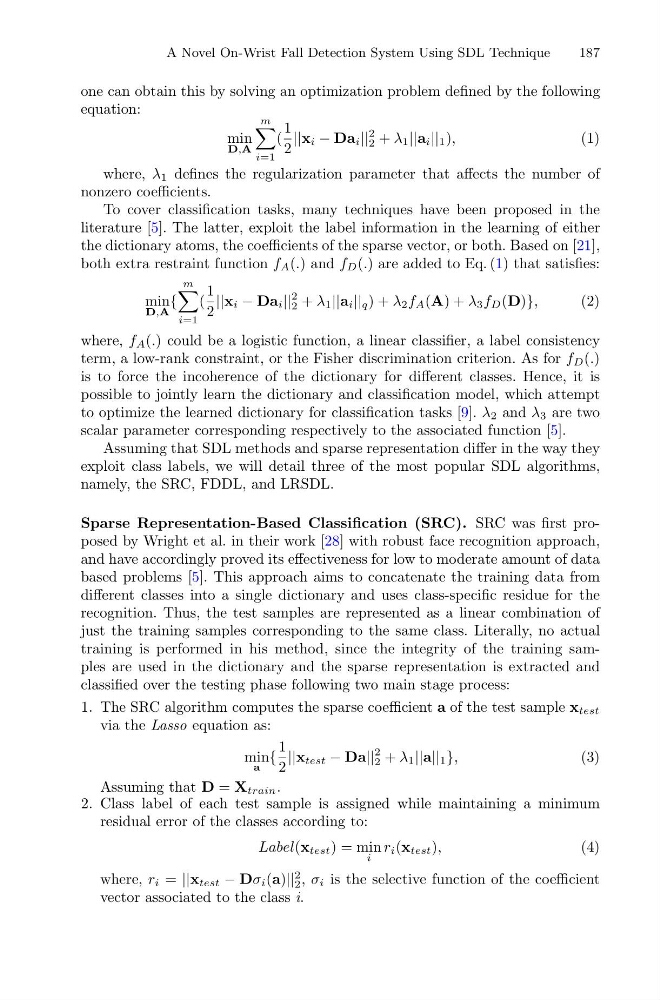
one can obtain this by solving an optimization problem defined by the following
equation:
min
D,A
m
i=1
(
1
2
||x i − Da i ||
2
2 + λ 1 ||a i || 1 ),
(1)
where, λ 1 defines the regularization parameter that affects the number of
nonzero coefficients.
To cover classification tasks, many techniques have been proposed in the
literature [5]. The latter, exploit the label information in the learning of either
the dictionary atoms, the coefficients of the sparse vector, or both. Based on [21],
both extra restraint function f A (.) and f D (.) are added to Eq. (1) that satisfies:
min
D,A
{
m
i=1
(
1
2
||x i − Da i ||
2
2 + λ 1 ||a i || q ) + λ 2 f A (A) + λ 3 f D (D)},
(2)
where, f A (.) could be a logistic function, a linear classifier, a label consistency
term, a low-rank constraint, or the Fisher discrimination criterion. As for f D (.)
is to force the incoherence of the dictionary for different classes. Hence, it is
possible to jointly learn the dictionary and classification model, which attempt
to optimize the learned dictionary for classification tasks [9]. λ 2 and λ 3 are two
scalar parameter corresponding respectively to the associated function [5].
Assuming that SDL methods and sparse representation differ in the way they
exploit class labels, we will detail three of the most popular SDL algorithms,
namely, the SRC, FDDL, and LRSDL.
Sparse Representation-Based Classification (SRC). SRC was first proposed by Wright et al. in their work [28] with robust face recognition approach,
and have accordingly proved its effectiveness for low to moderate amount of data
based problems [5]. This approach aims to concatenate the training data from
different classes into a single dictionary and uses class-specific residue for the
recognition. Thus, the test samples are represented as a linear combination of
just the training samples corresponding to the same class. Literally, no actual
training is performed in his method, since the integrity of the training samples are used in the dictionary and the sparse representation is extracted and
classified over the testing phase following two main stage process:
1. The SRC algorithm computes the sparse coefficient a of the test sample x test
via the Lasso equation as:
min
a
{
1
2
||x test − Da||
2
2 + λ 1 ||a|| 1 },
(3)
Assuming that D = X train .
2. Class label of each test sample is assigned while maintaining a minimum
residual error of the classes according to:
Label(x test ) = min
i
r i (x test ),
(4)
where, r i = ||x test − Dσ i (a)||
2
2 , σ i is the selective function of the coefficient
vector associated to the class i.
187
one can obtain this by solving an optimization problem defined by the following
equation:
min
D,A
m
i=1
(
1
2
||x i − Da i ||
2
2 + λ 1 ||a i || 1 ),
(1)
where, λ 1 defines the regularization parameter that affects the number of
nonzero coefficients.
To cover classification tasks, many techniques have been proposed in the
literature [5]. The latter, exploit the label information in the learning of either
the dictionary atoms, the coefficients of the sparse vector, or both. Based on [21],
both extra restraint function f A (.) and f D (.) are added to Eq. (1) that satisfies:
min
D,A
{
m
i=1
(
1
2
||x i − Da i ||
2
2 + λ 1 ||a i || q ) + λ 2 f A (A) + λ 3 f D (D)},
(2)
where, f A (.) could be a logistic function, a linear classifier, a label consistency
term, a low-rank constraint, or the Fisher discrimination criterion. As for f D (.)
is to force the incoherence of the dictionary for different classes. Hence, it is
possible to jointly learn the dictionary and classification model, which attempt
to optimize the learned dictionary for classification tasks [9]. λ 2 and λ 3 are two
scalar parameter corresponding respectively to the associated function [5].
Assuming that SDL methods and sparse representation differ in the way they
exploit class labels, we will detail three of the most popular SDL algorithms,
namely, the SRC, FDDL, and LRSDL.
Sparse Representation-Based Classification (SRC). SRC was first proposed by Wright et al. in their work [28] with robust face recognition approach,
and have accordingly proved its effectiveness for low to moderate amount of data
based problems [5]. This approach aims to concatenate the training data from
different classes into a single dictionary and uses class-specific residue for the
recognition. Thus, the test samples are represented as a linear combination of
just the training samples corresponding to the same class. Literally, no actual
training is performed in his method, since the integrity of the training samples are used in the dictionary and the sparse representation is extracted and
classified over the testing phase following two main stage process:
1. The SRC algorithm computes the sparse coefficient a of the test sample x test
via the Lasso equation as:
min
a
{
1
2
||x test − Da||
2
2 + λ 1 ||a|| 1 },
(3)
Assuming that D = X train .
2. Class label of each test sample is assigned while maintaining a minimum
residual error of the classes according to:
Label(x test ) = min
i
r i (x test ),
(4)
where, r i = ||x test − Dσ i (a)||
2
2 , σ i is the selective function of the coefficient
vector associated to the class i.