

Our persuasion strategy is therefore personalized in the sense that it respects abilities,
habits, choices, health situation, context, etc. of the person being followed.
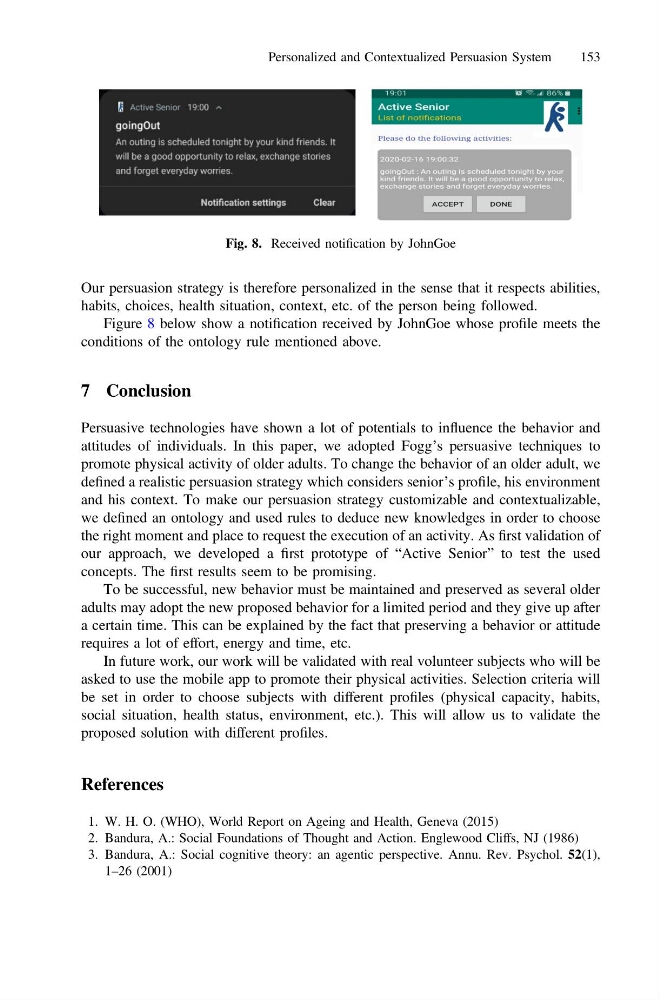
Figure 8 below show a notification received by JohnGoe whose profile meets the
conditions of the ontology rule mentioned above.
7 Conclusion
Persuasive technologies have shown a lot of potentials to influence the behavior and
attitudes of individuals. In this paper, we adopted Fogg’s persuasive techniques to
promote physical activity of older adults. To change the behavior of an older adult, we
defined a realistic persuasion strategy which considers senior’s profile, his environment
and his context. To make our persuasion strategy customizable and contextualizable,
we defined an ontology and used rules to deduce new knowledges in order to choose
the right moment and place to request the execution of an activity. As first validation of
our approach, we developed a first prototype of “Active Senior” to test the used
concepts. The first results seem to be promising.
To be successful, new behavior must be maintained and preserved as several older
adults may adopt the new proposed behavior for a limited period and they give up after
a certain time. This can be explained by the fact that preserving a behavior or attitude
requires a lot of effort, energy and time, etc.
In future work, our work will be validated with real volunteer subjects who will be
asked to use the mobile app to promote their physical activities. Selection criteria will
be set in order to choose subjects with different profiles (physical capacity, habits,
social situation, health status, environment, etc.). This will allow us to validate the
proposed solution with different profiles.
References
1. W. H. O. (WHO), World Report on Ageing and Health, Geneva (2015)
2. Bandura, A.: Social Foundations of Thought and Action. Englewood Cliffs, NJ (1986)
3. Bandura, A.: Social cognitive theory: an agentic perspective. Annu. Rev. Psychol. 52(1),
1–26 (2001)
Fig. 8. Received notification by JohnGoe
Personalized and Contextualized Persuasion System
153
habits, choices, health situation, context, etc. of the person being followed.
Figure 8 below show a notification received by JohnGoe whose profile meets the
conditions of the ontology rule mentioned above.
7 Conclusion
Persuasive technologies have shown a lot of potentials to influence the behavior and
attitudes of individuals. In this paper, we adopted Fogg’s persuasive techniques to
promote physical activity of older adults. To change the behavior of an older adult, we
defined a realistic persuasion strategy which considers senior’s profile, his environment
and his context. To make our persuasion strategy customizable and contextualizable,
we defined an ontology and used rules to deduce new knowledges in order to choose
the right moment and place to request the execution of an activity. As first validation of
our approach, we developed a first prototype of “Active Senior” to test the used
concepts. The first results seem to be promising.
To be successful, new behavior must be maintained and preserved as several older
adults may adopt the new proposed behavior for a limited period and they give up after
a certain time. This can be explained by the fact that preserving a behavior or attitude
requires a lot of effort, energy and time, etc.
In future work, our work will be validated with real volunteer subjects who will be
asked to use the mobile app to promote their physical activities. Selection criteria will
be set in order to choose subjects with different profiles (physical capacity, habits,
social situation, health status, environment, etc.). This will allow us to validate the
proposed solution with different profiles.
References
1. W. H. O. (WHO), World Report on Ageing and Health, Geneva (2015)
2. Bandura, A.: Social Foundations of Thought and Action. Englewood Cliffs, NJ (1986)
3. Bandura, A.: Social cognitive theory: an agentic perspective. Annu. Rev. Psychol. 52(1),
1–26 (2001)
Fig. 8. Received notification by JohnGoe
Personalized and Contextualized Persuasion System
153