

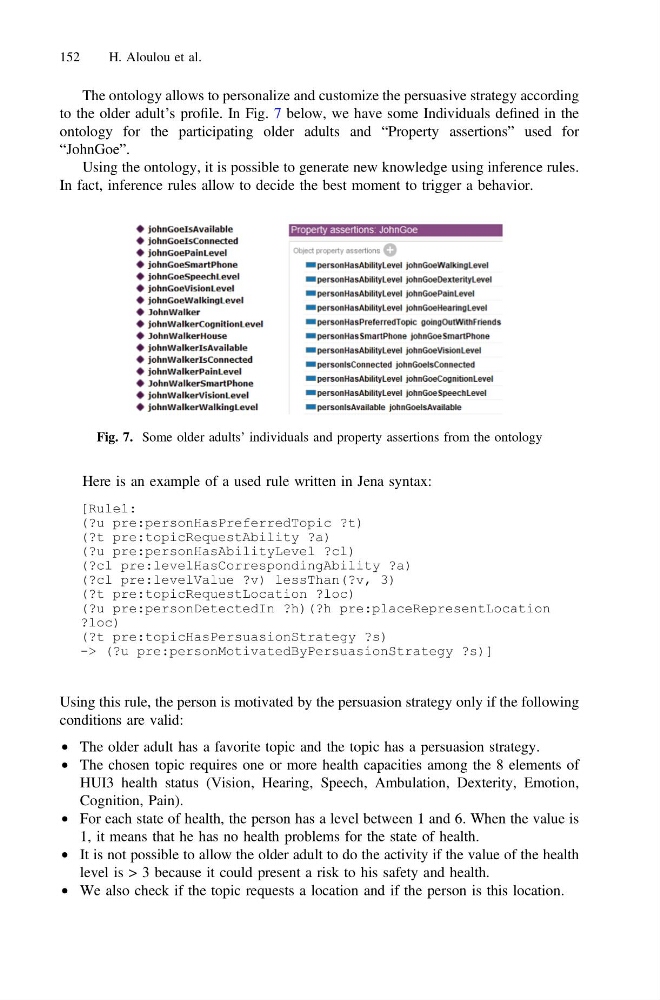
The ontology allows to personalize and customize the persuasive strategy according
to the older adult’s profile. In Fig. 7 below, we have some Individuals defined in the
ontology for the participating older adults and “Property assertions” used for
“JohnGoe”.
Using the ontology, it is possible to generate new knowledge using inference rules.
In fact, inference rules allow to decide the best moment to trigger a behavior.
Here is an example of a used rule written in Jena syntax:
[Rule1:
(?u pre:personHasPreferredTopic ?t)
(?t pre:topicRequestAbility ?a)
(?u pre:personHasAbilityLevel ?cl)
(?cl pre:levelHasCorrespondingAbility ?a)
(?cl pre:levelValue ?v) lessThan(?v, 3)
(?t pre:topicRequestLocation ?loc)
(?u pre:personDetectedIn ?h)(?h pre:placeRepresentLocation
?loc)
(?t pre:topicHasPersuasionStrategy ?s)
-> (?u pre:personMotivatedByPersuasionStrategy ?s)]
Using this rule, the person is motivated by the persuasion strategy only if the following
conditions are valid:
• The older adult has a favorite topic and the topic has a persuasion strategy.
• The chosen topic requires one or more health capacities among the 8 elements of
HUI3 health status (Vision, Hearing, Speech, Ambulation, Dexterity, Emotion,
Cognition, Pain).
• For each state of health, the person has a level between 1 and 6. When the value is
1, it means that he has no health problems for the state of health.
• It is not possible to allow the older adult to do the activity if the value of the health
level is > 3 because it could present a risk to his safety and health.
• We also check if the topic requests a location and if the person is this location.
Fig. 7. Some older adults’ individuals and property assertions from the ontology
152
H. Aloulou et al.
to the older adult’s profile. In Fig. 7 below, we have some Individuals defined in the
ontology for the participating older adults and “Property assertions” used for
“JohnGoe”.
Using the ontology, it is possible to generate new knowledge using inference rules.
In fact, inference rules allow to decide the best moment to trigger a behavior.
Here is an example of a used rule written in Jena syntax:
[Rule1:
(?u pre:personHasPreferredTopic ?t)
(?t pre:topicRequestAbility ?a)
(?u pre:personHasAbilityLevel ?cl)
(?cl pre:levelHasCorrespondingAbility ?a)
(?cl pre:levelValue ?v) lessThan(?v, 3)
(?t pre:topicRequestLocation ?loc)
(?u pre:personDetectedIn ?h)(?h pre:placeRepresentLocation
?loc)
(?t pre:topicHasPersuasionStrategy ?s)
-> (?u pre:personMotivatedByPersuasionStrategy ?s)]
Using this rule, the person is motivated by the persuasion strategy only if the following
conditions are valid:
• The older adult has a favorite topic and the topic has a persuasion strategy.
• The chosen topic requires one or more health capacities among the 8 elements of
HUI3 health status (Vision, Hearing, Speech, Ambulation, Dexterity, Emotion,
Cognition, Pain).
• For each state of health, the person has a level between 1 and 6. When the value is
1, it means that he has no health problems for the state of health.
• It is not possible to allow the older adult to do the activity if the value of the health
level is > 3 because it could present a risk to his safety and health.
• We also check if the topic requests a location and if the person is this location.
Fig. 7. Some older adults’ individuals and property assertions from the ontology
152
H. Aloulou et al.