

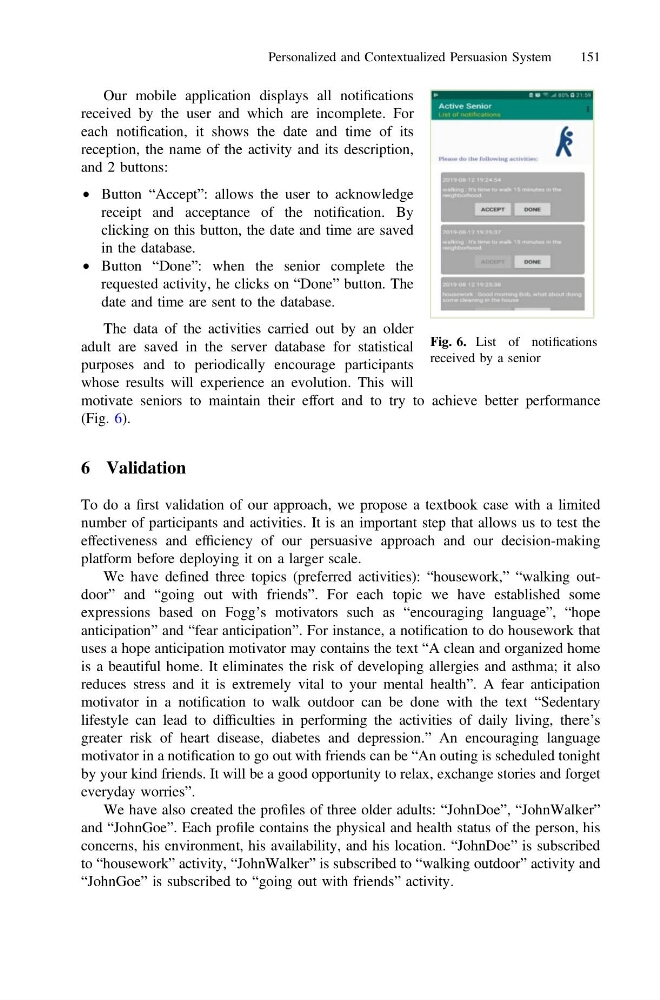
Our mobile application displays all notifications
received by the user and which are incomplete. For
each notification, it shows the date and time of its
reception, the name of the activity and its description,
and 2 buttons:
• Button “Accept”: allows the user to acknowledge
receipt and acceptance of the notification. By
clicking on this button, the date and time are saved
in the database.
• Button “Done”: when the senior complete the
requested activity, he clicks on “Done” button. The
date and time are sent to the database.
The data of the activities carried out by an older
adult are saved in the server database for statistical
purposes and to periodically encourage participants
whose results will experience an evolution. This will
motivate seniors to maintain their effort and to try to achieve better performance
(Fig. 6).
6 Validation
To do a first validation of our approach, we propose a textbook case with a limited
number of participants and activities. It is an important step that allows us to test the
effectiveness and efficiency of our persuasive approach and our decision-making
platform before deploying it on a larger scale.
We have defined three topics (preferred activities): “housework,” “walking outdoor” and “going out with friends”. For each topic we have established some
expressions based on Fogg’s motivators such as “encouraging language”, “hope
anticipation” and “fear anticipation”. For instance, a notification to do housework that
uses a hope anticipation motivator may contains the text “A clean and organized home
is a beautiful home. It eliminates the risk of developing allergies and asthma; it also
reduces stress and it is extremely vital to your mental health”. A fear anticipation
motivator in a notification to walk outdoor can be done with the text “Sedentary
lifestyle can lead to difficulties in performing the activities of daily living, there’s
greater risk of heart disease, diabetes and depression.” An encouraging language
motivator in a notification to go out with friends can be “An outing is scheduled tonight
by your kind friends. It will be a good opportunity to relax, exchange stories and forget
everyday worries”.
We have also created the profiles of three older adults: “JohnDoe”, “JohnWalker”
and “JohnGoe”. Each profile contains the physical and health status of the person, his
concerns, his environment, his availability, and his location. “JohnDoe” is subscribed
to “housework” activity, “JohnWalker” is subscribed to “walking outdoor” activity and
“JohnGoe” is subscribed to “going out with friends” activity.
Fig. 6. List of notifications
received by a senior
Personalized and Contextualized Persuasion System
151
received by the user and which are incomplete. For
each notification, it shows the date and time of its
reception, the name of the activity and its description,
and 2 buttons:
• Button “Accept”: allows the user to acknowledge
receipt and acceptance of the notification. By
clicking on this button, the date and time are saved
in the database.
• Button “Done”: when the senior complete the
requested activity, he clicks on “Done” button. The
date and time are sent to the database.
The data of the activities carried out by an older
adult are saved in the server database for statistical
purposes and to periodically encourage participants
whose results will experience an evolution. This will
motivate seniors to maintain their effort and to try to achieve better performance
(Fig. 6).
6 Validation
To do a first validation of our approach, we propose a textbook case with a limited
number of participants and activities. It is an important step that allows us to test the
effectiveness and efficiency of our persuasive approach and our decision-making
platform before deploying it on a larger scale.
We have defined three topics (preferred activities): “housework,” “walking outdoor” and “going out with friends”. For each topic we have established some
expressions based on Fogg’s motivators such as “encouraging language”, “hope
anticipation” and “fear anticipation”. For instance, a notification to do housework that
uses a hope anticipation motivator may contains the text “A clean and organized home
is a beautiful home. It eliminates the risk of developing allergies and asthma; it also
reduces stress and it is extremely vital to your mental health”. A fear anticipation
motivator in a notification to walk outdoor can be done with the text “Sedentary
lifestyle can lead to difficulties in performing the activities of daily living, there’s
greater risk of heart disease, diabetes and depression.” An encouraging language
motivator in a notification to go out with friends can be “An outing is scheduled tonight
by your kind friends. It will be a good opportunity to relax, exchange stories and forget
everyday worries”.
We have also created the profiles of three older adults: “JohnDoe”, “JohnWalker”
and “JohnGoe”. Each profile contains the physical and health status of the person, his
concerns, his environment, his availability, and his location. “JohnDoe” is subscribed
to “housework” activity, “JohnWalker” is subscribed to “walking outdoor” activity and
“JohnGoe” is subscribed to “going out with friends” activity.
Fig. 6. List of notifications
received by a senior
Personalized and Contextualized Persuasion System
151