

the list of notifications received by all participants and information whether the activity
has been done or not yet by corresponding person. In fact, when receiving a notification
to do a behavior on mobile app, an older adult can inform the server that he accepts to
do the behavior and he can inform it when the behavior is done. All information about
notifications, the deadline for accepting the activity and carrying it out are stored in the
database for statistics purpose.
We have defined a new ontology to be able to offer older adults contextualized
activities. We have saved our ontology in OWL format which provides a rich
vocabulary to add semantics and context and to allow reasoning and inference. Below
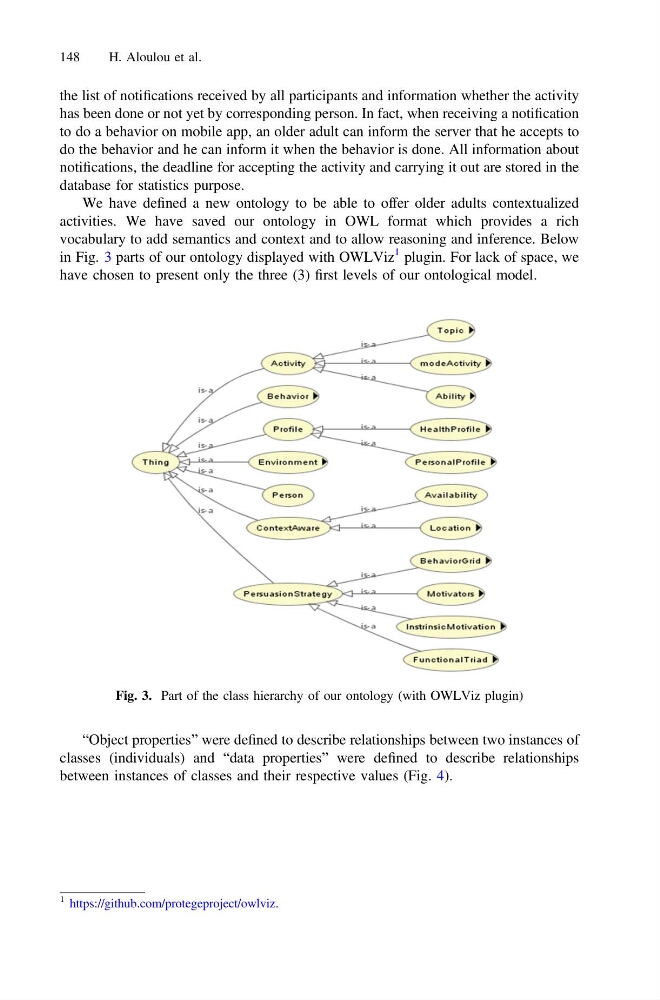
in Fig. 3 parts of our ontology displayed with OWLViz
1 plugin. For lack of space, we
have chosen to present only the three (3) first levels of our ontological model.
“Object properties” were defined to describe relationships between two instances of
classes (individuals) and “data properties” were defined to describe relationships
between instances of classes and their respective values (Fig. 4).
Fig. 3. Part of the class hierarchy of our ontology (with OWLViz plugin)
1 https://github.com/protegeproject/owlviz.
148
H. Aloulou et al.
has been done or not yet by corresponding person. In fact, when receiving a notification
to do a behavior on mobile app, an older adult can inform the server that he accepts to
do the behavior and he can inform it when the behavior is done. All information about
notifications, the deadline for accepting the activity and carrying it out are stored in the
database for statistics purpose.
We have defined a new ontology to be able to offer older adults contextualized
activities. We have saved our ontology in OWL format which provides a rich
vocabulary to add semantics and context and to allow reasoning and inference. Below
in Fig. 3 parts of our ontology displayed with OWLViz
1 plugin. For lack of space, we
have chosen to present only the three (3) first levels of our ontological model.
“Object properties” were defined to describe relationships between two instances of
classes (individuals) and “data properties” were defined to describe relationships
between instances of classes and their respective values (Fig. 4).
Fig. 3. Part of the class hierarchy of our ontology (with OWLViz plugin)
1 https://github.com/protegeproject/owlviz.
148
H. Aloulou et al.