

hope for a healthy aging. Also, all the 6 factors for maximal ability (time, money,
physical effort, brain cycles, social deviance, and non-routine) are considered in our
reasoning and persuasion strategy.
4 Proposed Architecture
The connectivity and portability of smartphones makes possible to reach older adults at
any time and place using automated notifications. All notifications and encouragement
for an older adult are posted on his smartphone via a mobile app. In addition, this app
enables collecting information on senior behavior and sent them instantly to a remote
decision-making platform via Internet. The platform filters and processes collected
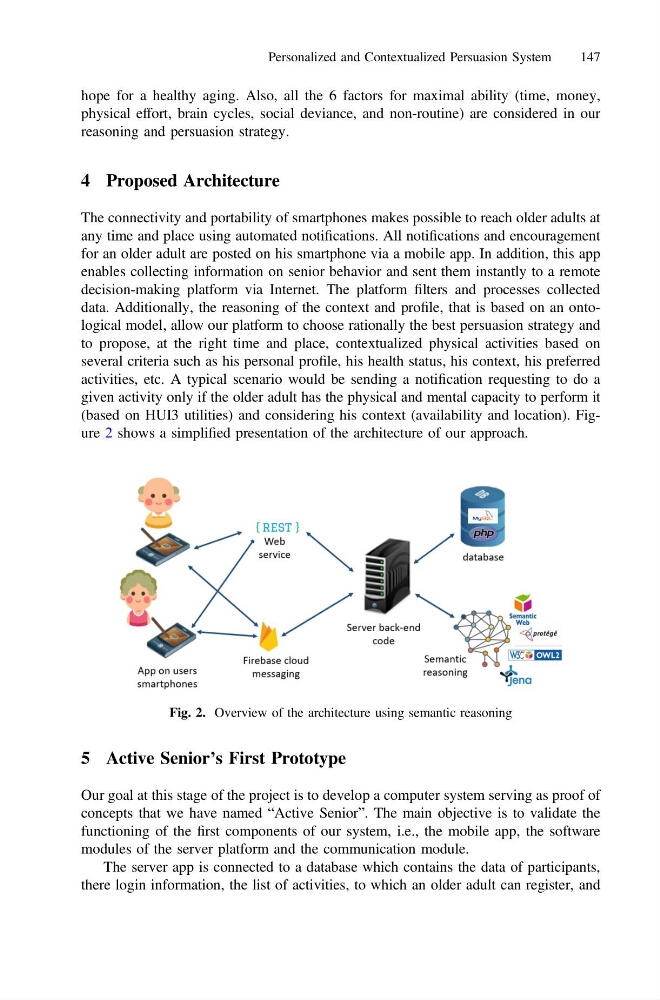
data. Additionally, the reasoning of the context and profile, that is based on an ontological model, allow our platform to choose rationally the best persuasion strategy and
to propose, at the right time and place, contextualized physical activities based on
several criteria such as his personal profile, his health status, his context, his preferred
activities, etc. A typical scenario would be sending a notification requesting to do a
given activity only if the older adult has the physical and mental capacity to perform it
(based on HUI3 utilities) and considering his context (availability and location). Figure 2 shows a simplified presentation of the architecture of our approach.
5 Active Senior’s First Prototype
Our goal at this stage of the project is to develop a computer system serving as proof of
concepts that we have named “Active Senior”. The main objective is to validate the
functioning of the first components of our system, i.e., the mobile app, the software
modules of the server platform and the communication module.
The server app is connected to a database which contains the data of participants,
there login information, the list of activities, to which an older adult can register, and
Fig. 2. Overview of the architecture using semantic reasoning
Personalized and Contextualized Persuasion System
147
physical effort, brain cycles, social deviance, and non-routine) are considered in our
reasoning and persuasion strategy.
4 Proposed Architecture
The connectivity and portability of smartphones makes possible to reach older adults at
any time and place using automated notifications. All notifications and encouragement
for an older adult are posted on his smartphone via a mobile app. In addition, this app
enables collecting information on senior behavior and sent them instantly to a remote
decision-making platform via Internet. The platform filters and processes collected
data. Additionally, the reasoning of the context and profile, that is based on an ontological model, allow our platform to choose rationally the best persuasion strategy and
to propose, at the right time and place, contextualized physical activities based on
several criteria such as his personal profile, his health status, his context, his preferred
activities, etc. A typical scenario would be sending a notification requesting to do a
given activity only if the older adult has the physical and mental capacity to perform it
(based on HUI3 utilities) and considering his context (availability and location). Figure 2 shows a simplified presentation of the architecture of our approach.
5 Active Senior’s First Prototype
Our goal at this stage of the project is to develop a computer system serving as proof of
concepts that we have named “Active Senior”. The main objective is to validate the
functioning of the first components of our system, i.e., the mobile app, the software
modules of the server platform and the communication module.
The server app is connected to a database which contains the data of participants,
there login information, the list of activities, to which an older adult can register, and
Fig. 2. Overview of the architecture using semantic reasoning
Personalized and Contextualized Persuasion System
147