

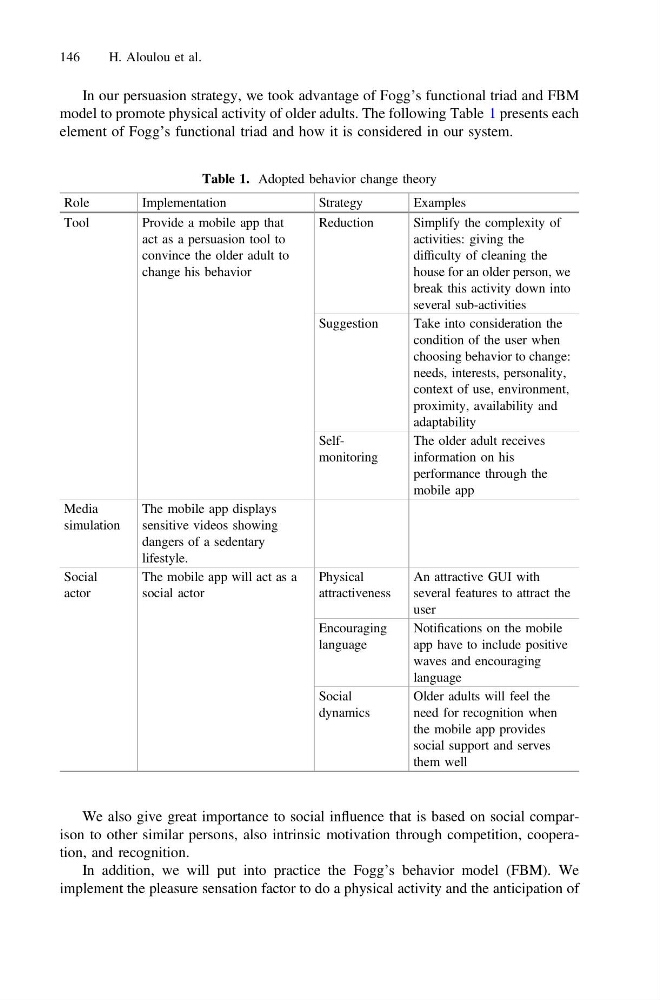
In our persuasion strategy, we took advantage of Fogg’s functional triad and FBM
model to promote physical activity of older adults. The following Table 1 presents each
element of Fogg’s functional triad and how it is considered in our system.
We also give great importance to social influence that is based on social comparison to other similar persons, also intrinsic motivation through competition, cooperation, and recognition.
In addition, we will put into practice the Fogg’s behavior model (FBM). We
implement the pleasure sensation factor to do a physical activity and the anticipation of
Table 1. Adopted behavior change theory
Role
Implementation
Strategy
Examples
Tool
Provide a mobile app that
act as a persuasion tool to
convince the older adult to
change his behavior
Reduction
Simplify the complexity of
activities: giving the
difficulty of cleaning the
house for an older person, we
break this activity down into
several sub-activities
Suggestion
Take into consideration the
condition of the user when
choosing behavior to change:
needs, interests, personality,
context of use, environment,
proximity, availability and
adaptability
Selfmonitoring
The older adult receives
information on his
performance through the
mobile app
Media
simulation
The mobile app displays
sensitive videos showing
dangers of a sedentary
lifestyle.
Social
actor
The mobile app will act as a
social actor
Physical
attractiveness
An attractive GUI with
several features to attract the
user
Encouraging
language
Notifications on the mobile
app have to include positive
waves and encouraging
language
Social
dynamics
Older adults will feel the
need for recognition when
the mobile app provides
social support and serves
them well
146
H. Aloulou et al.
model to promote physical activity of older adults. The following Table 1 presents each
element of Fogg’s functional triad and how it is considered in our system.
We also give great importance to social influence that is based on social comparison to other similar persons, also intrinsic motivation through competition, cooperation, and recognition.
In addition, we will put into practice the Fogg’s behavior model (FBM). We
implement the pleasure sensation factor to do a physical activity and the anticipation of
Table 1. Adopted behavior change theory
Role
Implementation
Strategy
Examples
Tool
Provide a mobile app that
act as a persuasion tool to
convince the older adult to
change his behavior
Reduction
Simplify the complexity of
activities: giving the
difficulty of cleaning the
house for an older person, we
break this activity down into
several sub-activities
Suggestion
Take into consideration the
condition of the user when
choosing behavior to change:
needs, interests, personality,
context of use, environment,
proximity, availability and
adaptability
Selfmonitoring
The older adult receives
information on his
performance through the
mobile app
Media
simulation
The mobile app displays
sensitive videos showing
dangers of a sedentary
lifestyle.
Social
actor
The mobile app will act as a
social actor
Physical
attractiveness
An attractive GUI with
several features to attract the
user
Encouraging
language
Notifications on the mobile
app have to include positive
waves and encouraging
language
Social
dynamics
Older adults will feel the
need for recognition when
the mobile app provides
social support and serves
them well
146
H. Aloulou et al.