

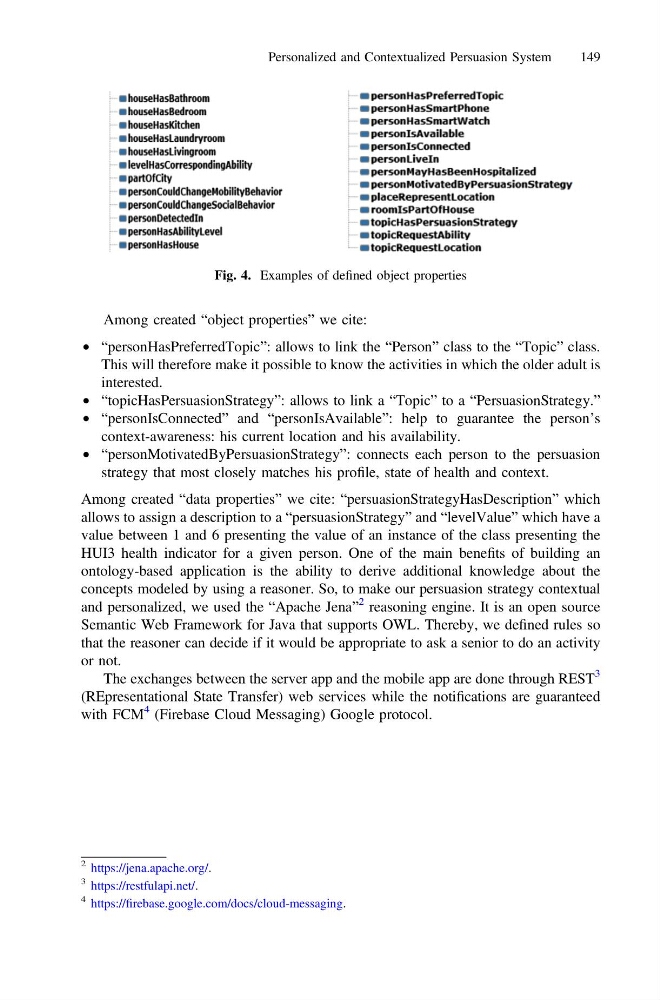
Among created “object properties” we cite:
• “personHasPreferredTopic”: allows to link the “Person” class to the “Topic” class.
This will therefore make it possible to know the activities in which the older adult is
interested.
• “topicHasPersuasionStrategy”: allows to link a “Topic” to a “PersuasionStrategy.”
• “personIsConnected” and “personIsAvailable”: help to guarantee the person’s
context-awareness: his current location and his availability.
• “personMotivatedByPersuasionStrategy”: connects each person to the persuasion
strategy that most closely matches his profile, state of health and context.
Among created “data properties” we cite: “persuasionStrategyHasDescription” which
allows to assign a description to a “persuasionStrategy” and “levelValue” which have a
value between 1 and 6 presenting the value of an instance of the class presenting the
HUI3 health indicator for a given person. One of the main benefits of building an
ontology-based application is the ability to derive additional knowledge about the
concepts modeled by using a reasoner. So, to make our persuasion strategy contextual
and personalized, we used the “Apache Jena”
2 reasoning engine. It is an open source
Semantic Web Framework for Java that supports OWL. Thereby, we defined rules so
that the reasoner can decide if it would be appropriate to ask a senior to do an activity
or not.
The exchanges between the server app and the mobile app are done through REST
3
(REpresentational State Transfer) web services while the notifications are guaranteed
with FCM
4 (Firebase Cloud Messaging) Google protocol.
Fig. 4. Examples of defined object properties
2 https://jena.apache.org/.
3 https://restfulapi.net/.
4 https://firebase.google.com/docs/cloud-messaging.
Personalized and Contextualized Persuasion System
149
• “personHasPreferredTopic”: allows to link the “Person” class to the “Topic” class.
This will therefore make it possible to know the activities in which the older adult is
interested.
• “topicHasPersuasionStrategy”: allows to link a “Topic” to a “PersuasionStrategy.”
• “personIsConnected” and “personIsAvailable”: help to guarantee the person’s
context-awareness: his current location and his availability.
• “personMotivatedByPersuasionStrategy”: connects each person to the persuasion
strategy that most closely matches his profile, state of health and context.
Among created “data properties” we cite: “persuasionStrategyHasDescription” which
allows to assign a description to a “persuasionStrategy” and “levelValue” which have a
value between 1 and 6 presenting the value of an instance of the class presenting the
HUI3 health indicator for a given person. One of the main benefits of building an
ontology-based application is the ability to derive additional knowledge about the
concepts modeled by using a reasoner. So, to make our persuasion strategy contextual
and personalized, we used the “Apache Jena”
2 reasoning engine. It is an open source
Semantic Web Framework for Java that supports OWL. Thereby, we defined rules so
that the reasoner can decide if it would be appropriate to ask a senior to do an activity
or not.
The exchanges between the server app and the mobile app are done through REST
3
(REpresentational State Transfer) web services while the notifications are guaranteed
with FCM
4 (Firebase Cloud Messaging) Google protocol.
Fig. 4. Examples of defined object properties
2 https://jena.apache.org/.
3 https://restfulapi.net/.
4 https://firebase.google.com/docs/cloud-messaging.
Personalized and Contextualized Persuasion System
149