

122
A. Jlassi et al.
– The precision (9) is the ratio of correctly predicted positive samples to the
total predicted positive samples.
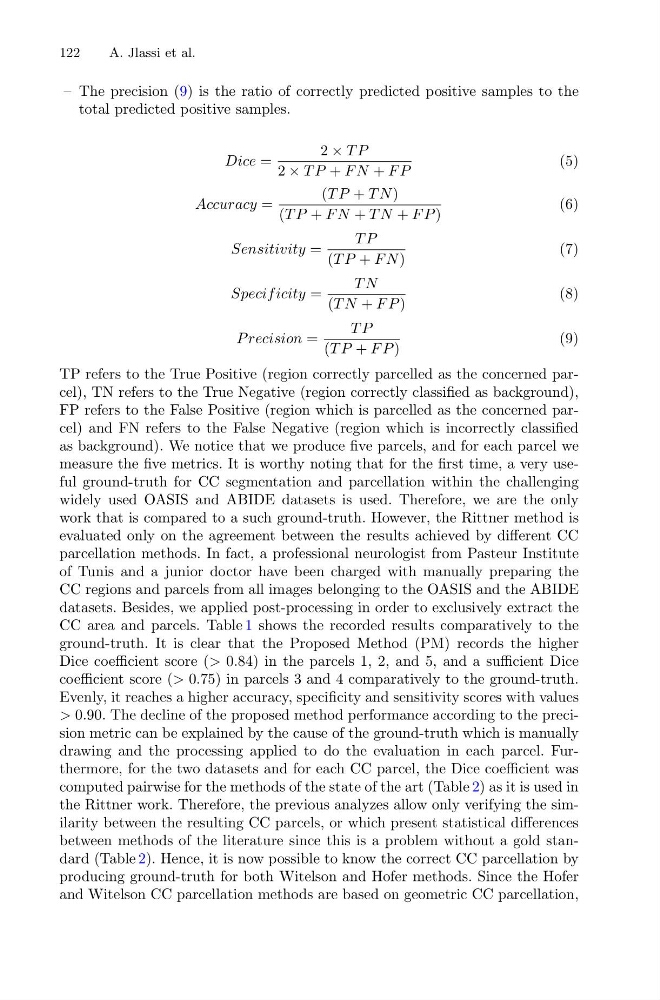
Dice =
2 × T P
2 × T P + F N + F P
(5)
Accuracy =
(T P + T N)
(T P + F N + T N + F P )
(6)
Sensitivity =
T P
(T P + F N)
(7)
Specif icity =
T N
(T N + F P )
(8)
P recision =
T P
(T P + F P )
(9)
TP refers to the True Positive (region correctly parcelled as the concerned parcel), TN refers to the True Negative (region correctly classified as background),
FP refers to the False Positive (region which is parcelled as the concerned parcel) and FN refers to the False Negative (region which is incorrectly classified
as background). We notice that we produce five parcels, and for each parcel we
measure the five metrics. It is worthy noting that for the first time, a very useful ground-truth for CC segmentation and parcellation within the challenging
widely used OASIS and ABIDE datasets is used. Therefore, we are the only
work that is compared to a such ground-truth. However, the Rittner method is
evaluated only on the agreement between the results achieved by different CC
parcellation methods. In fact, a professional neurologist from Pasteur Institute
of Tunis and a junior doctor have been charged with manually preparing the
CC regions and parcels from all images belonging to the OASIS and the ABIDE
datasets. Besides, we applied post-processing in order to exclusively extract the
CC area and parcels. Table 1 shows the recorded results comparatively to the
ground-truth. It is clear that the Proposed Method (PM) records the higher
Dice coefficient score (> 0.84) in the parcels 1, 2, and 5, and a sufficient Dice
coefficient score (> 0.75) in parcels 3 and 4 comparatively to the ground-truth.
Evenly, it reaches a higher accuracy, specificity and sensitivity scores with values
> 0.90. The decline of the proposed method performance according to the precision metric can be explained by the cause of the ground-truth which is manually
drawing and the processing applied to do the evaluation in each parcel. Furthermore, for the two datasets and for each CC parcel, the Dice coefficient was
computed pairwise for the methods of the state of the art (Table 2) as it is used in
the Rittner work. Therefore, the previous analyzes allow only verifying the similarity between the resulting CC parcels, or which present statistical differences
between methods of the literature since this is a problem without a gold standard (Table 2). Hence, it is now possible to know the correct CC parcellation by
producing ground-truth for both Witelson and Hofer methods. Since the Hofer
and Witelson CC parcellation methods are based on geometric CC parcellation,
A. Jlassi et al.
– The precision (9) is the ratio of correctly predicted positive samples to the
total predicted positive samples.
Dice =
2 × T P
2 × T P + F N + F P
(5)
Accuracy =
(T P + T N)
(T P + F N + T N + F P )
(6)
Sensitivity =
T P
(T P + F N)
(7)
Specif icity =
T N
(T N + F P )
(8)
P recision =
T P
(T P + F P )
(9)
TP refers to the True Positive (region correctly parcelled as the concerned parcel), TN refers to the True Negative (region correctly classified as background),
FP refers to the False Positive (region which is parcelled as the concerned parcel) and FN refers to the False Negative (region which is incorrectly classified
as background). We notice that we produce five parcels, and for each parcel we
measure the five metrics. It is worthy noting that for the first time, a very useful ground-truth for CC segmentation and parcellation within the challenging
widely used OASIS and ABIDE datasets is used. Therefore, we are the only
work that is compared to a such ground-truth. However, the Rittner method is
evaluated only on the agreement between the results achieved by different CC
parcellation methods. In fact, a professional neurologist from Pasteur Institute
of Tunis and a junior doctor have been charged with manually preparing the
CC regions and parcels from all images belonging to the OASIS and the ABIDE
datasets. Besides, we applied post-processing in order to exclusively extract the
CC area and parcels. Table 1 shows the recorded results comparatively to the
ground-truth. It is clear that the Proposed Method (PM) records the higher
Dice coefficient score (> 0.84) in the parcels 1, 2, and 5, and a sufficient Dice
coefficient score (> 0.75) in parcels 3 and 4 comparatively to the ground-truth.
Evenly, it reaches a higher accuracy, specificity and sensitivity scores with values
> 0.90. The decline of the proposed method performance according to the precision metric can be explained by the cause of the ground-truth which is manually
drawing and the processing applied to do the evaluation in each parcel. Furthermore, for the two datasets and for each CC parcel, the Dice coefficient was
computed pairwise for the methods of the state of the art (Table 2) as it is used in
the Rittner work. Therefore, the previous analyzes allow only verifying the similarity between the resulting CC parcels, or which present statistical differences
between methods of the literature since this is a problem without a gold standard (Table 2). Hence, it is now possible to know the correct CC parcellation by
producing ground-truth for both Witelson and Hofer methods. Since the Hofer
and Witelson CC parcellation methods are based on geometric CC parcellation,