

Superpixel Segmentation for CC Parcellation in MRI
123
their results did not vary among different subjects throughout the experimented
dataset. This explains this overlap measurement obtained which would have
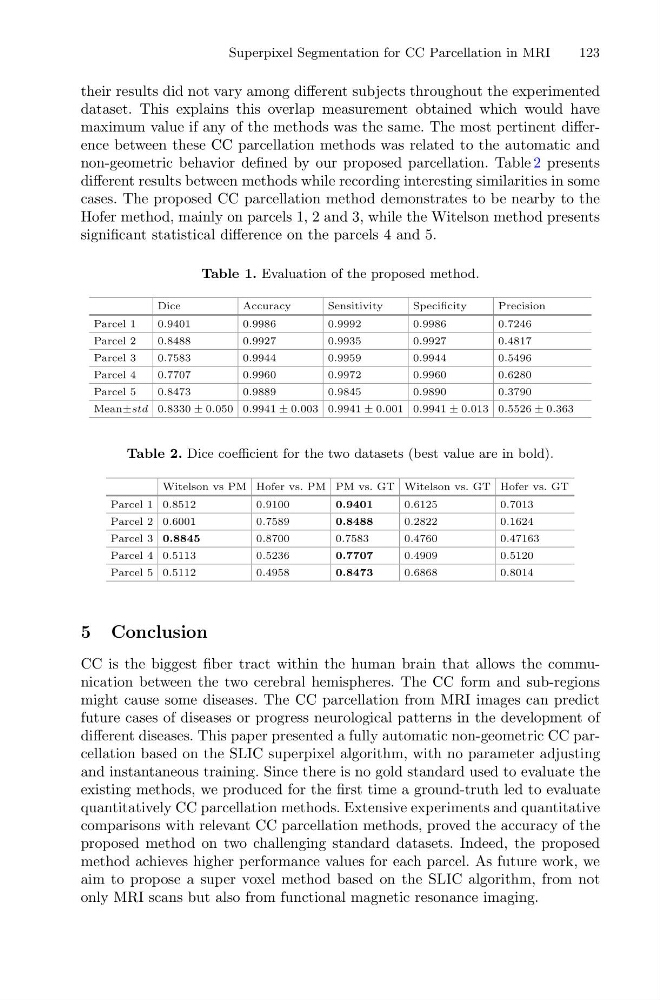
maximum value if any of the methods was the same. The most pertinent difference between these CC parcellation methods was related to the automatic and
non-geometric behavior defined by our proposed parcellation. Table 2 presents
different results between methods while recording interesting similarities in some
cases. The proposed CC parcellation method demonstrates to be nearby to the
Hofer method, mainly on parcels 1, 2 and 3, while the Witelson method presents
significant statistical difference on the parcels 4 and 5.
Table 1. Evaluation of the proposed method.
Dice
Accuracy
Sensitivity
Specificity
Precision
Parcel 1
0.9401
0.9986
0.9992
0.9986
0.7246
Parcel 2
0.8488
0.9927
0.9935
0.9927
0.4817
Parcel 3
0.7583
0.9944
0.9959
0.9944
0.5496
Parcel 4
0.7707
0.9960
0.9972
0.9960
0.6280
Parcel 5
0.8473
0.9889
0.9845
0.9890
0.3790
Mean±std 0.8330 ± 0.050 0.9941 ± 0.003 0.9941 ± 0.001 0.9941 ± 0.013 0.5526 ± 0.363
Table 2. Dice coefficient for the two datasets (best value are in bold).
Witelson vs PM Hofer vs. PM PM vs. GT Witelson vs. GT Hofer vs. GT
Parcel 1 0.8512
0.9100
0.9401
0.6125
0.7013
Parcel 2 0.6001
0.7589
0.8488
0.2822
0.1624
Parcel 3 0.8845
0.8700
0.7583
0.4760
0.47163
Parcel 4 0.5113
0.5236
0.7707
0.4909
0.5120
Parcel 5 0.5112
0.4958
0.8473
0.6868
0.8014
5 Conclusion
CC is the biggest fiber tract within the human brain that allows the communication between the two cerebral hemispheres. The CC form and sub-regions
might cause some diseases. The CC parcellation from MRI images can predict
future cases of diseases or progress neurological patterns in the development of
different diseases. This paper presented a fully automatic non-geometric CC parcellation based on the SLIC superpixel algorithm, with no parameter adjusting
and instantaneous training. Since there is no gold standard used to evaluate the
existing methods, we produced for the first time a ground-truth led to evaluate
quantitatively CC parcellation methods. Extensive experiments and quantitative
comparisons with relevant CC parcellation methods, proved the accuracy of the
proposed method on two challenging standard datasets. Indeed, the proposed
method achieves higher performance values for each parcel. As future work, we
aim to propose a super voxel method based on the SLIC algorithm, from not
only MRI scans but also from functional magnetic resonance imaging.
123
their results did not vary among different subjects throughout the experimented
dataset. This explains this overlap measurement obtained which would have
maximum value if any of the methods was the same. The most pertinent difference between these CC parcellation methods was related to the automatic and
non-geometric behavior defined by our proposed parcellation. Table 2 presents
different results between methods while recording interesting similarities in some
cases. The proposed CC parcellation method demonstrates to be nearby to the
Hofer method, mainly on parcels 1, 2 and 3, while the Witelson method presents
significant statistical difference on the parcels 4 and 5.
Table 1. Evaluation of the proposed method.
Dice
Accuracy
Sensitivity
Specificity
Precision
Parcel 1
0.9401
0.9986
0.9992
0.9986
0.7246
Parcel 2
0.8488
0.9927
0.9935
0.9927
0.4817
Parcel 3
0.7583
0.9944
0.9959
0.9944
0.5496
Parcel 4
0.7707
0.9960
0.9972
0.9960
0.6280
Parcel 5
0.8473
0.9889
0.9845
0.9890
0.3790
Mean±std 0.8330 ± 0.050 0.9941 ± 0.003 0.9941 ± 0.001 0.9941 ± 0.013 0.5526 ± 0.363
Table 2. Dice coefficient for the two datasets (best value are in bold).
Witelson vs PM Hofer vs. PM PM vs. GT Witelson vs. GT Hofer vs. GT
Parcel 1 0.8512
0.9100
0.9401
0.6125
0.7013
Parcel 2 0.6001
0.7589
0.8488
0.2822
0.1624
Parcel 3 0.8845
0.8700
0.7583
0.4760
0.47163
Parcel 4 0.5113
0.5236
0.7707
0.4909
0.5120
Parcel 5 0.5112
0.4958
0.8473
0.6868
0.8014
5 Conclusion
CC is the biggest fiber tract within the human brain that allows the communication between the two cerebral hemispheres. The CC form and sub-regions
might cause some diseases. The CC parcellation from MRI images can predict
future cases of diseases or progress neurological patterns in the development of
different diseases. This paper presented a fully automatic non-geometric CC parcellation based on the SLIC superpixel algorithm, with no parameter adjusting
and instantaneous training. Since there is no gold standard used to evaluate the
existing methods, we produced for the first time a ground-truth led to evaluate
quantitatively CC parcellation methods. Extensive experiments and quantitative
comparisons with relevant CC parcellation methods, proved the accuracy of the
proposed method on two challenging standard datasets. Indeed, the proposed
method achieves higher performance values for each parcel. As future work, we
aim to propose a super voxel method based on the SLIC algorithm, from not
only MRI scans but also from functional magnetic resonance imaging.