

There are many different approaches to the task of arrhythmia classification of ECG
signals in terms of which method is used, which arrhythmias are classified, which data
set is used, which features are extracted and whether individual beats or longer intervals
are classified. For example, Rajpurkar et al. [4] uses a deep convolutional neural
network trained on 30-s intervals of raw ECG signal data to classify 14 different
classes, including normal sinus rhythm, noise, atrial fibrillation and atrial flutter.
Atrial fibrillation presents a very complex input data for a neural network. Deep
neural networks have shown a big performance in learning non-linear input data. As
deep neural network is able to learn complex pattern presenting AF in ECG signal,
these techniques can widely help researchers on finding parts that are more important
on the ECG to focus on during the training set. Indeed, using a CNN results accuracy
overcome 95% [8, 10]. Accordingly, in [13], authors introduce a 2-channels neural
network in order to address the problem of AF presence in the ECG signals. This new
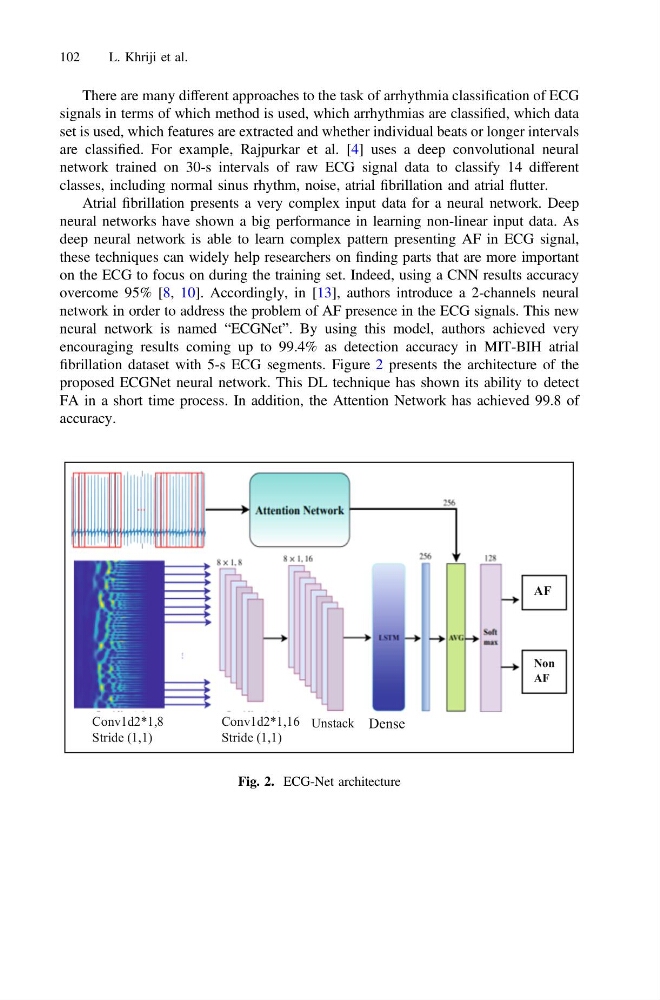
neural network is named “ECGNet”. By using this model, authors achieved very
encouraging results coming up to 99.4% as detection accuracy in MIT-BIH atrial
fibrillation dataset with 5-s ECG segments. Figure 2 presents the architecture of the
proposed ECGNet neural network. This DL technique has shown its ability to detect
FA in a short time process. In addition, the Attention Network has achieved 99.8 of
accuracy.
Conv1d2*1,8
Stride (1,1)
Conv1d2*1,16
Stride (1,1)
Unstack Dense
AF
Non
AF
Fig. 2. ECG-Net architecture
102
L. Khriji et al.
signals in terms of which method is used, which arrhythmias are classified, which data
set is used, which features are extracted and whether individual beats or longer intervals
are classified. For example, Rajpurkar et al. [4] uses a deep convolutional neural
network trained on 30-s intervals of raw ECG signal data to classify 14 different
classes, including normal sinus rhythm, noise, atrial fibrillation and atrial flutter.
Atrial fibrillation presents a very complex input data for a neural network. Deep
neural networks have shown a big performance in learning non-linear input data. As
deep neural network is able to learn complex pattern presenting AF in ECG signal,
these techniques can widely help researchers on finding parts that are more important
on the ECG to focus on during the training set. Indeed, using a CNN results accuracy
overcome 95% [8, 10]. Accordingly, in [13], authors introduce a 2-channels neural
network in order to address the problem of AF presence in the ECG signals. This new
neural network is named “ECGNet”. By using this model, authors achieved very
encouraging results coming up to 99.4% as detection accuracy in MIT-BIH atrial
fibrillation dataset with 5-s ECG segments. Figure 2 presents the architecture of the
proposed ECGNet neural network. This DL technique has shown its ability to detect
FA in a short time process. In addition, the Attention Network has achieved 99.8 of
accuracy.
Conv1d2*1,8
Stride (1,1)
Conv1d2*1,16
Stride (1,1)
Unstack Dense
AF
Non
AF
Fig. 2. ECG-Net architecture
102
L. Khriji et al.