

Because of the outstanding development in DL, its application in medical field (using
biomedical signals) is of huge interest. Accordingly, many works were developed using
DL models for ECG classification. In this context, our work in this paper presents a
new contribution using artificial neural network (ANN) architecture, to classify MITBIH dataset signal into normal and AFIB ECG signals.
The rest of this work is divided into 4 sections. Section 2 summarizes the state of
the art. Section 3 presents the propounded neural network model and experimental
results. Discussions and conclusion are depicted in Sects. 4 and 5, respectively.
2 State of the Art
In [2], Rahal et al. proposed a new approach for active classification of electrocardiogram ECG signals based on deep neural networks (DNN). Electrocardiogram ECG
classification plays an essential role in clinical diagnosis of cardiac insufficiency.
Zubair et al. in [3] proposed an ECG beat classification system based on convolutional
neural network (CNN). This model is divided into two main parts, one for features
extraction and the second for classification. Electrocardiogram ECG interpretation
plays an important role in clinical ECG workflow. Rajpurkar et al. [4] developed a new
method based on deep convolutional neural network to classify ECG signals belonging
to fourteen different classes. Acharya et al. [5] did another study where they designed a
novel deep CNN for ECG signals classification. Another work was proposed in [6]
based on deep belief Net used for classifying heartbeats into four classes. A new
method is presented in [7], which presents a new deep learning approach used for
detecting atrial fibrillation in real time. In this work, authors used an end-to-end neural
network combining a convolutional with a recurrent neural network (CNN, RNN) in
order to extract high-level features from the input signals.
This hybrid model was trained and tested under three different datasets containing a
total number of 85 classes. This model presents a particular performance by its ability
of analyzing 24 h of ECG recordings in less than one second. This algorithm was tested
on the three datasets in order to test its robustness and achieved the following results:
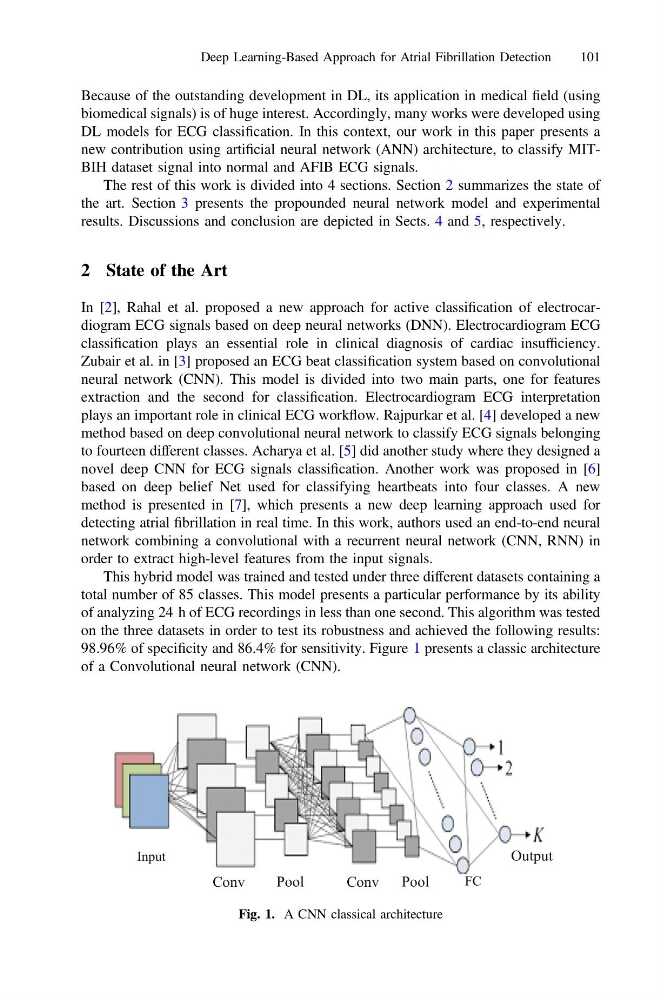
98.96% of specificity and 86.4% for sensitivity. Figure 1 presents a classic architecture
of a Convolutional neural network (CNN).
Input
Conv
Pool
Conv Pool
FC
Output
Fig. 1. A CNN classical architecture
Deep Learning-Based Approach for Atrial Fibrillation Detection
101
biomedical signals) is of huge interest. Accordingly, many works were developed using
DL models for ECG classification. In this context, our work in this paper presents a
new contribution using artificial neural network (ANN) architecture, to classify MITBIH dataset signal into normal and AFIB ECG signals.
The rest of this work is divided into 4 sections. Section 2 summarizes the state of
the art. Section 3 presents the propounded neural network model and experimental
results. Discussions and conclusion are depicted in Sects. 4 and 5, respectively.
2 State of the Art
In [2], Rahal et al. proposed a new approach for active classification of electrocardiogram ECG signals based on deep neural networks (DNN). Electrocardiogram ECG
classification plays an essential role in clinical diagnosis of cardiac insufficiency.
Zubair et al. in [3] proposed an ECG beat classification system based on convolutional
neural network (CNN). This model is divided into two main parts, one for features
extraction and the second for classification. Electrocardiogram ECG interpretation
plays an important role in clinical ECG workflow. Rajpurkar et al. [4] developed a new
method based on deep convolutional neural network to classify ECG signals belonging
to fourteen different classes. Acharya et al. [5] did another study where they designed a
novel deep CNN for ECG signals classification. Another work was proposed in [6]
based on deep belief Net used for classifying heartbeats into four classes. A new
method is presented in [7], which presents a new deep learning approach used for
detecting atrial fibrillation in real time. In this work, authors used an end-to-end neural
network combining a convolutional with a recurrent neural network (CNN, RNN) in
order to extract high-level features from the input signals.
This hybrid model was trained and tested under three different datasets containing a
total number of 85 classes. This model presents a particular performance by its ability
of analyzing 24 h of ECG recordings in less than one second. This algorithm was tested
on the three datasets in order to test its robustness and achieved the following results:
98.96% of specificity and 86.4% for sensitivity. Figure 1 presents a classic architecture
of a Convolutional neural network (CNN).
Input
Conv
Pool
Conv Pool
FC
Output
Fig. 1. A CNN classical architecture
Deep Learning-Based Approach for Atrial Fibrillation Detection
101