

3 Method and Results
3.1 Method
3.1.1 Dataset
The MIT-BIH dataset is known by its popularity as it has served for a long time as an
interesting reference to be useful for ECG signals classification and diagnosis detection.
In this context, we use three types of records from MIT-BIT dataset such as 100
samples of Normal sinus rhythm NSR, 40 samples of Atrial Fibrillation ATFIB and
finally 60 samples of Noisy ECG signals. Each sample constitutes of a matrix with a
size of 3600 * 1, reaching a total of 202 * 3600 for the input ECG data. Records as
depicted in Table 1 recognize each type of signals. For each record, an atrial fibrillation
should be classified similarly as a specialist would, the annotated parameters have been
labelled by specialist for a long time.
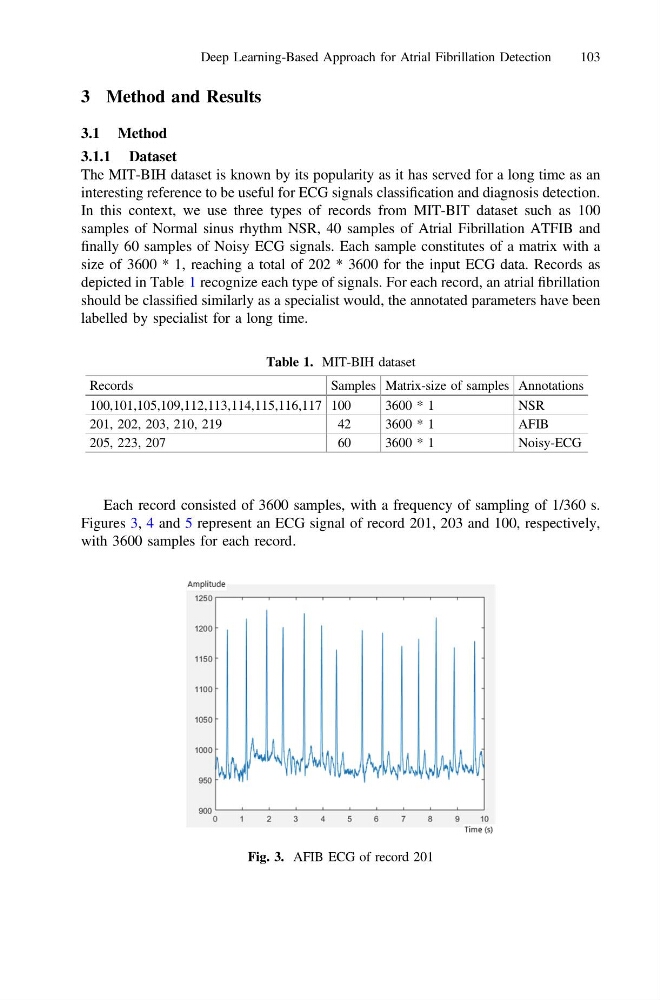
Each record consisted of 3600 samples, with a frequency of sampling of 1/360 s.
Figures 3, 4 and 5 represent an ECG signal of record 201, 203 and 100, respectively,
with 3600 samples for each record.
Table 1. MIT-BIH dataset
Records
Samples Matrix-size of samples Annotations
100,101,105,109,112,113,114,115,116,117 100
3600 * 1
NSR
201, 202, 203, 210, 219
42
3600 * 1
AFIB
205, 223, 207
60
3600 * 1
Noisy-ECG
Fig. 3. AFIB ECG of record 201
Deep Learning-Based Approach for Atrial Fibrillation Detection
103
3.1 Method
3.1.1 Dataset
The MIT-BIH dataset is known by its popularity as it has served for a long time as an
interesting reference to be useful for ECG signals classification and diagnosis detection.
In this context, we use three types of records from MIT-BIT dataset such as 100
samples of Normal sinus rhythm NSR, 40 samples of Atrial Fibrillation ATFIB and
finally 60 samples of Noisy ECG signals. Each sample constitutes of a matrix with a
size of 3600 * 1, reaching a total of 202 * 3600 for the input ECG data. Records as
depicted in Table 1 recognize each type of signals. For each record, an atrial fibrillation
should be classified similarly as a specialist would, the annotated parameters have been
labelled by specialist for a long time.
Each record consisted of 3600 samples, with a frequency of sampling of 1/360 s.
Figures 3, 4 and 5 represent an ECG signal of record 201, 203 and 100, respectively,
with 3600 samples for each record.
Table 1. MIT-BIH dataset
Records
Samples Matrix-size of samples Annotations
100,101,105,109,112,113,114,115,116,117 100
3600 * 1
NSR
201, 202, 203, 210, 219
42
3600 * 1
AFIB
205, 223, 207
60
3600 * 1
Noisy-ECG
Fig. 3. AFIB ECG of record 201
Deep Learning-Based Approach for Atrial Fibrillation Detection
103