

270
In some respect, Israel’s water policy faces a dilemma: with the reduction of the
household consumption of drinking water and the increased use of wastewater for
public gardening (which also leads to a substitution of drinking water), there is less
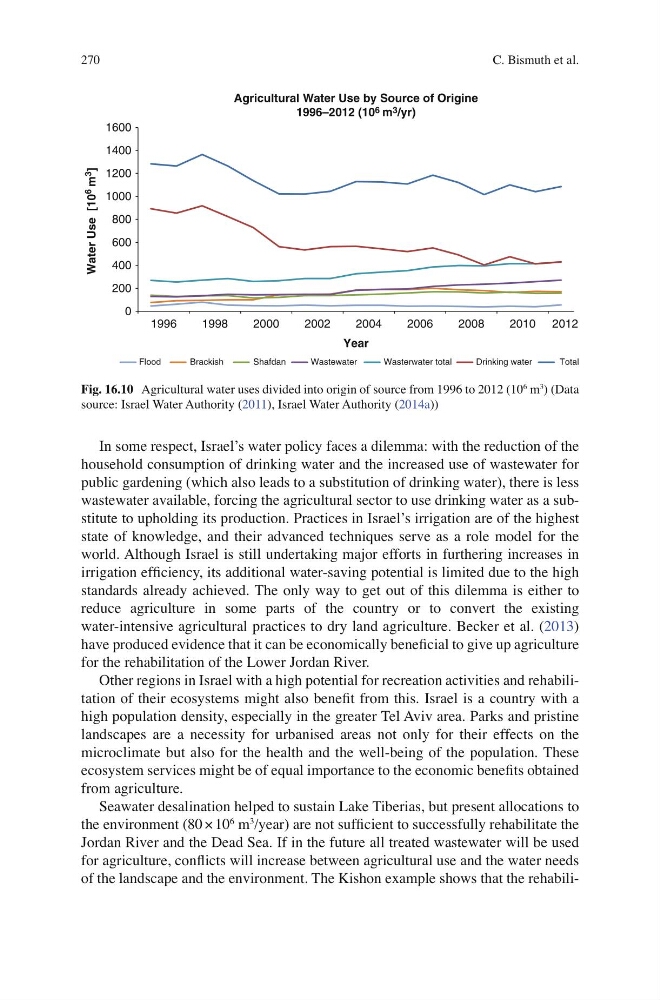
wastewater available, forcing the agricultural sector to use drinking water as a substitute to upholding its production. Practices in Israel’s irrigation are of the highest
state of knowledge, and their advanced techniques serve as a role model for the
world. Although Israel is still undertaking major efforts in furthering increases in
irrigation effi ciency, its additional water-saving potential is limited due to the high
standards already achieved. The only way to get out of this dilemma is either to
reduce agriculture in some parts of the country or to convert the existing
water- intensive agricultural practices to dry land agriculture. Becker et al. ( 2013 )
have produced evidence that it can be economically benefi cial to give up agriculture
for the rehabilitation of the Lower Jordan River.
Other regions in Israel with a high potential for recreation activities and rehabilitation of their ecosystems might also benefi t from this. Israel is a country with a
high population density, especially in the greater Tel Aviv area. Parks and pristine
landscapes are a necessity for urbanised areas not only for their effects on the
microclimate but also for the health and the well-being of the population. These
ecosystem services might be of equal importance to the economic benefi ts obtained
from agriculture.
Seawater desalination helped to sustain Lake Tiberias, but present allocations to
the environment (80 × 10
6 m
3 /year) are not suffi cient to successfully rehabilitate the
Jordan River and the Dead Sea. If in the future all treated wastewater will be used
for agriculture, confl icts will increase between agricultural use and the water needs
of the landscape and the environment. The Kishon example shows that the rehabili0
200
400
600
800
1000
1200
1400
1600
1996
1998
2000
2002
2004
2006
2008
2010 2012
Water Use [10
6
m
3
]
Year
Agricultural Water Use by Source of Origine
1996–2012 (10 6 m 3 /yr)
Flood
Total
Brackish
Shafdan
Wastewater
Wasterwater total
Drinking water
Fig. 16.10 Agricultural water uses divided into origin of source from 1996 to 2012 (10
6 m
3 ) (Data
source: Israel Water Authority ( 2011 ), Israel Water Authority ( 2014a ))
C. Bismuth et al.
In some respect, Israel’s water policy faces a dilemma: with the reduction of the
household consumption of drinking water and the increased use of wastewater for
public gardening (which also leads to a substitution of drinking water), there is less
wastewater available, forcing the agricultural sector to use drinking water as a substitute to upholding its production. Practices in Israel’s irrigation are of the highest
state of knowledge, and their advanced techniques serve as a role model for the
world. Although Israel is still undertaking major efforts in furthering increases in
irrigation effi ciency, its additional water-saving potential is limited due to the high
standards already achieved. The only way to get out of this dilemma is either to
reduce agriculture in some parts of the country or to convert the existing
water- intensive agricultural practices to dry land agriculture. Becker et al. ( 2013 )
have produced evidence that it can be economically benefi cial to give up agriculture
for the rehabilitation of the Lower Jordan River.
Other regions in Israel with a high potential for recreation activities and rehabilitation of their ecosystems might also benefi t from this. Israel is a country with a
high population density, especially in the greater Tel Aviv area. Parks and pristine
landscapes are a necessity for urbanised areas not only for their effects on the
microclimate but also for the health and the well-being of the population. These
ecosystem services might be of equal importance to the economic benefi ts obtained
from agriculture.
Seawater desalination helped to sustain Lake Tiberias, but present allocations to
the environment (80 × 10
6 m
3 /year) are not suffi cient to successfully rehabilitate the
Jordan River and the Dead Sea. If in the future all treated wastewater will be used
for agriculture, confl icts will increase between agricultural use and the water needs
of the landscape and the environment. The Kishon example shows that the rehabili0
200
400
600
800
1000
1200
1400
1600
1996
1998
2000
2002
2004
2006
2008
2010 2012
Water Use [10
6
m
3
]
Year
Agricultural Water Use by Source of Origine
1996–2012 (10 6 m 3 /yr)
Flood
Total
Brackish
Shafdan
Wastewater
Wasterwater total
Drinking water
Fig. 16.10 Agricultural water uses divided into origin of source from 1996 to 2012 (10
6 m
3 ) (Data
source: Israel Water Authority ( 2011 ), Israel Water Authority ( 2014a ))
C. Bismuth et al.