

263
1. Equal treatment: The price of water from all water corporations should be equal
for all end consumers (except for industrial consumers – they have different
prices due to different sewage components).
2. Block tariffs: Water prices for domestic uses are staggered in block tariffs. The
fi rst block goes up to 3.5 m
3 per capita and month. The approved quantity for a
single member household is fi xed to 7 m
3
. According to Kislev ( 2011 ), only in
few cases for small households with high consumption is a higher block rate
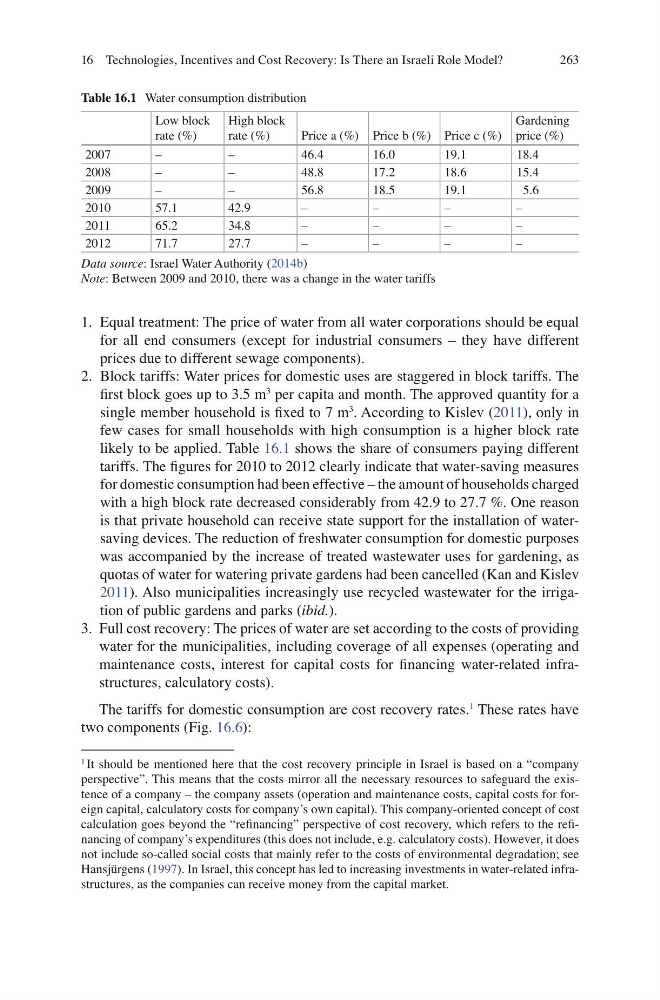
likely to be applied. Table 16.1 shows the share of consumers paying different
tariffs. The fi gures for 2010 to 2012 clearly indicate that water-saving measures
for domestic consumption had been effective – the amount of households charged
with a high block rate decreased considerably from 42.9 to 27.7 %. One reason
is that private household can receive state support for the installation of watersaving devices. The reduction of freshwater consumption for domestic purposes
was accompanied by the increase of treated wastewater uses for gardening, as
quotas of water for watering private gardens had been cancelled (Kan and Kislev
2011 ). Also municipalities increasingly use recycled wastewater for the irrigation of public gardens and parks ( ibid. ).
3. Full cost recovery: The prices of water are set according to the costs of providing
water for the municipalities, including coverage of all expenses (operating and
maintenance costs, interest for capital costs for fi nancing water-related infrastructures, calculatory costs).
The tariffs for domestic consumption are cost recovery rates.
1 These rates have
two components (Fig. 16.6 ):
1 It should be mentioned here that the cost recovery principle in Israel is based on a “company
perspective”. This means that the costs mirror all the necessary resources to safeguard the existence of a company – the company assets (operation and maintenance costs, capital costs for foreign capital, calculatory costs for company’s own capital). This company-oriented concept of cost
calculation goes beyond the “refi nancing” perspective of cost recovery, which refers to the refi -
nancing of company’s expenditures (this does not include, e.g. calculatory costs). However, it does
not include so-called social costs that mainly refer to the costs of environmental degradation; see
Hansjürgens ( 1997 ). In Israel, this concept has led to increasing investments in water-related infrastructures, as the companies can receive money from the capital market.
Table 16.1 Water consumption distribution
Low block
rate (%)
High block
rate (%)
Price a (%) Price b (%) Price c (%)
Gardening
price (%)
2007
–
–
46.4
16.0
19.1
18.4
2008
–
–
48.8
17.2
18.6
15.4
2009
–
–
56.8
18.5
19.1
5.6
2010
57.1
42.9
–
–
–
–
2011
65.2
34.8
–
–
–
–
2012
71.7
27.7
–
–
–
–
Data source : Israel Water Authority ( 2014b )
Note : Between 2009 and 2010, there was a change in the water tariffs
16 Technologies, Incentives and Cost Recovery: Is There an Israeli Role Model?
1. Equal treatment: The price of water from all water corporations should be equal
for all end consumers (except for industrial consumers – they have different
prices due to different sewage components).
2. Block tariffs: Water prices for domestic uses are staggered in block tariffs. The
fi rst block goes up to 3.5 m
3 per capita and month. The approved quantity for a
single member household is fi xed to 7 m
3
. According to Kislev ( 2011 ), only in
few cases for small households with high consumption is a higher block rate
likely to be applied. Table 16.1 shows the share of consumers paying different
tariffs. The fi gures for 2010 to 2012 clearly indicate that water-saving measures
for domestic consumption had been effective – the amount of households charged
with a high block rate decreased considerably from 42.9 to 27.7 %. One reason
is that private household can receive state support for the installation of watersaving devices. The reduction of freshwater consumption for domestic purposes
was accompanied by the increase of treated wastewater uses for gardening, as
quotas of water for watering private gardens had been cancelled (Kan and Kislev
2011 ). Also municipalities increasingly use recycled wastewater for the irrigation of public gardens and parks ( ibid. ).
3. Full cost recovery: The prices of water are set according to the costs of providing
water for the municipalities, including coverage of all expenses (operating and
maintenance costs, interest for capital costs for fi nancing water-related infrastructures, calculatory costs).
The tariffs for domestic consumption are cost recovery rates.
1 These rates have
two components (Fig. 16.6 ):
1 It should be mentioned here that the cost recovery principle in Israel is based on a “company
perspective”. This means that the costs mirror all the necessary resources to safeguard the existence of a company – the company assets (operation and maintenance costs, capital costs for foreign capital, calculatory costs for company’s own capital). This company-oriented concept of cost
calculation goes beyond the “refi nancing” perspective of cost recovery, which refers to the refi -
nancing of company’s expenditures (this does not include, e.g. calculatory costs). However, it does
not include so-called social costs that mainly refer to the costs of environmental degradation; see
Hansjürgens ( 1997 ). In Israel, this concept has led to increasing investments in water-related infrastructures, as the companies can receive money from the capital market.
Table 16.1 Water consumption distribution
Low block
rate (%)
High block
rate (%)
Price a (%) Price b (%) Price c (%)
Gardening
price (%)
2007
–
–
46.4
16.0
19.1
18.4
2008
–
–
48.8
17.2
18.6
15.4
2009
–
–
56.8
18.5
19.1
5.6
2010
57.1
42.9
–
–
–
–
2011
65.2
34.8
–
–
–
–
2012
71.7
27.7
–
–
–
–
Data source : Israel Water Authority ( 2014b )
Note : Between 2009 and 2010, there was a change in the water tariffs
16 Technologies, Incentives and Cost Recovery: Is There an Israeli Role Model?