

229
15.1.2 Unpredictable Transboundary Flows
Seen through the lens of shared resources, the problem becomes more serious. Arid
Jordan is already vulnerable to multi-year drought (JME 2009 , p. 31). Its geostrategic location and the legacy of regional confl ict combined with heightened
regional instability add to uncertainties. This is because a signifi cant proportion of
the surface and renewable groundwater providing most of Jordan’s water derive
from transboundary fl ows. Jordan is located downstream from Syria and Israel, with
whom waters of the River Yarmouk and River Jordan respectively are shared (Yorke
2013 , pp. 120–123). Aggravating matters, bilateral agreement on joint management
of cross-border surface supplies
1 is either non-existent (1987 Jordan-Syria accord)
or inadequate (Jordan-Israel Peace 1994 , Annexes II, IV) and Jordan receives less
than its rightful shares (SFG 2011 , p. 26; MWI 2012 ). Meanwhile, fossil water
1 The problem also surrounds groundwater. Of eleven renewable groundwater reservoir basins,
four are shared with Syria (Yorke 2013 , pp. 16–17).
0
100
200
300
400
500
600
700
1994
1998
2002
2006
2010
Year
Annual Total Water Use in Jordan by Sector (10 6 m 3 /yr)
Industrial
Irrigation, Wastewater
Municipal
Irrigation, Fresh Water
Water Use [10
6
m
3
]
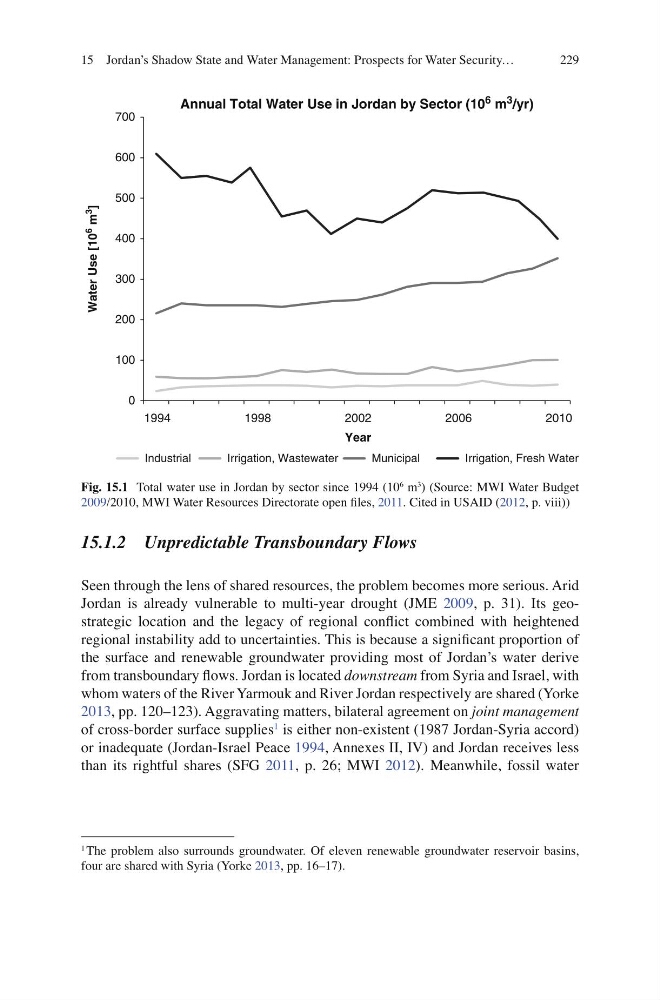
Fig. 15.1 Total water use in Jordan by sector since 1994 (10
6 m
3
) (Source: MWI Water Budget
2009 /2010, MWI Water Resources Directorate open fi les, 2011 . Cited in USAID ( 2012 , p. viii))
15 Jordan’s Shadow State and Water Management: Prospects for Water Security…
15.1.2 Unpredictable Transboundary Flows
Seen through the lens of shared resources, the problem becomes more serious. Arid
Jordan is already vulnerable to multi-year drought (JME 2009 , p. 31). Its geostrategic location and the legacy of regional confl ict combined with heightened
regional instability add to uncertainties. This is because a signifi cant proportion of
the surface and renewable groundwater providing most of Jordan’s water derive
from transboundary fl ows. Jordan is located downstream from Syria and Israel, with
whom waters of the River Yarmouk and River Jordan respectively are shared (Yorke
2013 , pp. 120–123). Aggravating matters, bilateral agreement on joint management
of cross-border surface supplies
1 is either non-existent (1987 Jordan-Syria accord)
or inadequate (Jordan-Israel Peace 1994 , Annexes II, IV) and Jordan receives less
than its rightful shares (SFG 2011 , p. 26; MWI 2012 ). Meanwhile, fossil water
1 The problem also surrounds groundwater. Of eleven renewable groundwater reservoir basins,
four are shared with Syria (Yorke 2013 , pp. 16–17).
0
100
200
300
400
500
600
700
1994
1998
2002
2006
2010
Year
Annual Total Water Use in Jordan by Sector (10 6 m 3 /yr)
Industrial
Irrigation, Wastewater
Municipal
Irrigation, Fresh Water
Water Use [10
6
m
3
]
Fig. 15.1 Total water use in Jordan by sector since 1994 (10
6 m
3
) (Source: MWI Water Budget
2009 /2010, MWI Water Resources Directorate open fi les, 2011 . Cited in USAID ( 2012 , p. viii))
15 Jordan’s Shadow State and Water Management: Prospects for Water Security…