

119
Soviet rule divided existing territorial units, created new republics and, at the
same time, integrated them under the roof of a political union. The creation of
eponymous republics – meant to respect and to refl ect the ethnic divide in Central
Asia – and the implementation of autonomy policies that lacked any sense of
autonomous decision-making (Kreutzmann 2013b ) provided the blueprint for
profound interference to the socio-economic structures of the formerly independent khanates and administratively divided the Fergana Valley along newly created and delineated boundaries. Other reforms such as collectivisation of
productive resources, the introduction of central planning, and expansion of communication infrastructure on the Soviet Union’s scale and the supply of citizens
with similar sets of low-cost consumer goods indicate the centralised approach in
state organisation.
Plans to expand the irrigation system and to integrate the long-distance water
management in a scientifi c approach to agrobusiness and agricultural technologies,
as well as raising it to become part of the industrial processing of agricultural goods,
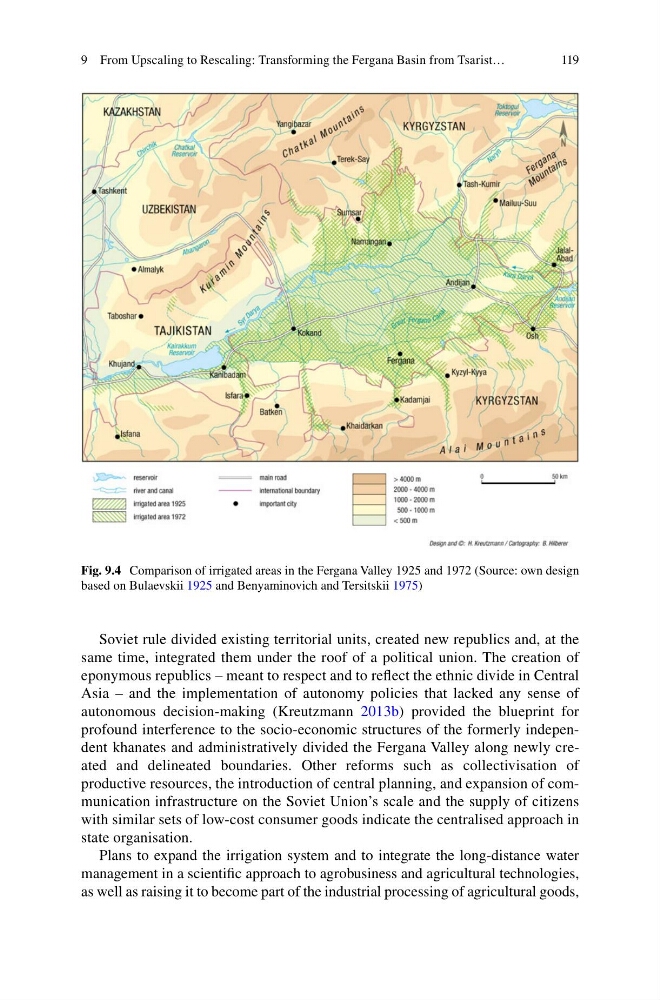
Fig. 9.4 Comparison of irrigated areas in the Fergana Valley 1925 and 1972 (Source: own design
based on Bulaevskii 1925 and Benyaminovich and Tersitskii 1975 )
9 From Upscaling to Rescaling: Transforming the Fergana Basin from Tsarist…
Soviet rule divided existing territorial units, created new republics and, at the
same time, integrated them under the roof of a political union. The creation of
eponymous republics – meant to respect and to refl ect the ethnic divide in Central
Asia – and the implementation of autonomy policies that lacked any sense of
autonomous decision-making (Kreutzmann 2013b ) provided the blueprint for
profound interference to the socio-economic structures of the formerly independent khanates and administratively divided the Fergana Valley along newly created and delineated boundaries. Other reforms such as collectivisation of
productive resources, the introduction of central planning, and expansion of communication infrastructure on the Soviet Union’s scale and the supply of citizens
with similar sets of low-cost consumer goods indicate the centralised approach in
state organisation.
Plans to expand the irrigation system and to integrate the long-distance water
management in a scientifi c approach to agrobusiness and agricultural technologies,
as well as raising it to become part of the industrial processing of agricultural goods,
Fig. 9.4 Comparison of irrigated areas in the Fergana Valley 1925 and 1972 (Source: own design
based on Bulaevskii 1925 and Benyaminovich and Tersitskii 1975 )
9 From Upscaling to Rescaling: Transforming the Fergana Basin from Tsarist…