

118
irrigation systems in Fergana during the Tsarist rule can be interpreted as part of the
civilising mission which was so aptly commented upon by Fyodor M. Dostojevski
who compared Russian interest in Central Asia with the same mission of European
powers in North America (Hauner 1992 ). The control of regional resources and
experiments with new technologies in the Central Asian “laboratory” enabled the
colonial power to envisage an interconnected system of producing raw materials in
Central Asia and processing them in Russia. The establishment of an extensive
engineered water management system with major rivers connected supported the
construction of huge reservoirs and the greening of the desert and steppe. Thus, the
conversion of the Fergana Valley into a fertile, irrigated, cotton-producing oasis of
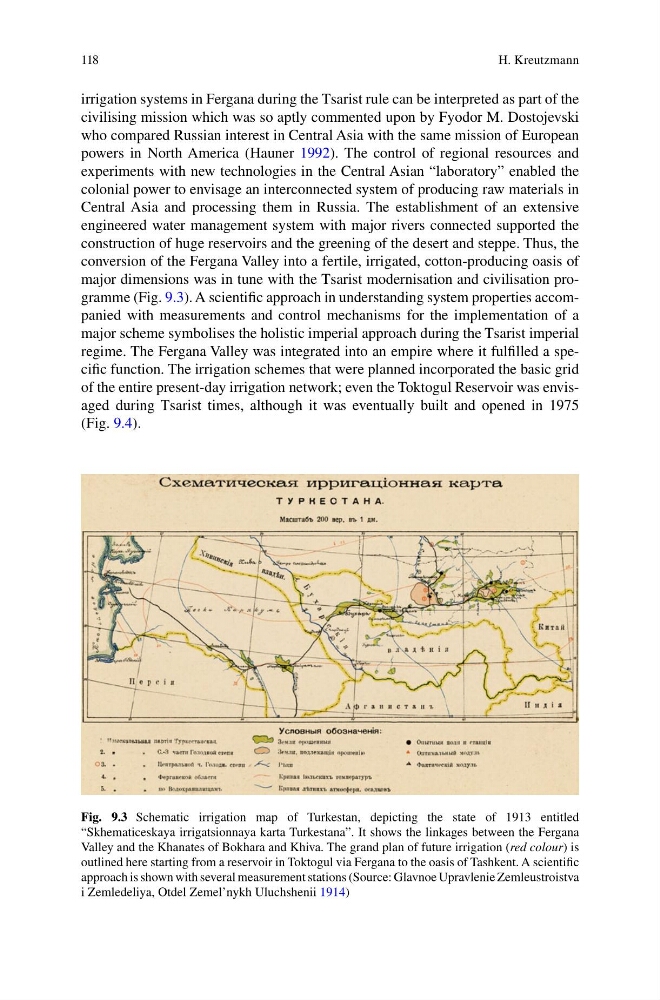
major dimensions was in tune with the Tsarist modernisation and civilisation programme (Fig. 9.3 ). A scientifi c approach in understanding system properties accompanied with measurements and control mechanisms for the implementation of a
major scheme symbolises the holistic imperial approach during the Tsarist imperial
regime. The Fergana Valley was integrated into an empire where it fulfi lled a specifi c function. The irrigation schemes that were planned incorporated the basic grid
of the entire present-day irrigation network; even the Toktogul Reservoir was envisaged during Tsarist times, although it was eventually built and opened in 1975
(Fig. 9.4 ).
Fig. 9.3 Schematic irrigation map of Turkestan, depicting the state of 1913 entitled
“Skhematiceskaya irrigatsionnaya karta Turkestana”. It shows the linkages between the Fergana
Valley and the Khanates of Bokhara and Khiva. The grand plan of future irrigation ( red colour ) is
outlined here starting from a reservoir in Toktogul via Fergana to the oasis of Tashkent. A scientifi c
approach is shown with several measurement stations (Source: Glavnoe Upravlenie Zemleustroistva
i Zemledeliya, Otdel Zemel’nykh Uluchshenii 1914 )
H. Kreutzmann
irrigation systems in Fergana during the Tsarist rule can be interpreted as part of the
civilising mission which was so aptly commented upon by Fyodor M. Dostojevski
who compared Russian interest in Central Asia with the same mission of European
powers in North America (Hauner 1992 ). The control of regional resources and
experiments with new technologies in the Central Asian “laboratory” enabled the
colonial power to envisage an interconnected system of producing raw materials in
Central Asia and processing them in Russia. The establishment of an extensive
engineered water management system with major rivers connected supported the
construction of huge reservoirs and the greening of the desert and steppe. Thus, the
conversion of the Fergana Valley into a fertile, irrigated, cotton-producing oasis of
major dimensions was in tune with the Tsarist modernisation and civilisation programme (Fig. 9.3 ). A scientifi c approach in understanding system properties accompanied with measurements and control mechanisms for the implementation of a
major scheme symbolises the holistic imperial approach during the Tsarist imperial
regime. The Fergana Valley was integrated into an empire where it fulfi lled a specifi c function. The irrigation schemes that were planned incorporated the basic grid
of the entire present-day irrigation network; even the Toktogul Reservoir was envisaged during Tsarist times, although it was eventually built and opened in 1975
(Fig. 9.4 ).
Fig. 9.3 Schematic irrigation map of Turkestan, depicting the state of 1913 entitled
“Skhematiceskaya irrigatsionnaya karta Turkestana”. It shows the linkages between the Fergana
Valley and the Khanates of Bokhara and Khiva. The grand plan of future irrigation ( red colour ) is
outlined here starting from a reservoir in Toktogul via Fergana to the oasis of Tashkent. A scientifi c
approach is shown with several measurement stations (Source: Glavnoe Upravlenie Zemleustroistva
i Zemledeliya, Otdel Zemel’nykh Uluchshenii 1914 )
H. Kreutzmann