

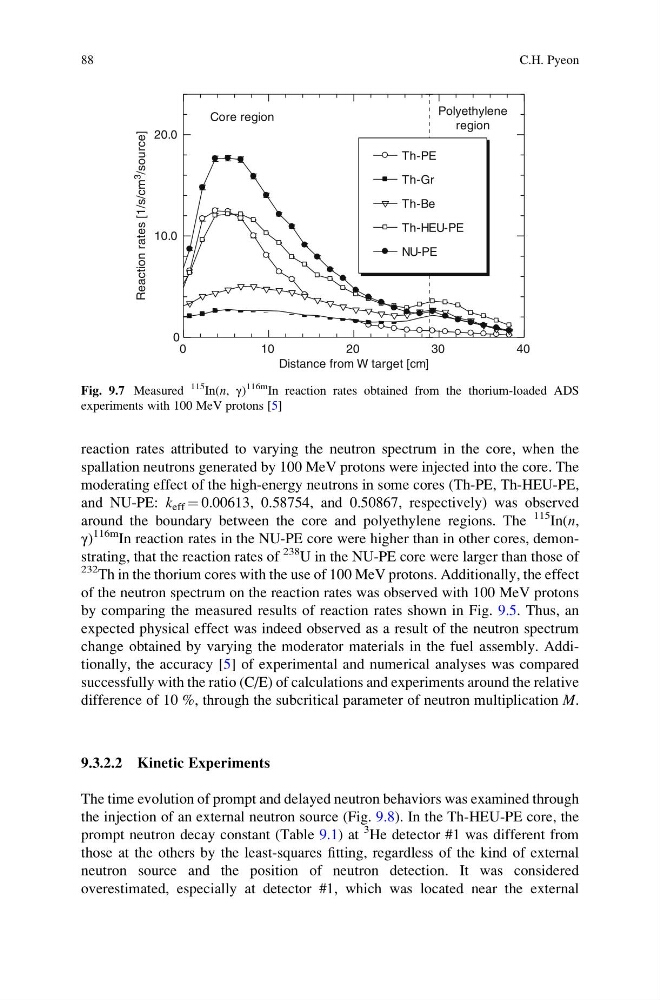
reaction rates attributed to varying the neutron spectrum in the core, when the
spallation neutrons generated by 100 MeV protons were injected into the core. The
moderating effect of the high-energy neutrons in some cores (Th-PE, Th-HEU-PE,
and NU-PE: k eff ¼ 0.00613, 0.58754, and 0.50867, respectively) was observed
around the boundary between the core and polyethylene regions. The
115
In(n,
γ)
116m In reaction rates in the NU-PE core were higher than in other cores, demonstrating, that the reaction rates of
238 U in the NU-PE core were larger than those of
232 Th in the thorium cores with the use of 100 MeV protons. Additionally, the effect
of the neutron spectrum on the reaction rates was observed with 100 MeV protons
by comparing the measured results of reaction rates shown in Fig. 9.5. Thus, an
expected physical effect was indeed observed as a result of the neutron spectrum
change obtained by varying the moderator materials in the fuel assembly. Additionally, the accuracy [5] of experimental and numerical analyses was compared
successfully with the ratio (C/E) of calculations and experiments around the relative
difference of 10 %, through the subcritical parameter of neutron multiplication M.
9.3.2.2 Kinetic Experiments
The time evolution of prompt and delayed neutron behaviors was examined through
the injection of an external neutron source (Fig. 9.8). In the Th-HEU-PE core, the
prompt neutron decay constant (Table 9.1) at
3 He detector #1 was different from
those at the others by the least-squares fitting, regardless of the kind of external
neutron source and the position of neutron detection. It was considered
overestimated, especially at detector #1, which was located near the external
0
10
20
30
40
0
10.0
20.0
Distance from W target [cm]
Reaction rates [1/s/cm
3
/source]
Th-PE
Th-Gr
Th-Be
Th-HEU-PE
NU-PE
Core region
Polyethylene
region
Fig. 9.7 Measured
115
In(n, γ)
116m In reaction rates obtained from the thorium-loaded ADS
experiments with 100 MeV protons [5]
88
C.H. Pyeon
spallation neutrons generated by 100 MeV protons were injected into the core. The
moderating effect of the high-energy neutrons in some cores (Th-PE, Th-HEU-PE,
and NU-PE: k eff ¼ 0.00613, 0.58754, and 0.50867, respectively) was observed
around the boundary between the core and polyethylene regions. The
115
In(n,
γ)
116m In reaction rates in the NU-PE core were higher than in other cores, demonstrating, that the reaction rates of
238 U in the NU-PE core were larger than those of
232 Th in the thorium cores with the use of 100 MeV protons. Additionally, the effect
of the neutron spectrum on the reaction rates was observed with 100 MeV protons
by comparing the measured results of reaction rates shown in Fig. 9.5. Thus, an
expected physical effect was indeed observed as a result of the neutron spectrum
change obtained by varying the moderator materials in the fuel assembly. Additionally, the accuracy [5] of experimental and numerical analyses was compared
successfully with the ratio (C/E) of calculations and experiments around the relative
difference of 10 %, through the subcritical parameter of neutron multiplication M.
9.3.2.2 Kinetic Experiments
The time evolution of prompt and delayed neutron behaviors was examined through
the injection of an external neutron source (Fig. 9.8). In the Th-HEU-PE core, the
prompt neutron decay constant (Table 9.1) at
3 He detector #1 was different from
those at the others by the least-squares fitting, regardless of the kind of external
neutron source and the position of neutron detection. It was considered
overestimated, especially at detector #1, which was located near the external
0
10
20
30
40
0
10.0
20.0
Distance from W target [cm]
Reaction rates [1/s/cm
3
/source]
Th-PE
Th-Gr
Th-Be
Th-HEU-PE
NU-PE
Core region
Polyethylene
region
Fig. 9.7 Measured
115
In(n, γ)
116m In reaction rates obtained from the thorium-loaded ADS
experiments with 100 MeV protons [5]
88
C.H. Pyeon