

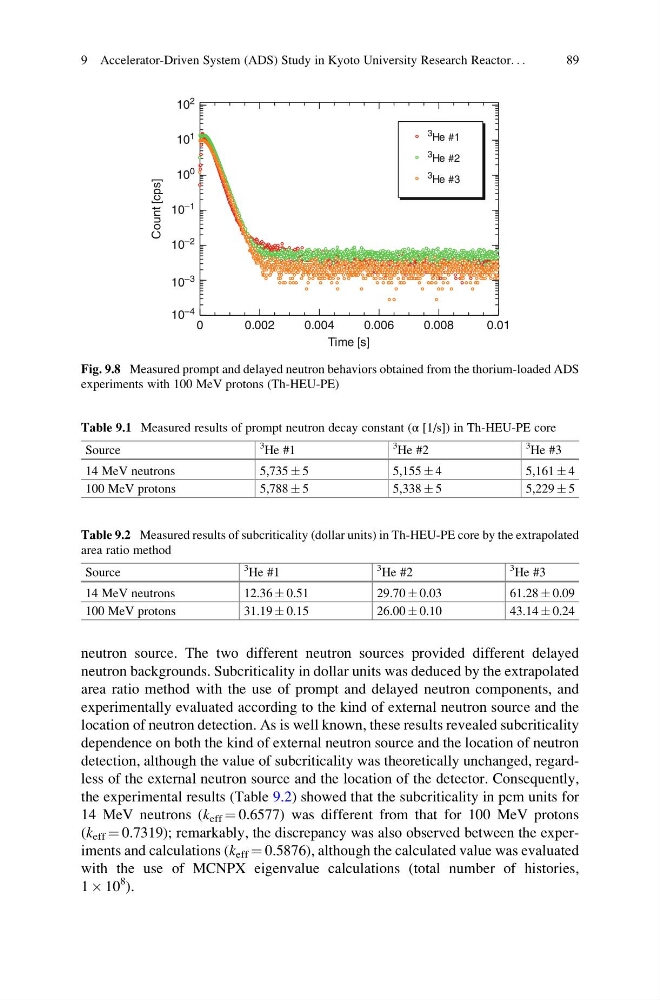
neutron source. The two different neutron sources provided different delayed
neutron backgrounds. Subcriticality in dollar units was deduced by the extrapolated
area ratio method with the use of prompt and delayed neutron components, and
experimentally evaluated according to the kind of external neutron source and the
location of neutron detection. As is well known, these results revealed subcriticality
dependence on both the kind of external neutron source and the location of neutron
detection, although the value of subcriticality was theoretically unchanged, regardless of the external neutron source and the location of the detector. Consequently,
the experimental results (Table 9.2) showed that the subcriticality in pcm units for
14 MeV neutrons (k eff ¼ 0.6577) was different from that for 100 MeV protons
(k eff ¼ 0.7319); remarkably, the discrepancy was also observed between the experiments and calculations (k eff ¼ 0.5876), although the calculated value was evaluated
with the use of MCNPX eigenvalue calculations (total number of histories,
1 Â 10
8 ).
0
0.002
0.004
0.006
0.008
0.01
10
–4
10
–3
10 –2
10 –1
10
0
10 1
10
2
Time [s]
Count [cps]
3 He #1
3 He #2
3 He #3
Fig. 9.8 Measured prompt and delayed neutron behaviors obtained from the thorium-loaded ADS
experiments with 100 MeV protons (Th-HEU-PE)
Table 9.1 Measured results of prompt neutron decay constant (α [1/s]) in Th-HEU-PE core
Source
3
He #1
3
He #2
3
He #3
14 MeV neutrons
5,735 Æ 5
5,155 Æ 4
5,161 Æ 4
100 MeV protons
5,788 Æ 5
5,338 Æ 5
5,229 Æ 5
Table 9.2 Measured results of subcriticality (dollar units) in Th-HEU-PE core by the extrapolated
area ratio method
Source
3
He #1
3
He #2
3
He #3
14 MeV neutrons
12.36 Æ 0.51
29.70 Æ 0.03
61.28 Æ 0.09
100 MeV protons
31.19 Æ 0.15
26.00 Æ 0.10
43.14 Æ 0.24
9 Accelerator-Driven System (ADS) Study in Kyoto University Research Reactor. . .
89
neutron backgrounds. Subcriticality in dollar units was deduced by the extrapolated
area ratio method with the use of prompt and delayed neutron components, and
experimentally evaluated according to the kind of external neutron source and the
location of neutron detection. As is well known, these results revealed subcriticality
dependence on both the kind of external neutron source and the location of neutron
detection, although the value of subcriticality was theoretically unchanged, regardless of the external neutron source and the location of the detector. Consequently,
the experimental results (Table 9.2) showed that the subcriticality in pcm units for
14 MeV neutrons (k eff ¼ 0.6577) was different from that for 100 MeV protons
(k eff ¼ 0.7319); remarkably, the discrepancy was also observed between the experiments and calculations (k eff ¼ 0.5876), although the calculated value was evaluated
with the use of MCNPX eigenvalue calculations (total number of histories,
1 Â 10
8 ).
0
0.002
0.004
0.006
0.008
0.01
10
–4
10
–3
10 –2
10 –1
10
0
10 1
10
2
Time [s]
Count [cps]
3 He #1
3 He #2
3 He #3
Fig. 9.8 Measured prompt and delayed neutron behaviors obtained from the thorium-loaded ADS
experiments with 100 MeV protons (Th-HEU-PE)
Table 9.1 Measured results of prompt neutron decay constant (α [1/s]) in Th-HEU-PE core
Source
3
He #1
3
He #2
3
He #3
14 MeV neutrons
5,735 Æ 5
5,155 Æ 4
5,161 Æ 4
100 MeV protons
5,788 Æ 5
5,338 Æ 5
5,229 Æ 5
Table 9.2 Measured results of subcriticality (dollar units) in Th-HEU-PE core by the extrapolated
area ratio method
Source
3
He #1
3
He #2
3
He #3
14 MeV neutrons
12.36 Æ 0.51
29.70 Æ 0.03
61.28 Æ 0.09
100 MeV protons
31.19 Æ 0.15
26.00 Æ 0.10
43.14 Æ 0.24
9 Accelerator-Driven System (ADS) Study in Kyoto University Research Reactor. . .
89