

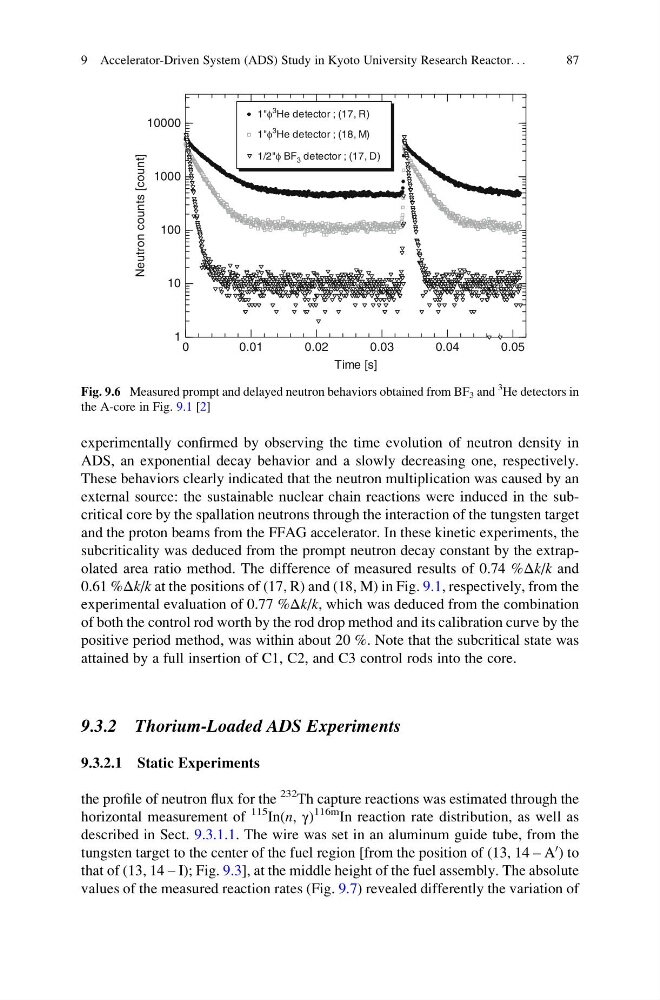
experimentally confirmed by observing the time evolution of neutron density in
ADS, an exponential decay behavior and a slowly decreasing one, respectively.
These behaviors clearly indicated that the neutron multiplication was caused by an
external source: the sustainable nuclear chain reactions were induced in the subcritical core by the spallation neutrons through the interaction of the tungsten target
and the proton beams from the FFAG accelerator. In these kinetic experiments, the
subcriticality was deduced from the prompt neutron decay constant by the extrapolated area ratio method. The difference of measured results of 0.74 %Δk/k and
0.61 %Δk/k at the positions of (17, R) and (18, M) in Fig. 9.1, respectively, from the
experimental evaluation of 0.77 %Δk/k, which was deduced from the combination
of both the control rod worth by the rod drop method and its calibration curve by the
positive period method, was within about 20 %. Note that the subcritical state was
attained by a full insertion of C1, C2, and C3 control rods into the core.
9.3.2 Thorium-Loaded ADS Experiments
9.3.2.1 Static Experiments
the profile of neutron flux for the
232 Th capture reactions was estimated through the
horizontal measurement of
115
In(n, γ)
116m In reaction rate distribution, as well as
described in Sect. 9.3.1.1. The wire was set in an aluminum guide tube, from the
tungsten target to the center of the fuel region [from the position of (13, 14 – A
0 ) to
that of (13, 14 – I); Fig. 9.3], at the middle height of the fuel assembly. The absolute
values of the measured reaction rates (Fig. 9.7) revealed differently the variation of
0
0.01
0.02
0.03
0.04
0.05
1
10
100
1000
10000
Time [s]
Neutron counts [count]
1"φ
3
He detector ; (17, R)
1"φ
3
He detector ; (18, M)
1/2"φ BF 3 detector ; (17, D)
Fig. 9.6 Measured prompt and delayed neutron behaviors obtained from BF 3 and
3
He detectors in
the A-core in Fig. 9.1 [2]
9 Accelerator-Driven System (ADS) Study in Kyoto University Research Reactor. . .
87
ADS, an exponential decay behavior and a slowly decreasing one, respectively.
These behaviors clearly indicated that the neutron multiplication was caused by an
external source: the sustainable nuclear chain reactions were induced in the subcritical core by the spallation neutrons through the interaction of the tungsten target
and the proton beams from the FFAG accelerator. In these kinetic experiments, the
subcriticality was deduced from the prompt neutron decay constant by the extrapolated area ratio method. The difference of measured results of 0.74 %Δk/k and
0.61 %Δk/k at the positions of (17, R) and (18, M) in Fig. 9.1, respectively, from the
experimental evaluation of 0.77 %Δk/k, which was deduced from the combination
of both the control rod worth by the rod drop method and its calibration curve by the
positive period method, was within about 20 %. Note that the subcritical state was
attained by a full insertion of C1, C2, and C3 control rods into the core.
9.3.2 Thorium-Loaded ADS Experiments
9.3.2.1 Static Experiments
the profile of neutron flux for the
232 Th capture reactions was estimated through the
horizontal measurement of
115
In(n, γ)
116m In reaction rate distribution, as well as
described in Sect. 9.3.1.1. The wire was set in an aluminum guide tube, from the
tungsten target to the center of the fuel region [from the position of (13, 14 – A
0 ) to
that of (13, 14 – I); Fig. 9.3], at the middle height of the fuel assembly. The absolute
values of the measured reaction rates (Fig. 9.7) revealed differently the variation of
0
0.01
0.02
0.03
0.04
0.05
1
10
100
1000
10000
Time [s]
Neutron counts [count]
1"φ
3
He detector ; (17, R)
1"φ
3
He detector ; (18, M)
1/2"φ BF 3 detector ; (17, D)
Fig. 9.6 Measured prompt and delayed neutron behaviors obtained from BF 3 and
3
He detectors in
the A-core in Fig. 9.1 [2]
9 Accelerator-Driven System (ADS) Study in Kyoto University Research Reactor. . .
87