

be changed to another chemical species in the diluted HCl solution in a day.
In addition, the changed chemical species and IO 3
À were reduced to I
À by the
reductant in this experimental condition. Consequently, inorganic iodine species
were analyzed at pH 2 with the reductant, and only I
À was analyzed in 3 M NaOH.
It is possibly to apply speciation methods to analyze I
À and IO 3
À , depending on the
solution conditions.
27.4.2 Combustion Method
When 1 g pine bark was combusted by the electric furnace without control, smoking
was observed at the temperature range from 200
to 300
C, especially at 240
C.
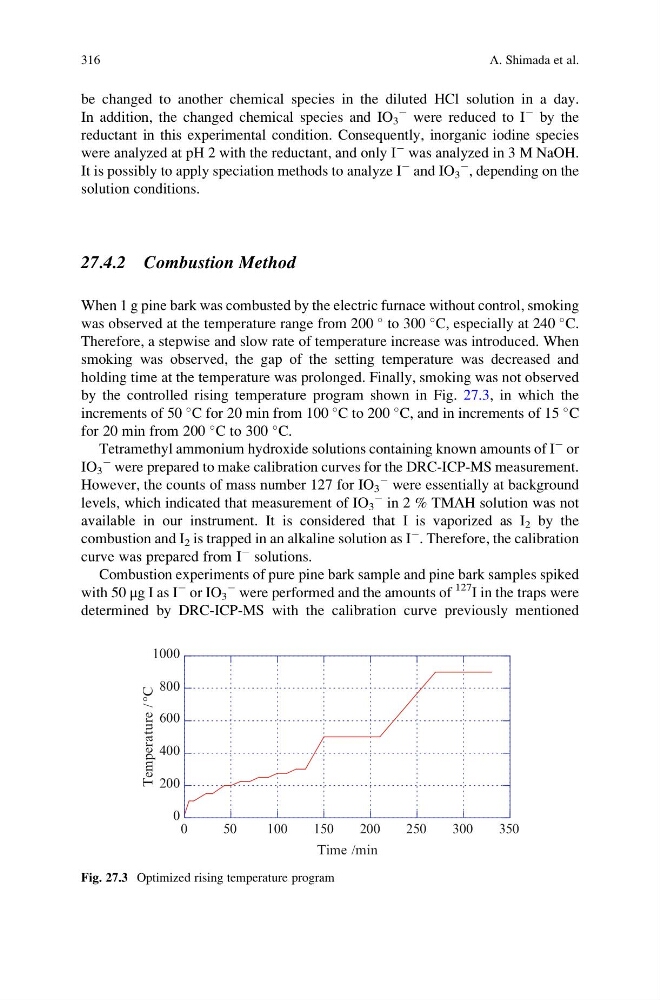
Therefore, a stepwise and slow rate of temperature increase was introduced. When
smoking was observed, the gap of the setting temperature was decreased and
holding time at the temperature was prolonged. Finally, smoking was not observed
by the controlled rising temperature program shown in Fig. 27.3, in which the
increments of 50
C for 20 min from 100
C to 200
C, and in increments of 15
C
for 20 min from 200
C to 300
C.
Tetramethyl ammonium hydroxide solutions containing known amounts of I
À or
IO 3
À were prepared to make calibration curves for the DRC-ICP-MS measurement.
However, the counts of mass number 127 for IO 3
À were essentially at background
levels, which indicated that measurement of IO 3
À in 2 % TMAH solution was not
available in our instrument. It is considered that I is vaporized as I 2 by the
combustion and I 2 is trapped in an alkaline solution as I
À . Therefore, the calibration
curve was prepared from I
À solutions.
Combustion experiments of pure pine bark sample and pine bark samples spiked
with 50 μg I as I
À or IO 3
À were performed and the amounts of
127
I in the traps were
determined by DRC-ICP-MS with the calibration curve previously mentioned
0
200
400
600
800
1000
0
50
100
150
200
250
300
350
Temperature / °C
Time /min
Fig. 27.3 Optimized rising temperature program
316
A. Shimada et al.
In addition, the changed chemical species and IO 3
À were reduced to I
À by the
reductant in this experimental condition. Consequently, inorganic iodine species
were analyzed at pH 2 with the reductant, and only I
À was analyzed in 3 M NaOH.
It is possibly to apply speciation methods to analyze I
À and IO 3
À , depending on the
solution conditions.
27.4.2 Combustion Method
When 1 g pine bark was combusted by the electric furnace without control, smoking
was observed at the temperature range from 200
to 300
C, especially at 240
C.
Therefore, a stepwise and slow rate of temperature increase was introduced. When
smoking was observed, the gap of the setting temperature was decreased and
holding time at the temperature was prolonged. Finally, smoking was not observed
by the controlled rising temperature program shown in Fig. 27.3, in which the
increments of 50
C for 20 min from 100
C to 200
C, and in increments of 15
C
for 20 min from 200
C to 300
C.
Tetramethyl ammonium hydroxide solutions containing known amounts of I
À or
IO 3
À were prepared to make calibration curves for the DRC-ICP-MS measurement.
However, the counts of mass number 127 for IO 3
À were essentially at background
levels, which indicated that measurement of IO 3
À in 2 % TMAH solution was not
available in our instrument. It is considered that I is vaporized as I 2 by the
combustion and I 2 is trapped in an alkaline solution as I
À . Therefore, the calibration
curve was prepared from I
À solutions.
Combustion experiments of pure pine bark sample and pine bark samples spiked
with 50 μg I as I
À or IO 3
À were performed and the amounts of
127
I in the traps were
determined by DRC-ICP-MS with the calibration curve previously mentioned
0
200
400
600
800
1000
0
50
100
150
200
250
300
350
Temperature / °C
Time /min
Fig. 27.3 Optimized rising temperature program
316
A. Shimada et al.