

27.4 Results and Discussion
27.4.1 Separation Using Anion-SR
Good recovery of I
À (as
129
I
À ) from the Anion-SR was observed in the 3 M NaOH
solution, but only minor amounts of IO 3
À (as
127 IO 3
À ) were recovered (Table 27.1).
The percent recoveries did not appear to be dependent on the reductant because
good recoveries of I
À and poor recoveries of IO 3
À were observed regardless of the
presence or absence of NaHSO 3 . This result supports the expectation that
129 I
À is
extracted and
127 IO 3
À is not extracted by the Anion-SR, as
127 IO 3
À was not reduced
to
127 I
À by NaHSO 3 in 3 M NaOH solution, and the isotopic exchange reaction
between
127 IO 3
À and
129 I
À and reduction from
127 IO 3
À to
127 I
À were negligible at
least for 1 day. It is reported that
129
I in seawater offshore of Fukushima is mainly
129 I
À regardless of the presence of large amounts of natural
127 IO 3
À [8].
In the diluted HCl solution at pH 2,
129
I and
127 I were recovered in the presence
of the reductant and were not recovered without the reductant (Table 27.1). Both the
isotopes behaved similarly in this case despite the difference in the initial chemical
species,
129 I
À and
127 IO 3
À . In contrast, the experiments using 1 μg
127 I
À in the
diluted HCl solution at pH 2 without the reductant and standing, higher recovery of
127 I
À
, 72 Æ 6 %, was obtained. Although the influence of the I
À amount on recovery
cannot be wholly denied, it is possible that a considerable amount of
129 I
À would
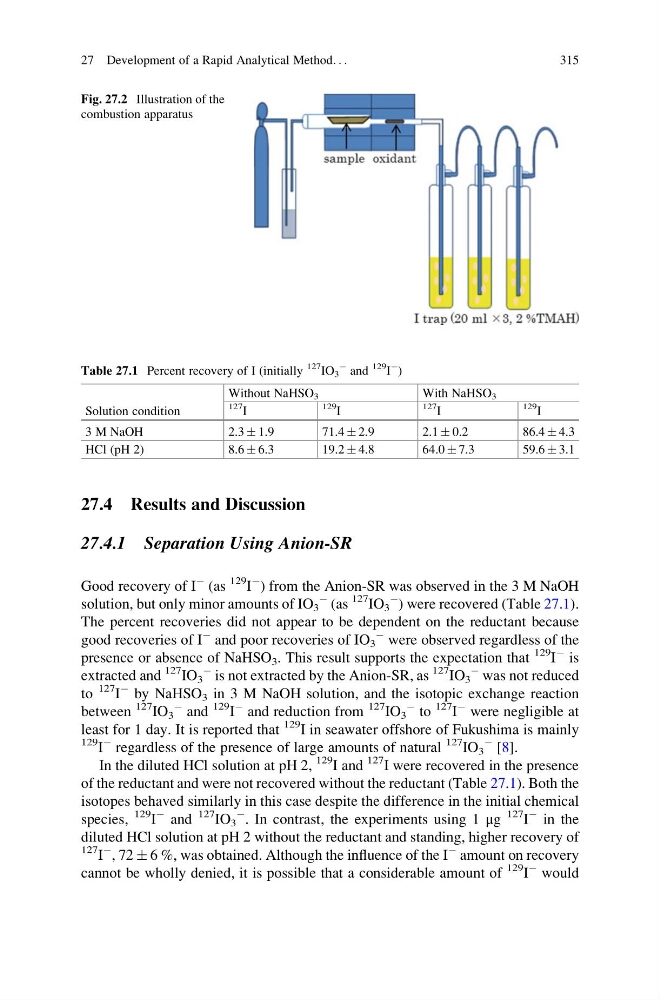
Fig. 27.2 Illustration of the
combustion apparatus
Table 27.1 Percent recovery of I (initially
127
IO 3
À and
129
I
À
)
Solution condition
Without NaHSO 3
With NaHSO 3
127
I
129
I
127
I
129
I
3 M NaOH
2.3 Æ 1.9
71.4 Æ 2.9
2.1 Æ 0.2
86.4 Æ 4.3
HCl (pH 2)
8.6 Æ 6.3
19.2 Æ 4.8
64.0 Æ 7.3
59.6 Æ 3.1
27 Development of a Rapid Analytical Method. . .
315
27.4.1 Separation Using Anion-SR
Good recovery of I
À (as
129
I
À ) from the Anion-SR was observed in the 3 M NaOH
solution, but only minor amounts of IO 3
À (as
127 IO 3
À ) were recovered (Table 27.1).
The percent recoveries did not appear to be dependent on the reductant because
good recoveries of I
À and poor recoveries of IO 3
À were observed regardless of the
presence or absence of NaHSO 3 . This result supports the expectation that
129 I
À is
extracted and
127 IO 3
À is not extracted by the Anion-SR, as
127 IO 3
À was not reduced
to
127 I
À by NaHSO 3 in 3 M NaOH solution, and the isotopic exchange reaction
between
127 IO 3
À and
129 I
À and reduction from
127 IO 3
À to
127 I
À were negligible at
least for 1 day. It is reported that
129
I in seawater offshore of Fukushima is mainly
129 I
À regardless of the presence of large amounts of natural
127 IO 3
À [8].
In the diluted HCl solution at pH 2,
129
I and
127 I were recovered in the presence
of the reductant and were not recovered without the reductant (Table 27.1). Both the
isotopes behaved similarly in this case despite the difference in the initial chemical
species,
129 I
À and
127 IO 3
À . In contrast, the experiments using 1 μg
127 I
À in the
diluted HCl solution at pH 2 without the reductant and standing, higher recovery of
127 I
À
, 72 Æ 6 %, was obtained. Although the influence of the I
À amount on recovery
cannot be wholly denied, it is possible that a considerable amount of
129 I
À would
Fig. 27.2 Illustration of the
combustion apparatus
Table 27.1 Percent recovery of I (initially
127
IO 3
À and
129
I
À
)
Solution condition
Without NaHSO 3
With NaHSO 3
127
I
129
I
127
I
129
I
3 M NaOH
2.3 Æ 1.9
71.4 Æ 2.9
2.1 Æ 0.2
86.4 Æ 4.3
HCl (pH 2)
8.6 Æ 6.3
19.2 Æ 4.8
64.0 Æ 7.3
59.6 Æ 3.1
27 Development of a Rapid Analytical Method. . .
315