

Percent recovery ¼
Amount of I in the recovered solution
Added amount of I
 100
ð27:1Þ
The separation experiment to determine percent recovery was carried out
twice, and the uncertainty was quantified by the dispersion in these two
measurements.
27.3 Combustion Method
A known amount of I
À or IO 3
À was added to 1 g pine bark, representative of tree
samples taken at the establishment of the Japan Atomic Energy Agency, and the
bark was put in a wet oxygen gas line set in an electric furnace. Because smoking
was observed with noncontrolled temperature increase, especially around
240
C, the rate of temperature increase in the range from 100
C to 300
C
was controlled by steps and slow. The vaporized I was trapped in three steps of
20 ml 2 % TMAH solution. Because insoluble organic material was deposited in
the gas line and the trap, an oxidant (8.2 g hopcalite II) was set between the
sample and traps to decompose it (Fig. 27.2). The temperature of the oxidant was
set to 500
C before the temperature increase of the pine bark sample. The
temperature of the sample was kept at 500
C for 1 h and then increased to
900
C for 1 h to vaporize iodine species in the sample. The extracted I in the
traps was measured by DRC-ICP-MS.
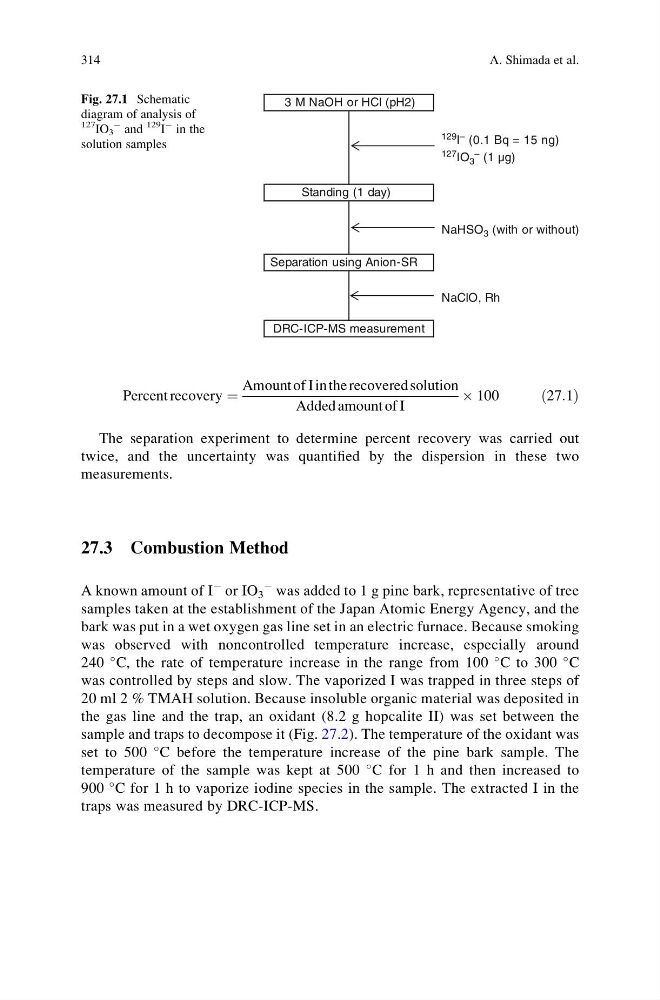
129 I
– (0.1 Bq = 15 ng)
127 IO 3
– (1 µg)
NaHSO 3 (with or without)
NaClO, Rh
3 M NaOH or HCl (pH2)
Standing (1 day)
Separation using Anion-SR
DRC-ICP-MS measurement
Fig. 27.1 Schematic
diagram of analysis of
127
IO 3
À and
129
I
À in the
solution samples
314
A. Shimada et al.
Amount of I in the recovered solution
Added amount of I
 100
ð27:1Þ
The separation experiment to determine percent recovery was carried out
twice, and the uncertainty was quantified by the dispersion in these two
measurements.
27.3 Combustion Method
A known amount of I
À or IO 3
À was added to 1 g pine bark, representative of tree
samples taken at the establishment of the Japan Atomic Energy Agency, and the
bark was put in a wet oxygen gas line set in an electric furnace. Because smoking
was observed with noncontrolled temperature increase, especially around
240
C, the rate of temperature increase in the range from 100
C to 300
C
was controlled by steps and slow. The vaporized I was trapped in three steps of
20 ml 2 % TMAH solution. Because insoluble organic material was deposited in
the gas line and the trap, an oxidant (8.2 g hopcalite II) was set between the
sample and traps to decompose it (Fig. 27.2). The temperature of the oxidant was
set to 500
C before the temperature increase of the pine bark sample. The
temperature of the sample was kept at 500
C for 1 h and then increased to
900
C for 1 h to vaporize iodine species in the sample. The extracted I in the
traps was measured by DRC-ICP-MS.
129 I
– (0.1 Bq = 15 ng)
127 IO 3
– (1 µg)
NaHSO 3 (with or without)
NaClO, Rh
3 M NaOH or HCl (pH2)
Standing (1 day)
Separation using Anion-SR
DRC-ICP-MS measurement
Fig. 27.1 Schematic
diagram of analysis of
127
IO 3
À and
129
I
À in the
solution samples
314
A. Shimada et al.